


Building a trailer

Thread Starter
|
Posting Guru
Joined: Dec 2007
Posts: 2,324
Likes: 0
From: Revelstoke B.C.
 Building a trailer
I want to use the axle off a '76 f250 to buid a trailer on.I was wondering if it's recomended to remove all the gut's out of the 'dif.It's a dana 60 full floating rear axle.

Post Fiend
Joined: Jun 2002
Posts: 13,873
Likes: 3
From: Atlanta GA
I would leave the guts in it. That is a pretty big axle to use for a trailer unless you are hauling a car or something or using the truck bed too. Probably 4x heavier then a normal trailer axle.
Thread Starter
|
Posting Guru
Joined: Dec 2007
Posts: 2,324
Likes: 0
From: Revelstoke B.C.
Wel that's what I was thinking (leaving the gut's in),a couple guy's told me otherwise.I plan on using the box off of my truck.So what I'm going to do is cut the frame on the parts truck,keep the axle under it and turn it into a trailer.I was curiouse how it was supposed to work with no gut's considering the floating axle.I think it would be best to leave the gut's in.
Thread Starter
|
Posting Guru
Joined: Dec 2007
Posts: 2,324
Likes: 0
From: Revelstoke B.C.
It's going to be really hard to break it.It should make the ideal trailer for what I want to use it for.Sycostang67,did you do anything fancy to make the reciever set up?For example,where did you end up cutting the frame?

Lead Driver


Joined: Dec 2002
Posts: 5,491
Likes: 16
From: Kuna ID
I've done it different both times. The first trailer I made was a chevy 1/2 ton, and the frame was already cut. I made a rectangular tube out of some angle iron that fit into a standard 2" coupler like the ones you see at auto parts stores. The other end of the tube fit nicely between the frame rails when they were pulled together.
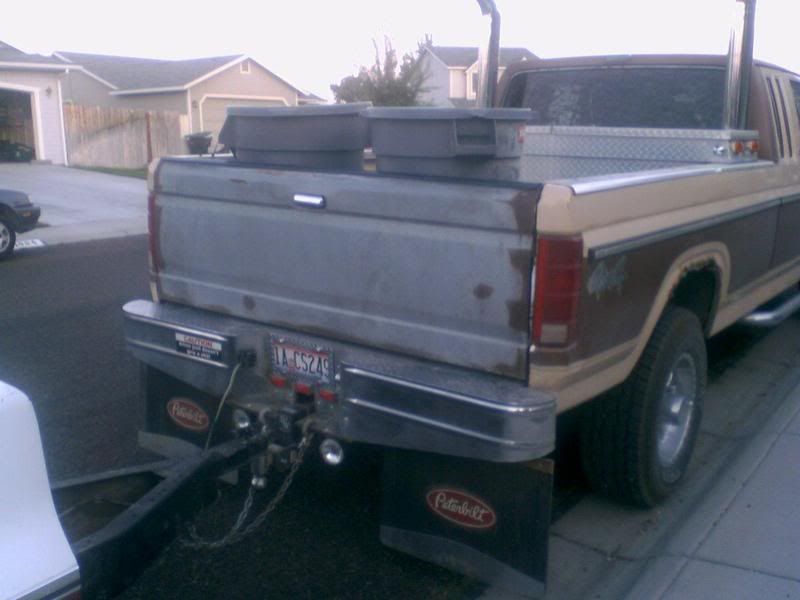
The 2nd trailer I made from a 3/4 ton supercab ford 4x4. I cut the frame just behind the rear spring mount for the front springs. I used a different hitch that had an A shaped mounting surface, so I brought the frame rails in just far enough to fit in the back of the coupler.

The 2nd trailer I made from a 3/4 ton supercab ford 4x4. I cut the frame just behind the rear spring mount for the front springs. I used a different hitch that had an A shaped mounting surface, so I brought the frame rails in just far enough to fit in the back of the coupler.
Trending Topics
Post Fiend
Joined: Jul 2006
Posts: 6,948
Likes: 44
attempting to tear out the internals of a FF axle will prove to be a little difficult, and not worth the effort. The axle flange sels the fluid into the axle, and if removed will require that a plate be made to retain the vital juice within the axle.
The differential is just along for the ride and will not make it any more difficult to tow, but trying to remove the diff, and axles will not really provide any benifits.
The differential is just along for the ride and will not make it any more difficult to tow, but trying to remove the diff, and axles will not really provide any benifits.
FTE Stories
Ford Trucks for Ford Truck Enthusiasts

3 Best / 3 Worst Parts of Modern Ford Ownership
Brett Foote
10 Amazing Upgrades That Solve Common Ford Truck Owner Headaches
Pouria Savadkouei
Every 2026 Ford Engine Explained
Brett Foote
10 Ugly Ford Trucks That We Still Kinda Love
Joe Kucinski
10 Things Every Truck Owner NEEDS (2026 Edition)
Michael S. Palmer
Rezvani's Latest Post-Apocalyptic Monster Is a Ford F-150 Raptor Underneath
Verdad Gallardo
Top 10 Most Expensive Ford Trucks Ever Sold on Bring a Trailer
Joe Kucinski
2027 Ford Super Duty Buyer's Guide (Every Model, Engine, & Package)
Brett Foote
Top 10 Ford Truck Tragedies
Joe Kucinski
Post Fiend
Joined: Jun 2002
Posts: 13,873
Likes: 3
From: Atlanta GA
Now that I thought about it for a day, I vote for keeping the guts. Reason being the bearings are lubed by the diff. fluid and without the axles spinning, it might not work its way up into the tube to the bearing.
Thread Starter
|
Posting Guru
Joined: Dec 2007
Posts: 2,324
Likes: 0
From: Revelstoke B.C.
Originally Posted by Sycostang67
I've done it different both times. The first trailer I made was a chevy 1/2 ton, and the frame was already cut. I made a rectangular tube out of some angle iron that fit into a standard 2" coupler like the ones you see at auto parts stores. The other end of the tube fit nicely between the frame rails when they were pulled together.
The 2nd trailer I made from a 3/4 ton supercab ford 4x4. I cut the frame just behind the rear spring mount for the front springs. I used a different hitch that had an A shaped mounting surface, so I brought the frame rails in just far enough to fit in the back of the coupler.

The 2nd trailer I made from a 3/4 ton supercab ford 4x4. I cut the frame just behind the rear spring mount for the front springs. I used a different hitch that had an A shaped mounting surface, so I brought the frame rails in just far enough to fit in the back of the coupler.
Post Fiend
Joined: Jun 2002
Posts: 13,873
Likes: 3
From: Atlanta GA
Since you probably will have a short tongue. Before you finish welding everything up, push/drag the trailer sideways so it is jack-knifed. See what it hits, if it is not going to hit the bumper, add a vertical box so it hits the bumper instead of the trailer tongue/box hitting the body or tail pipe of your tow vehicle.
Thread Starter
|
Posting Guru
Joined: Dec 2007
Posts: 2,324
Likes: 0
From: Revelstoke B.C.
This is great,I really appreciate good advice.One more thing,I need some opinions on the best over-all trailer length.
-for best maneuverability
-backing up
-load distribution/tongue weight
Those sort of thing's,whatever you might think work's the best.
-for best maneuverability
-backing up
-load distribution/tongue weight
Those sort of thing's,whatever you might think work's the best.
Post Fiend
Joined: Jun 2002
Posts: 13,873
Likes: 3
From: Atlanta GA
> One more thing,I need some opinions on the best over-all trailer length
12 foot bed with a 4 foot tongue with the 50 degree bulldog coupler, dual axles. Big enough for small cars, small enough for most garages.
12 foot bed with a 4 foot tongue with the 50 degree bulldog coupler, dual axles. Big enough for small cars, small enough for most garages.
Post Fiend
Joined: Jun 2002
Posts: 13,873
Likes: 3
From: Atlanta GA
Here is an CL ad for a F-250 trailer, just some food for thought since people have posted a picture or two.
http://atlanta.craigslist.org/bar/568672803.html
http://atlanta.craigslist.org/bar/568672803.html