


coolant temp sender

Thread Starter
|
Junior User
Joined: Jan 2007
Posts: 94
Likes: 0
 coolant temp sender
Whats does the coolant temp. sensor do?And wht is the difference between this sensor and temp switch for gauge. Mine 3.0 never gets warm by the gauge only slightly so heater never gets very hot. Checked thermostat it works fine. Flushed system several times. Just wondering what the coolant temp sensor does. thanks terry

Post Fiend
Joined: Apr 2005
Posts: 5,720
Likes: 5
From: Washington state

Senior User
Joined: Jan 2008
Posts: 140
Likes: 0
Originally Posted by tk1251k
Whats does the coolant temp. sensor do?And wht is the difference between this sensor and temp switch for gauge. Mine 3.0 never gets warm by the gauge only slightly so heater never gets very hot. Checked thermostat it works fine. Flushed system several times. Just wondering what the coolant temp sensor does. thanks terry
I haven't found a solution yet, other than a winter front on the Radiator.

Postmaster

Joined: Apr 2001
Posts: 3,818
Likes: 3
Both the Engine Coolant Temperature sensor (ECT) and the Engine Temperature Gauge Sensor are thermistors - temperature sensitive devices that change resistance with changes in temperature. The ECT is especially important as it sends temperature information to the computer "brain" (powertrain control module) which in turn uses that information to regulate how rich or lean the engine runs. Obviously, if the ECT is not functioning, the "brain" thinks the engine is always cold and thus keeps things in a rich state, wasting fuel. These sensors do slowly go bad over the years. There are charts whereby you can test their functionality based on ambient temperature and resulting resistance readouts, but I find greater ease of mind just to change it out if in doubt.
Those of you with low reading dashboard temperature gauges, suffer from essential the same problem, a poorly functioning sensor. These sensors have a single wire rather than the two wire, larger ECT sensor - and best of all they are dirt cheap, often going for around $5-6 at most parts stores. I drove around for several years thinking I had a really efficient cooling system as it never registered above "N". I had lots of heat but always a low reading. One day, it dawned on me the sensor might be the problem - it was. Now it reads dead mid range where its supposed to be.
Those of you with low reading dashboard temperature gauges, suffer from essential the same problem, a poorly functioning sensor. These sensors have a single wire rather than the two wire, larger ECT sensor - and best of all they are dirt cheap, often going for around $5-6 at most parts stores. I drove around for several years thinking I had a really efficient cooling system as it never registered above "N". I had lots of heat but always a low reading. One day, it dawned on me the sensor might be the problem - it was. Now it reads dead mid range where its supposed to be.
Last edited by aerocolorado; Jan 17, 2008 at 06:06 PM.
Senior User
Joined: Jan 2008
Posts: 140
Likes: 0
Originally Posted by aerocolorado
Both the Engine Coolant Temperature sensor (ECT) and the Engine Temperature Gauge Sensor are thermistors - temperature sensitive devices that change resistance with changes in temperature. The ECT is especially important as it sends temperature information to the computer "brain" (powertrain control module) which in turn uses that information to regulate how rich or lean the engine runs. Obviously, if the ECT is not functioning, the "brain" thinks the engine is always cold and thus keeps things in a rich state, wasting fuel. These sensors do slowly go bad over the years. There are charts whereby you can test their functionality based on ambient temperature and resulting resistance readouts, but I find greater ease of mind just to change it out if in doubt.
Those of you with low reading dashboard temperature gauges, suffer from essential the same problem, a poorly functioning sensor. These sensors have a single wire rather than the two wire, larger ECT sensor - and best of all they are dirt cheap, often going for around $5-6 at most parts stores. I drove around for several years thinking I had a really efficient cooling system as it never registered above "N". I had lots of heat but always a low reading. One day, it dawned on me the sensor might be the problem - it was. Now it reads dead mid range where its supposed to be.
Those of you with low reading dashboard temperature gauges, suffer from essential the same problem, a poorly functioning sensor. These sensors have a single wire rather than the two wire, larger ECT sensor - and best of all they are dirt cheap, often going for around $5-6 at most parts stores. I drove around for several years thinking I had a really efficient cooling system as it never registered above "N". I had lots of heat but always a low reading. One day, it dawned on me the sensor might be the problem - it was. Now it reads dead mid range where its supposed to be.
Strangely enough, I've changed both of these sensors and my gauge still reads very low. It does "sometimes" reach mid-range, but only if I have been driving for an hour or 2. And oddly enough, even with a winter front on the vehicle, the gauge very quickly drops when driving?? All the way to "C" usually.

Elder User
Joined: Jan 2004
Posts: 558
Likes: 0
From: North Alabama
This is indeed unusual. . . as my 94 3.0 is doing the same thing. Heat never gets above lukewarm, temp gauge never moves up, but it isn't burning rich and no CEL. I drove it home from work, then 5 miles to grocery stors, and even the water pump wasn't too hot to touch. The heater in this van used to run me out even in the snow. I, too, have flushed system, replaced sensors, and new thermostat.

Elder User
Joined: Dec 2006
Posts: 830
Likes: 0
From: Kitchener,Ontario,Canada
Originally Posted by DaveMac2Vans
This is indeed unusual. . . as my 94 3.0 is doing the same thing. Heat never gets above lukewarm, temp gauge never moves up, but it isn't burning rich and no CEL. I drove it home from work, then 5 miles to grocery stors, and even the water pump wasn't too hot to touch. The heater in this van used to run me out even in the snow. I, too, have flushed system, replaced sensors, and new thermostat.
1) What temp thermostat went in your engine ? correct is 195 *F.
2) Is your fan clutch working properly? this might slightly affect the engines running temp.
The thermostat could have more wide ranging effects though!
Heat (or lack of) inside the vehicle doesn't really prove anything about the engine temp. It just proves that the hot air/water flow is not getting either to the heater core or down the ducting into the vehicle.
Regards Aeroman.
Last edited by Aeroman59; Jan 17, 2008 at 11:24 PM.
Trending Topics
Post Fiend
Joined: Apr 2005
Posts: 5,720
Likes: 5
From: Washington state
heater efficiency in an Aero relies on
correct thermostat 195d F and correct pressure good sealing radiator cap
full coolant level, no air in system
tight seal of the heater core to mount, the foam degrades and falls apart over time
tight seal of the temp door
water flow thru the heater core, the fine core tubes plug over time and scale builts up reducing flow even though the core may be scorching hot to touch
water pump efficiency since the pump pulls coolant thru the heater core instead of pushing, slipping drive belt on pump which is common with no squeal, damaged water pump impeller-some are plastic and break from heat stress over time
hoses breaking down internally where most of the damage occurs, swelling and impeding coolant flow
too high of a concentration of antifreeze in system, more than recommended 50%, slows flow of coolant thru small core openings
correct thermostat 195d F and correct pressure good sealing radiator cap
full coolant level, no air in system
tight seal of the heater core to mount, the foam degrades and falls apart over time
tight seal of the temp door
water flow thru the heater core, the fine core tubes plug over time and scale builts up reducing flow even though the core may be scorching hot to touch
water pump efficiency since the pump pulls coolant thru the heater core instead of pushing, slipping drive belt on pump which is common with no squeal, damaged water pump impeller-some are plastic and break from heat stress over time
hoses breaking down internally where most of the damage occurs, swelling and impeding coolant flow
too high of a concentration of antifreeze in system, more than recommended 50%, slows flow of coolant thru small core openings
Last edited by 96_4wdr; Jan 18, 2008 at 04:48 AM.
FTE Stories
Ford Trucks for Ford Truck Enthusiasts

3 Best / 3 Worst Parts of Modern Ford Ownership
Brett Foote
10 Amazing Upgrades That Solve Common Ford Truck Owner Headaches
Pouria Savadkouei
Every 2026 Ford Engine Explained
Brett Foote
10 Ugly Ford Trucks That We Still Kinda Love
Joe Kucinski
10 Things Every Truck Owner NEEDS (2026 Edition)
Michael S. Palmer
Rezvani's Latest Post-Apocalyptic Monster Is a Ford F-150 Raptor Underneath
Verdad Gallardo
Top 10 Most Expensive Ford Trucks Ever Sold on Bring a Trailer
Joe Kucinski
2027 Ford Super Duty Buyer's Guide (Every Model, Engine, & Package)
Brett Foote
Top 10 Ford Truck Tragedies
Joe Kucinski
Thread Starter
|
Junior User
Joined: Jan 2007
Posts: 94
Likes: 0
All these things going on seem to be most of my problems. Low heater output,low temp. gauge reading.I took out thermostat to check it out. It was fully closed as shoul be when cold. I placed in boiling water it opened a little over 1/8 of an inch.If not opening all the the the engine should run hot but it doesn't.I am going to put in another thermostat and temp switch today and also flush system once again and get back with results. It also takes about 15 minutes for engine to get hot enough for thermostat to open this seems to long . terry
Post Fiend
Joined: Apr 2005
Posts: 5,720
Likes: 5
From: Washington state
replace O ring seal on thermostat each time
the O ring breaks down and leaks by defeating thermostat
make sure the thermostat wiggle pin hole is up
take an infrared temp gauge reading on steel pipe out of thermostat housing when engine hot. should be above 150d F minimum
the dash idiot gauge is worthless except to warn of a sudden overheating when the needle pegs on the right side
takes a long time to warm the box interior of an Aero even with both heaters. was 28d F here today, took at least a 1/2 hr before I was comfortable
the O ring breaks down and leaks by defeating thermostat
make sure the thermostat wiggle pin hole is up
take an infrared temp gauge reading on steel pipe out of thermostat housing when engine hot. should be above 150d F minimum
the dash idiot gauge is worthless except to warn of a sudden overheating when the needle pegs on the right side
takes a long time to warm the box interior of an Aero even with both heaters. was 28d F here today, took at least a 1/2 hr before I was comfortable
Last edited by 96_4wdr; Jan 18, 2008 at 06:12 AM.
Post Fiend
Joined: Apr 2005
Posts: 5,720
Likes: 5
From: Washington state
maybe there isn't an O ring on the 3L? 4L does have an O ring that goes around the outside of the flat metal plate and seals to housing hole.
not an Aero but the quickest i could grab
pin at top left in plate
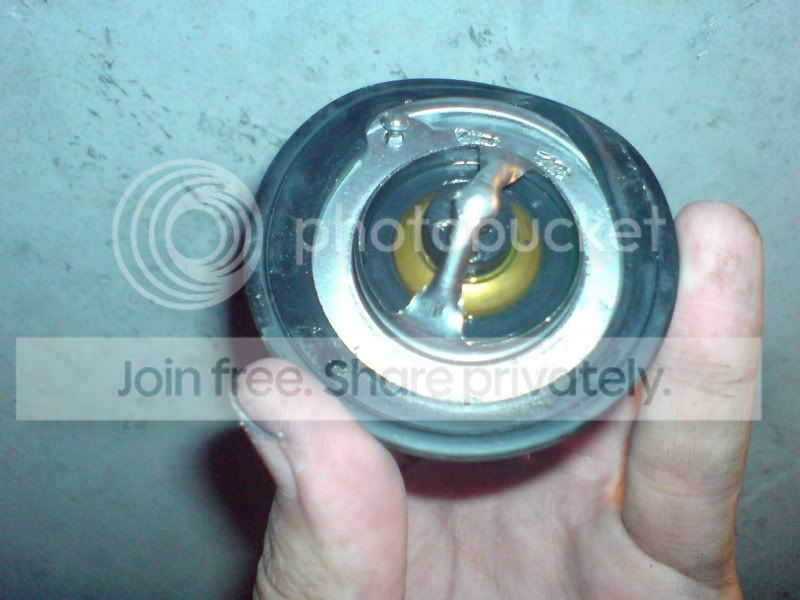
not an Aero but the quickest i could grab
pin at top left in plate
Thread Starter
|
Junior User
Joined: Jan 2007
Posts: 94
Likes: 0
Thanks for the pictures.I dont think 3.0 does have o ring. The little pin at the top dont think it has that either. The only thing manual says is to place thermostat housing bridge perpindicular to mounting holes. Yep I think or am sure 4.0 thermostat mounts on the front of engine and 3.0 mounts top of engine. thanks
Postmaster
Joined: Apr 2001
Posts: 3,818
Likes: 3
A quick check for heater core plugging is to run engine to normal temperature, let idle, and then grasp each line leading into and away from the heater core. Both should be equally hot if the core is open. One line cooler than the other indicates a blockage.
Thread Starter
|
Junior User
Joined: Jan 2007
Posts: 94
Likes: 0
My rear heater coil not working for sure one line hot one cold.I tried blowing core out by loosening both lines from underneath didnt work. Now I forget which line goes where. Anyone know which f the two lines under van hooks to the coolant vacuum. I think the line out of core goes into vacuum regulator and line that would be hot goes into core directly. thanks terry