


Question??????

Thread Starter
|
Senior User
Joined: Apr 2007
Posts: 125
Likes: 0
From: Kershaw, South Carolina
Question??????
My front fenders are rusted in the seam where the top and bottom pieces bolt together.(1950) The rust is pretty bad in both the top and the bottom. Can these be fixed: patch panels or anything? Or should I just go with fiberglass?

Fleet Mechanic
Joined: Mar 2005
Posts: 1,511
Likes: 1
From: peyton, colorado

Patch panels are available from several sources, or pm reamer and see if he makes them. That is a common rust area on those trucks, mine were bad too. Making your own panels is not that hard, the curves are pretty straightforward. $10-$20 worth of sheetmetal should get you all you need.

Fleet Owner


Joined: Jul 2004
Posts: 27,299
Likes: 1,059
From: NM
I was going to do that on my '52, it is not as simple as you'd think. If you have $2k worth of stretchers, shrinkers, forming dies, and can match the compound curves, no problem. They do sell patch panels but they are not very accurate, and are not made the same way. I went with single-piece fiberglas.

Hotshot
Joined: Oct 2004
Posts: 15,882
Likes: 88
From: Durham NC
You can get a 2 unit shrinker/stretcher for ~ 300.00 or a single machine with 2 sets of jaws for ~ 175. It can pay for itself in one job. I highly recommend purchasing one or a double unit if you are doing much patch panel work.
Fleet Mechanic
Joined: Mar 2005
Posts: 1,511
Likes: 1
From: peyton, colorado
Actually, I've made the patch panels he's asking about with simple hand tools. Both the bolt in area he's talking about, and the bottom of the front at the running board attachment point were bad on my truck. The basic curve is simple, and the compound in those areas is slight enough that some hammer and bag will get you there. Once you've welded in the patches, you'll need to fine tune with hammer and dolly. When making patches, remember it's easier to stretch than shrink. You'll wind up using alittle filler, but you'd need some if you purchased patches, too. Take your time and think about what you want the metal to do before you hammer it.

Hotshot


Joined: Jan 2001
Posts: 16,887
Likes: 3,130
From: SE Wisc. (the Rust Belt)
I made my own patch panels for the front fenders on my F-4. On the top part of the fender the metal was mostly ate away. I made a pattern on cardboard, traced it on to a piece of 12 ga metal and cut the metal to shape. I then used a gas wrench to heat the edge and hammered it over an old piece of railroad rail. I made the rest of the patches out of 16 ga steel I had laying around.
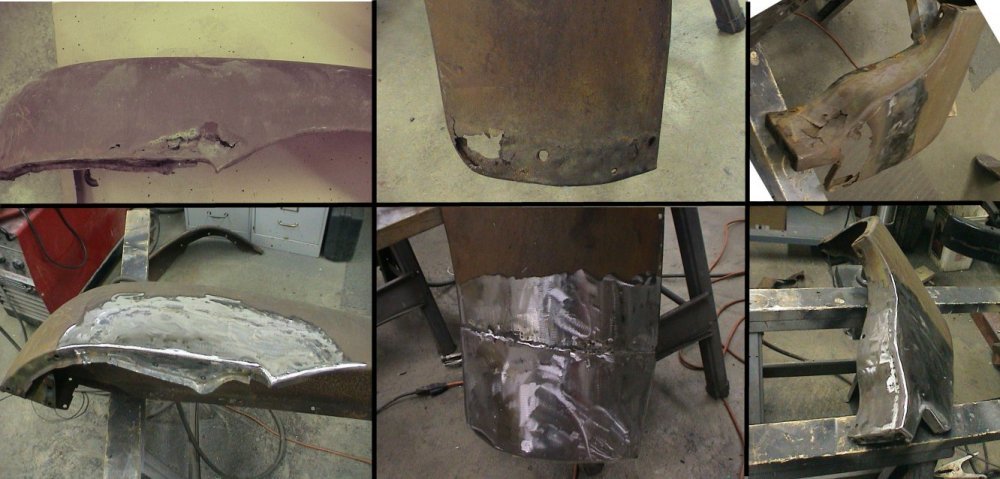
I don't have the money to spend on fancy tools, I use whatever I have laying around.
I don't have the money to spend on fancy tools, I use whatever I have laying around.

Post Fiend
Joined: Jun 2001
Posts: 7,493
Likes: 7
From: Erie, pa
Originally Posted by rhopper
Actually, I've made the patch panels he's asking about with simple hand tools. Both the bolt in area he's talking about, and the bottom of the front at the running board attachment point were bad on my truck. The basic curve is simple, and the compound in those areas is slight enough that some hammer and bag will get you there. Once you've welded in the patches, you'll need to fine tune with hammer and dolly. When making patches, remember it's easier to stretch than shrink. You'll wind up using alittle filler, but you'd need some if you purchased patches, too. Take your time and think about what you want the metal to do before you hammer it.
Trending Topics
Fleet Mechanic
Joined: Mar 2005
Posts: 1,511
Likes: 1
From: peyton, colorado
Bobj, my fenders rusted in exactly the same spots! It's funny, I was at an antique truck show this past weekend, a few F1 to F6's there. The unrestored trucks all had rust in the same spots, and the same crack in the front of the hood.
FTE Stories
Ford Trucks for Ford Truck Enthusiasts

3 Best / 3 Worst Parts of Modern Ford Ownership
Brett Foote
10 Amazing Upgrades That Solve Common Ford Truck Owner Headaches
Pouria Savadkouei
Every 2026 Ford Engine Explained
Brett Foote
10 Ugly Ford Trucks That We Still Kinda Love
Joe Kucinski
10 Things Every Truck Owner NEEDS (2026 Edition)
Michael S. Palmer
Rezvani's Latest Post-Apocalyptic Monster Is a Ford F-150 Raptor Underneath
Verdad Gallardo
Top 10 Most Expensive Ford Trucks Ever Sold on Bring a Trailer
Joe Kucinski
2027 Ford Super Duty Buyer's Guide (Every Model, Engine, & Package)
Brett Foote
Top 10 Ford Truck Tragedies
Joe Kucinski
Lead Driver

Joined: Apr 2002
Posts: 8,813
Likes: 13
From: Littleton, New Hampshire
Originally Posted by bsteele52
With the fiberglass have ya'll seen any spider-web when a rock hits the under side?

Seriously, I suppose that can happen but if you get some quality made fenders like from Bebops that should not be a problem.

Thread Starter
|
Senior User
Joined: Apr 2007
Posts: 125
Likes: 0
From: Kershaw, South Carolina
Thanks for all the replies guys. I'm a long way from the body work. Just trying to make plans. Still have to get the bed off(all but two bolts out justing waiting on my help to show up) then remove cab and start stripping the frame.
Hotshot
Joined: Oct 2004
Posts: 15,882
Likes: 88
From: Durham NC
Hopper is right, anything a machine can do can also be done by hand as well, just that some techniques i.e. shrinking, takes a lot of technique and skill or a lot of cutting and welding. A shrinking/stretching machine does make curving a flanged piece or making a deep compound curve nearly a pleasure. I am very skilled at hand shrinking/stretching, but would never give my machines back.
Hotshot
Joined: Jan 2001
Posts: 16,887
Likes: 3,130
From: SE Wisc. (the Rust Belt)
Originally Posted by rhopper
Bobj, my fenders rusted in exactly the same spots! It's funny, I was at an antique truck show this past weekend, a few F1 to F6's there. The unrestored trucks all had rust in the same spots, and the same crack in the front of the hood.
The fenders have perfect places for all the road gunk to sit and collect moisture, nice design. The designers never thought the trucks would last longer than 10-15 years, they came with 90 day warranties, and I am sure they never thought there would be a bunch of goofs restoring these old crates 50+ later.