




New aFe Stage 2 Intake!

Senior User
Joined: Jul 2004
Posts: 375
Likes: 0
From: W. Philly Burbs
18 horsepower seems "within reason" for an aftermarket intake system, its more than likely elevated but they always are, for our trucks or even rice burners.
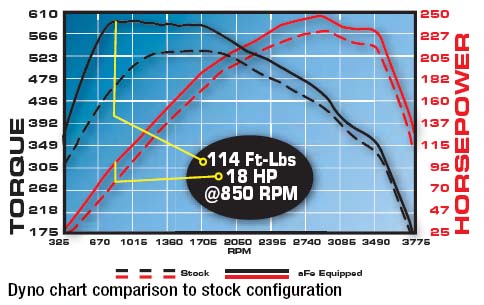
However, when i first saw 114 ft lbs of torque, i figured it was a misprint.....then i saw it again.......there is no way in heck its 114, or did u mean 14 and misprint it twice?
But if it is 114 ft lbs, those guys runnin the dyno are smokin the crack pipe, next thing someone will try selling me spark plugs for my truck so the fuel burns better and get an extra 300 hp

However, when i first saw 114 ft lbs of torque, i figured it was a misprint.....then i saw it again.......there is no way in heck its 114, or did u mean 14 and misprint it twice?
But if it is 114 ft lbs, those guys runnin the dyno are smokin the crack pipe, next thing someone will try selling me spark plugs for my truck so the fuel burns better and get an extra 300 hp

Former Vendor
Joined: Mar 2004
Posts: 4,362
Likes: 3
From: Hendersonville, NC
Originally Posted by jdadamsjr
I buy the 18 hp... but there is a linear equation between hp and torque and NO WAY a 18 hp increase equates to a 114 lbft increase !!!!!!
According to most I have heard from, there is actually a serious seat of the pants improvement with the new Stage 2 setup- something not reportedly obtained with most other intakes for the 6.0

Cargo Master
Joined: Jun 2003
Posts: 2,203
Likes: 0
From: Carlsbad, California
Originally Posted by Springer
114 is claimed at 850 RPM, maybe most of the gain is gone by 1200?
But if their peak gain is 18 hp, then the 114 lb-ft of more torque at 830 RPM would have to plummet after that. By 1000 RPM the torque gained would have to be down to 95 lb-ft to not exceed 18 HP. At 2000 RPM it would be down to half that.
Common sense wise though it doesn't quite seem right to me. Not being an intake designer I'd think that you'd expect an intake to provide more improvement on the top end than down low where the volume of air being drawn/pushed through the air cleaner is much less.
FTE Stories
Ford Trucks for Ford Truck Enthusiasts

Top 10 Most Expensive Ford Trucks Ever Sold on Bring a Trailer
Joe Kucinski
2027 Ford Super Duty Buyer's Guide (Every Model, Engine, & Package)
Brett Foote
Top 10 Ford Truck Tragedies
Joe Kucinski
AEV FXL Super Duty - the Super Duty Raptor Ford Doesn't Make
Brett Foote
Lobo Vs Lobo: Proof the F-150 Lobo Should Be Even Lower!
Michael S. Palmer
Ford's 2001 Explorer Sportsman Concept Looks For a New Home
Verdad Gallardo
10 Best Ford Truck Engines We Miss the Most!
Joe Kucinski
2026 Shelby F-150 Off-Road: Better Than a Raptor R?
Brett Foote
2027 Super Duty Carhartt Package First Look: 12 Things You NEED to Know!
Michael S. Palmer
Freshman User
Joined: Aug 2004
Posts: 41
Likes: 0
area under the dyno curve is where performance is felt. if the torque numbers are down low in the rpm...which makes sense for the numbers they are posting, there should be some feel off line. my question is...i'd like to see this unit in combination with a tuner. anyone have comments on this idea?
Mountain Pass
Joined: Aug 2004
Posts: 121
Likes: 0
From: Tally
http://www.afefilters.com/images/54-10392.pdf
There was a link to the pdf on that page with a small dyno graph in it.
There was a link to the pdf on that page with a small dyno graph in it.
Last edited by Gt-358; Feb 10, 2005 at 09:28 AM.
Former Vendor
Joined: Mar 2004
Posts: 4,362
Likes: 3
From: Hendersonville, NC
Originally Posted by Gt-358
http://www.afefilters.com/images/54-10392.pdf
http://www.blownstangs.com/temp/afe-dyno.jpg
There was a link to the pdf on that page with a small dyno graph in it.
http://www.blownstangs.com/temp/afe-dyno.jpg
There was a link to the pdf on that page with a small dyno graph in it.
Last edited by IB Tim; Feb 10, 2005 at 11:42 AM. Reason: remove img
Former Vendor
Joined: Mar 2004
Posts: 4,362
Likes: 3
From: Hendersonville, NC
Originally Posted by drmdrvn
area under the dyno curve is where performance is felt. if the torque numbers are down low in the rpm...which makes sense for the numbers they are posting, there should be some feel off line. my question is...i'd like to see this unit in combination with a tuner. anyone have comments on this idea?
Cargo Master
Joined: Jun 2003
Posts: 2,203
Likes: 0
From: Carlsbad, California
It is a nice looking curve. Don't get me wrong, I'd love 114 lb-ft more torque down low.
But my curiosity still remains, if they are flowing that much more air, why the large gain at low RPM and little gain at higher RPMs where the engine needs more air.
Some other limiting factor must start to kick in around the mid 800 RPM range pulling down the torque output, or maybe due to some wierd aerodynamic thingy the filter doesn't flow that much better at high RPMs.
Or possibly their relocation of the MAS has caused the motor to think it's getting a lot more air at low RPMs and fuel up accordingly.
In any case it is interesting.
But my curiosity still remains, if they are flowing that much more air, why the large gain at low RPM and little gain at higher RPMs where the engine needs more air.
Some other limiting factor must start to kick in around the mid 800 RPM range pulling down the torque output, or maybe due to some wierd aerodynamic thingy the filter doesn't flow that much better at high RPMs.
Or possibly their relocation of the MAS has caused the motor to think it's getting a lot more air at low RPMs and fuel up accordingly.
In any case it is interesting.
Senior User
Joined: Jul 2004
Posts: 375
Likes: 0
From: W. Philly Burbs
sorry, even under "peak numbers" that graph is bull, no way a "cleaner flowing" intake is going to do that...........my 2 cense
As pappy used to say " If something seems to good to be true. it probable is"
As pappy used to say " If something seems to good to be true. it probable is"
Last edited by Daryl Hunter; Feb 13, 2005 at 11:18 PM. Reason: Language
