


Engine math?

Thread Starter
|
Posting Guru
Joined: Jun 2004
Posts: 1,371
Likes: 0
From: just outside of Phila.
Engine math?
Are there certain equations that are necessary/helpful to engine building. I have an engine that I am going to take the time to rebuild. It's not going to be anything wild, but I've never done it and would like to know some of the numbers a little better and what they meant.
Postmaster
Joined: Jul 2003
Posts: 3,934
Likes: 0
From: iowa
there are displacement in cubic inches, compression tratio equations! Other than that there is adding and substracting like measuring the crank journal the minusing the diameter of the connecting rod with the bearing in and the caps tightened to spec. This tells the bearing clearence. There is a spec for about everything honestly. Crank runout, piston clearence, ring gap, valve clearence, etc.
Thread Starter
|
Posting Guru
Joined: Jun 2004
Posts: 1,371
Likes: 0
From: just outside of Phila.
It's an old 327 block...I know that there are a ton of equations. Maybe what I meant is, what are the more important ones, or is there one source for all of them. I was always under the impression that you could take the specifications of parts, and do all of the math and figure out how well your car will run. Kind of like a dyno just in all paperwork without ever turning a bolt. I am correct? Close?

Senior User
Joined: Dec 2003
Posts: 328
Likes: 0
From: Eastern Ohio
You can figure the compression and cam specs in and have an idea of where the motor will want to start making power, and whether it will be a bottom end grunter or hi-rpm screamer (thats based on opening and closings and duration, etc.... unfortunately, it takes a bit to explain here and is usually better done in person as questions always come up)... The best thing is still the DesktopDyno (DD) which I and many others here have installed on our computers.... list a series of specs for a motor (cam duration, open and close, lobe center, lift.... bore, stroke, carb, intake, and exhaust) and somebody here will run it on DD and let you know what it is making according to the computer.... just remember, the computer is only an estimate tho!!!

Elder User
Joined: Jun 2003
Posts: 886
Likes: 1
From: Houston/Hope BC
Thread Starter
|
Posting Guru
Joined: Jun 2004
Posts: 1,371
Likes: 0
From: just outside of Phila.
That's a good website to have saved, thank you Ecuri.
I think that the desktop dyno is closer to what I'm looking for, I've heard a lot about it. But I'm not sure that I'm making my point as clear as I would like to. It's an old 327/300. (and for Fordeverpower- 327/300 with Edel. perf RPM manifold, Edel. 600cfm carb, and the heads have the double camel hump stamped on them. A backyard mechanic told me in between his beers that they were corvette F/I heads, haven't taken casting numbers from it yet though...I will say in an old boat of a car, it makes it move like stink). I don't know about the internals of it, as I was 14 when I got it and just wanted it to start. I wouldn't mind learning some of the old numbers, but in the future, when I take it apart, I want to have an enitre battle plan laid out for the parts that I want to buy (full rebuild) and install. A lot of catalogues have the specifications for the parts, and I would like to be able to take all of my part numbers and their specs, combine them with the other parts, and be able to gauge performance numbers, horsepower, MPG, and basically, 'will these things work together without blowing an engine apart?'. Looking to turn 327 into an almost daily, pavement pounder with serious muscle but realistic steetability. Sorry for the long post guys, just want to be certain about things and make sure it's right the first time. Thanks to all, let me know.
I think that the desktop dyno is closer to what I'm looking for, I've heard a lot about it. But I'm not sure that I'm making my point as clear as I would like to. It's an old 327/300. (and for Fordeverpower- 327/300 with Edel. perf RPM manifold, Edel. 600cfm carb, and the heads have the double camel hump stamped on them. A backyard mechanic told me in between his beers that they were corvette F/I heads, haven't taken casting numbers from it yet though...I will say in an old boat of a car, it makes it move like stink). I don't know about the internals of it, as I was 14 when I got it and just wanted it to start. I wouldn't mind learning some of the old numbers, but in the future, when I take it apart, I want to have an enitre battle plan laid out for the parts that I want to buy (full rebuild) and install. A lot of catalogues have the specifications for the parts, and I would like to be able to take all of my part numbers and their specs, combine them with the other parts, and be able to gauge performance numbers, horsepower, MPG, and basically, 'will these things work together without blowing an engine apart?'. Looking to turn 327 into an almost daily, pavement pounder with serious muscle but realistic steetability. Sorry for the long post guys, just want to be certain about things and make sure it's right the first time. Thanks to all, let me know.
Trending Topics
Postmaster
Joined: Jul 2003
Posts: 3,934
Likes: 0
From: iowa
FTE Stories
Ford Trucks for Ford Truck Enthusiasts

3 Best / 3 Worst Parts of Modern Ford Ownership
Brett Foote
10 Amazing Upgrades That Solve Common Ford Truck Owner Headaches
Pouria Savadkouei
Every 2026 Ford Engine Explained
Brett Foote
10 Ugly Ford Trucks That We Still Kinda Love
Joe Kucinski
10 Things Every Truck Owner NEEDS (2026 Edition)
Michael S. Palmer
Rezvani's Latest Post-Apocalyptic Monster Is a Ford F-150 Raptor Underneath
Verdad Gallardo
Top 10 Most Expensive Ford Trucks Ever Sold on Bring a Trailer
Joe Kucinski
2027 Ford Super Duty Buyer's Guide (Every Model, Engine, & Package)
Brett Foote
Top 10 Ford Truck Tragedies
Joe Kucinski
Thread Starter
|
Posting Guru
Joined: Jun 2004
Posts: 1,371
Likes: 0
From: just outside of Phila.
just got a phone call today from someone looking to take the car the motor is in, and now I can pull the motor and start tinkering around. It was my first car, and I'm gonna miss the old girl (1970 Monte Carlo), but I'll have the engine to remind me
Elder User
Joined: Jun 2003
Posts: 886
Likes: 1
From: Houston/Hope BC
This is more what you are looking for:
http://www.rbracing-rsr.com/runnertorquecalc.html
http://www-staff.lboro.ac.uk/~elvpc/papers/VL.htm
http://victorylibrary.com/mopar/intake-tech-c.htm
you need to find a piston velocity/acceleration calculator yourself.
I do not think desktop dyno tells you when things break. That is a nice engine, and has been hot-rodded for years, try to find some old guys that built them in the 60's for advice and blend that with what new you find. GL.
http://www.rbracing-rsr.com/runnertorquecalc.html
http://www-staff.lboro.ac.uk/~elvpc/papers/VL.htm
http://victorylibrary.com/mopar/intake-tech-c.htm
you need to find a piston velocity/acceleration calculator yourself.
I do not think desktop dyno tells you when things break. That is a nice engine, and has been hot-rodded for years, try to find some old guys that built them in the 60's for advice and blend that with what new you find. GL.


New User
Joined: Jul 2004
Posts: 1
Likes: 0
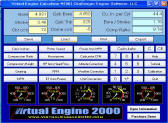
Here is a free calculator with all the formulas built in - no need for all the complicated math
http://www.virtualengine2000.com/ProgramDownload.htm
http://www.virtualengine2000.com/ProgramDownload.htm