WOW What a difference!

Thread Starter
|
Senior User
Joined: Nov 2003
Posts: 165
Likes: 0
From: Illinois
I don't see any problems with switching over to synthetic at high mileage...
The guy with 205,000 miles on his rig is going to be missing out on one of the "benefits" of synth--which is long term wear reduction. (Supposedly) His motor probably is worn enough now that synthetic probably won't make any difference over dino oil in the long haul, but it sure can help with your cold starting, and to some degree, your fuel mileage. (Shell claims 3% increase)
The guy with 205,000 miles on his rig is going to be missing out on one of the "benefits" of synth--which is long term wear reduction. (Supposedly) His motor probably is worn enough now that synthetic probably won't make any difference over dino oil in the long haul, but it sure can help with your cold starting, and to some degree, your fuel mileage. (Shell claims 3% increase)

Freshman User
Joined: Oct 2003
Posts: 37
Likes: 0
Originally posted by jharvey3
Also has anyone used the Fram quick drain valve, if so is it good, bad or just ugly?
John
Also has anyone used the Fram quick drain valve, if so is it good, bad or just ugly?
John
Thread Starter
|
Senior User
Joined: Nov 2003
Posts: 165
Likes: 0
From: Illinois

Senior User
Joined: Dec 2003
Posts: 152
Likes: 0
From: Arizona
There is no prodlem switching over to synthetic oil at any mileage, as stated previously strjock81 the motor is previously worn and synthetic will slow the long term wear process. The only thing that I would not do is go back to dino oil after running synthetic. A Friend of mine works for a independent testing company and warns against it because the synthetic oil creates a film that conventional oil does not and if you switch it will remove this film. The only down side to the drain valves is that it leaves oil in the pan, about 1/2 to 3/4 of a quart, that would have drained out if you just remove the plug.
Thread Starter
|
Senior User
Joined: Nov 2003
Posts: 165
Likes: 0
From: Illinois
Originally posted by Jlower
I now have 16K on my Rotella synthetic, It's still transparent, But then again I do use a by-pass oil filter.
P.S ... jschira is right, we've had a few colder days but it seem to be staying in the 80s for us in Tucson as well.
I now have 16K on my Rotella synthetic, It's still transparent, But then again I do use a by-pass oil filter.
P.S ... jschira is right, we've had a few colder days but it seem to be staying in the 80s for us in Tucson as well.

Senior User
Joined: Jun 2003
Posts: 372
Likes: 0
From: Dayton, OH

Nope, the lab analysis keeps coming back as "like new". When I do the filter change It does wind up costing me about a 4 quarts in make up oil. Maybe that make up oil is enough to keeps the oil refreshed. Running synthetic was costing me appx-$85 every oil change @3k miles. It only cost me $9.00 to change the by-pass filter and $13.00 for 1 gal of oil at the 15K miles point. The bypass system cost me $350. If I had stayed running without the bypass then I would of spent $425 in oil changes. I've already recouped for the initial cost of the system. This truck is my daily driver so from here on out I'm pocketing that oil change money so I can keep modding the truck.
The Fumoto valve is a pretty well designed product. I needed to replace my oil pan gasket a couple months back. We drained the pan through the fumoto. When the pan came down there was only about 2-3 ounces (almost a film) left in the pan. There certainly wasn't enough left to blame on the valve.
The Fumoto valve is a pretty well designed product. I needed to replace my oil pan gasket a couple months back. We drained the pan through the fumoto. When the pan came down there was only about 2-3 ounces (almost a film) left in the pan. There certainly wasn't enough left to blame on the valve.
Last edited by Jlower; Jan 7, 2004 at 10:12 PM.
Thread Starter
|
Senior User
Joined: Nov 2003
Posts: 165
Likes: 0
From: Illinois
How often are you changing full flow and bypass filters, and how often are you sending in analysis? $20 analysis has to come into the cost function somewhere too, because if you have done it every 5K miles, then there's another 60 bucks associated with the system. I really would like to do this, just trying to figure up a cost to value ratio. I don't know if I am convinced yet that 20000 miles on synth ran through a bypass system is better for the motor than changing at 3000 with dino oil and no bypass system, if the costs are somewhat similar. The biggest bonus would be not having to change the oil as often, although on mine the filter is the worst part--draining is simple.
Does your oil analysis check for the antifoam additive specifically, or are they more concerned with soot levels, ash levels, wear metals, and viscosity trends? I suppose if the truck is still running well, the antifoaming agent must still be present in sufficient quantities...
Now if I could get like 100,000 out of my synthetic like the Amsoil people claim, I would buy the system tomorrow!
Does your oil analysis check for the antifoam additive specifically, or are they more concerned with soot levels, ash levels, wear metals, and viscosity trends? I suppose if the truck is still running well, the antifoaming agent must still be present in sufficient quantities...
Now if I could get like 100,000 out of my synthetic like the Amsoil people claim, I would buy the system tomorrow!
Senior User
Joined: Jun 2003
Posts: 372
Likes: 0
From: Dayton, OH
The Full Flow should be changed at 25K. I did neglect to total in the analysis fees. I'm paying $17 per analysis every 5K from Titan Labs. I havn't been paying much attention to the PPM results just the summary. I will check to see if the foaming is listed in the analysis or not.
I'm using a Gulf Coast Filters.com By-Pass filter. The base where I'm stationed started installing them on their diesel fleet about 4 to 5 years ago. They already have a couple of buses, wreckers, and general purpose fleet vehicles with over 100,000 miles on the same oil. Doing some research I found out the all of the military branches have started to convert every diesel auto and marine vehicle inside DOD to GCF. Our fleet mechanics told me that the vehicles that are using this filter have had a dramatic decrease in engine related problems. I decided to give it a shot and have been pleased ever since.
I'm using a Gulf Coast Filters.com By-Pass filter. The base where I'm stationed started installing them on their diesel fleet about 4 to 5 years ago. They already have a couple of buses, wreckers, and general purpose fleet vehicles with over 100,000 miles on the same oil. Doing some research I found out the all of the military branches have started to convert every diesel auto and marine vehicle inside DOD to GCF. Our fleet mechanics told me that the vehicles that are using this filter have had a dramatic decrease in engine related problems. I decided to give it a shot and have been pleased ever since.
FTE Stories
Ford Trucks for Ford Truck Enthusiasts

3 Best / 3 Worst Parts of Modern Ford Ownership
Brett Foote
10 Amazing Upgrades That Solve Common Ford Truck Owner Headaches
Pouria Savadkouei
Every 2026 Ford Engine Explained
Brett Foote
10 Ugly Ford Trucks That We Still Kinda Love
Joe Kucinski
10 Things Every Truck Owner NEEDS (2026 Edition)
Michael S. Palmer
Rezvani's Latest Post-Apocalyptic Monster Is a Ford F-150 Raptor Underneath
Verdad Gallardo
Top 10 Most Expensive Ford Trucks Ever Sold on Bring a Trailer
Joe Kucinski
2027 Ford Super Duty Buyer's Guide (Every Model, Engine, & Package)
Brett Foote
Top 10 Ford Truck Tragedies
Joe Kucinski
Thread Starter
|
Senior User
Joined: Nov 2003
Posts: 165
Likes: 0
From: Illinois
Are you using the O-1 filter or the O-2 filter, the O-2 is for 250-500 HP engines, which is what I need, but the thing is HUGE. Dont know where I would put it. Guess I could use the smaller one and change more often.
Senior User
Joined: Jun 2003
Posts: 372
Likes: 0
From: Dayton, OH
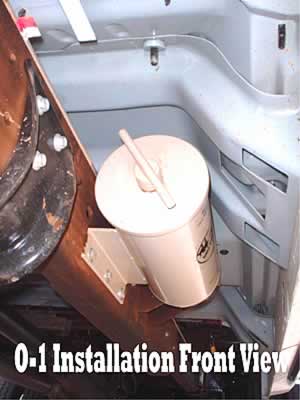
I'm using the O-1 model. GCF said that even if I push my PSD's HP up over 300 the O-1 would still be sufficient for my needs. The Filter will bolt straight to the frame. Here is their suggestion.
 .
.
I decided to adapt it to my own need and weld it to a 12"x12"x3/8" steel plate and then bolt that to the frame with the filter extending about 1-2 inches below the frame. I wanted to keep the filter as close to the oil pan as possible. It also gives me a little more room when changing the filter. I have plans for mounting an air tank along the frame so the further forward the oil filter the better it worked for me.
Here is how it ties in to your engine.

.I decided to adapt it to my own need and weld it to a 12"x12"x3/8" steel plate and then bolt that to the frame with the filter extending about 1-2 inches below the frame. I wanted to keep the filter as close to the oil pan as possible. It also gives me a little more room when changing the filter. I have plans for mounting an air tank along the frame so the further forward the oil filter the better it worked for me.
Here is how it ties in to your engine.
Last edited by Jlower; Jan 11, 2004 at 04:20 PM.