


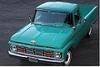
 then you don't have that worry




Wheel Hop

Thread Starter
|
Cross-Country
Joined: Jun 2024
Posts: 95
Likes: 13
Wheel Hop
My 1966 F100 2WD short bed had wheel hop when I got it. After installing Caltracs, it no longer hops, but the tires still seem to scratch on acceleration from a stop. Can't adjust it out. Two questions...
1. What do I try next? It has new leaf springs.
2. I used to deliver appliances in these trucks when they were new. They didn't have this problem then. What's different?
thanks, rex
1. What do I try next? It has new leaf springs.
2. I used to deliver appliances in these trucks when they were new. They didn't have this problem then. What's different?
thanks, rex

Lead Gopher


Joined: Aug 2012
Posts: 10,049
Likes: 1,603
From: Seattle

By 'scratch' are you referring to the tires breaking loose and spinning on the pavement? These trucks are very light in the back end - especially the short wheelbase/short bed trucks - put an appliance in the back for some weight!!
Lead Gopher
Joined: Aug 2012
Posts: 10,049
Likes: 1,603
From: Seattle
Short story - A buddy in high school had a 1967 RS/SS Camaro with a 327 V8 in it. He couldn't burn rubber due to EXTREME wheel hop. He could bounce down the road a few inches at a time. It was really hilarious.
I had a 1968 Firebird with 350 V8 from the factory - visually not an entirely different car and roughly the same power - and I could sit in place and burn rubber all day - zero wheel hop.
The main difference between these two cars that was the wheel hop factor was his car had a single leaf spring on both sides in the rear - called monoleaf rear springs. My Firebird had I think it was 4 leaves. Multi-leaf spring packs. HUGE difference.
As another example you can't always just drop a Fuel Injected 351 Windsor into one of these trucks without engineering anything else to go along with that change. You said you had wheel hop before you changed out the springs, but that you installed the same specification springs during the replacement? What if this truck has had wheel hop since it was brand new like my buddies Camaro regardless of how many leaves in the rear spring? You haven't owned it the entire time it sounds like. How this truck was equipped originally and how it has been changed would be factors to consider. These trucks brand new with a good running 352 were rated at 208 gross horsepower and 172 net horsepower. Less for any 6 cylinder engine. Not sure what your old appliance delivery trucks had but between that and dozens of various factors that influence traction that come into play you might be trying to compare apples to oranges. In your case maybe genetically modified oranges. How much HP from your 351? Not sure?
Maybe your truck has 4 leaves but with your new engine and changes maybe it needs 6. Or it has 6 and needs 8. That's the wheel hop factor and just a skim on that, but you also mentioned it scratching?!? Was that the tires breaking loose and if you don't want that happening then...or did you want it to happen?!? I'm not clear on what you said. Burn rubber easily or not at all???
Just trying to open up the communication. You can get better answers if you ask better questions and try to give a bit more info. So far you are basically talking too high level to have any takeaways.
The truck in the video I posted looks like an old beater Farm Truck. That's the whole point of it. Ultimate sleeper. But, you can bet there is a whole LOT of engineering that has gone into that truck to get it to hook up and run a 10.2 quarter mile at 128MPH. That's better than the old 1963 427 XL truck ever ran. Tires are a big factor. They've come a long way.
And consider this: The Farm Truck, famous from Street Outlaws, has been clocked at over 150 mph in the quarter mile. While exact times vary depending on tuning and conditions, it's known to have run in the six-second range, making it surprisingly fast for a truck.
Its big-block Chevy engine produces nearly four-digit horsepower, allowing it to compete with high-performance cars. Pretty wild for a truck that looks like it belongs on a farm, right?
I had a 1968 Firebird with 350 V8 from the factory - visually not an entirely different car and roughly the same power - and I could sit in place and burn rubber all day - zero wheel hop.
The main difference between these two cars that was the wheel hop factor was his car had a single leaf spring on both sides in the rear - called monoleaf rear springs. My Firebird had I think it was 4 leaves. Multi-leaf spring packs. HUGE difference.
As another example you can't always just drop a Fuel Injected 351 Windsor into one of these trucks without engineering anything else to go along with that change. You said you had wheel hop before you changed out the springs, but that you installed the same specification springs during the replacement? What if this truck has had wheel hop since it was brand new like my buddies Camaro regardless of how many leaves in the rear spring? You haven't owned it the entire time it sounds like. How this truck was equipped originally and how it has been changed would be factors to consider. These trucks brand new with a good running 352 were rated at 208 gross horsepower and 172 net horsepower. Less for any 6 cylinder engine. Not sure what your old appliance delivery trucks had but between that and dozens of various factors that influence traction that come into play you might be trying to compare apples to oranges. In your case maybe genetically modified oranges. How much HP from your 351? Not sure?
Maybe your truck has 4 leaves but with your new engine and changes maybe it needs 6. Or it has 6 and needs 8. That's the wheel hop factor and just a skim on that, but you also mentioned it scratching?!? Was that the tires breaking loose and if you don't want that happening then...or did you want it to happen?!? I'm not clear on what you said. Burn rubber easily or not at all???
Just trying to open up the communication. You can get better answers if you ask better questions and try to give a bit more info. So far you are basically talking too high level to have any takeaways.
The truck in the video I posted looks like an old beater Farm Truck. That's the whole point of it. Ultimate sleeper. But, you can bet there is a whole LOT of engineering that has gone into that truck to get it to hook up and run a 10.2 quarter mile at 128MPH. That's better than the old 1963 427 XL truck ever ran. Tires are a big factor. They've come a long way.
And consider this: The Farm Truck, famous from Street Outlaws, has been clocked at over 150 mph in the quarter mile. While exact times vary depending on tuning and conditions, it's known to have run in the six-second range, making it surprisingly fast for a truck.
Its big-block Chevy engine produces nearly four-digit horsepower, allowing it to compete with high-performance cars. Pretty wild for a truck that looks like it belongs on a farm, right?
Trending Topics

Lead Driver


Joined: Jun 2006
Posts: 5,653
Likes: 978
From: Near Yosemite CA
Tires, when these trucks were new, the tires were what, 1950's technology, rubber compounds have changed a lot, and depending on what tires you have on it, the grip changes... wheel hop is the springs loading and unloading, you got that under control with the Caltracs keeping the springs from wrapping, now you have more torque than the sticky icky on the tires can handle, can you go wider tires? Add a bit more grip, maybe a different compound for stick...
My 66 F100 might spin a tire if there's gravel on the road with the 300 sixer, but my 77 F250 after I rebuilt the 351Measly, it would light up the 35's, they were old and hard rubber, I switched to newer Irok 33's with softer rubber and now it starts hopping if I get on it, not that I do it too often... 🤭
As TA said, lots of engineering to get a brick to stick and go, and you know them ain't farm tires they're relying on, or even good street tires, them's sticky icky slicks.
My 66 F100 might spin a tire if there's gravel on the road with the 300 sixer, but my 77 F250 after I rebuilt the 351Measly, it would light up the 35's, they were old and hard rubber, I switched to newer Irok 33's with softer rubber and now it starts hopping if I get on it, not that I do it too often... 🤭
As TA said, lots of engineering to get a brick to stick and go, and you know them ain't farm tires they're relying on, or even good street tires, them's sticky icky slicks.
FTE Stories
Ford Trucks for Ford Truck Enthusiasts

2027 Ford Super Duty Buyer's Guide (Every Model, Engine, & Package)
Brett Foote
Top 10 Ford Truck Tragedies
Joe Kucinski
AEV FXL Super Duty - the Super Duty Raptor Ford Doesn't Make
Brett Foote
Lobo Vs Lobo: Proof the F-150 Lobo Should Be Even Lower!
Michael S. Palmer
Ford's 2001 Explorer Sportsman Concept Looks For a New Home
Verdad Gallardo
10 Best Ford Truck Engines We Miss the Most!
Joe Kucinski
2026 Shelby F-150 Off-Road: Better Than a Raptor R?
Brett Foote
2027 Super Duty Carhartt Package First Look: 12 Things You NEED to Know!
Michael S. Palmer
10 Most Surprising 2026 Ford Truck Features!
Joe Kucinski


Cross-Country
Joined: Aug 2024
Posts: 74
Likes: 16
From: SoCal
Might just be normal if you're getting hard on the throttle. But if it's isolated to one tire you can adjust that side to have more preload hence more grip. Or unload the opposite side. Caltracs can act almost as a limited slip with adjustment(as long as you're going in a straight line) How bad is the chirp and slip? When does it happen? If it's happening at mild throttle you could need some stickier tires. Old tires have less grip. Could even be a high stall converter causing the "issue" or a binding throttle if you're having throttle control issues.
Lead Gopher
Joined: Aug 2012
Posts: 10,049
Likes: 1,603
From: Seattle
If only the right rear tire is spinning/slipping it could be your differential is not a locking type. Locking differentials as you may know can redirect power from the tire that is slipping to the tire that is gripping. Or maybe you do have a locking differential, and you are experiencing a small gap between where the one tire is trying to get traction but it's also in the process of redirecting some of the power to the other wheel and tire.
Thread Starter
|
Cross-Country
Joined: Jun 2024
Posts: 95
Likes: 13
It's an open diff and a manual transmission (T5). I'm not getting on it when taking off, in fact quite the opposite to keep it from chirping. Also, the tires are wider than original and have very few miles on them.
I have played with the Caltracs preloads and have only been able to move the chirping from one side to the other.
Some of you have suggested the bigger engine might be the culprit, but it had this problem with the 300 IL6 in it.
I have played with the Caltracs preloads and have only been able to move the chirping from one side to the other.
Some of you have suggested the bigger engine might be the culprit, but it had this problem with the 300 IL6 in it.