When you click on links to various merchants on this site and make a purchase, this can result in this site earning a commission. Affiliate programs and affiliations include, but are not limited to, the eBay Partner Network.
No I haven't tried any tuning. Not necessarily opposed to it and had considered it, but I was happy with it in stock configuration. Something has suddenly changed in the last month to make this a persistent problem. I've never had any black smoke or huffing when requesting power until recently. It sure seems like it's starving for air when that EGR is active. I'll capture a plot of EGRDC, EGRVP, EGRTP, VGT, BARO, MAP, MAF, EPB_A, RPM, EOT, ECT. Any other PIDs of interest? I'll also pull any codes that occur while this is happening.
Last edited by hanoverclarkegs; Oct 27, 2025 at 12:12 PM.
Do you suppose this could be a problem with the EGR throttle plate command or feedback causing the throttle plate to close completely? I imagine the function of the EGR throttle plate is to manage the flow of compressed air when the EGR is active.
Any idea what inputs are involved in determining the EGRTP commanded position? I would suspect EGR valve position, EGR throttle position, maybe MAF.
Last edited by hanoverclarkegs; Oct 28, 2025 at 05:53 AM.
I thought I had read that later factory tunes rendered that throttle plate non functional and obsolete. I don’t have one on an 05, but I thought I remembered that somewhere.
I'll have to check what software version my PCM is programmed to. All I know is that as soon as the EOT/ECT temps get above 150F, I can see the EGR and EGRTP being commanded. If I shut the EGR off with IDS, the vehicle runs normally with no black smoke, engine loping and good boost.
Do you still have black smoke when the problem occurs?
Yes, heavy black smoke when stepping into the throttle. It feels and sounds like the turbo is fighting itself. It huffs until the RPM's get about 2-2.5K then takes off. If I were to describe it with words it'd be...chug,chug,chug,chug,chug then takeoff.
Have you checked the EGR sensor and the EGR sensor pipe to the manifold to see if it is clean?
I haven't inspected either the EBP sensor or tube, but will tomorrow
Can you see with IDS that the EGR valve is activated when the problem occurs?
Yes, I see the EGR active in IDS every time the problem occurs and if I take manual control of the EGR and set it to 0%, I can drive without any of the drivability issues. It'll remain that way until give control back to the PCM control loop.
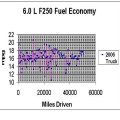
Here's a couple of runs that shows some instability in the control loop for the EGR in the first plot and some semmingly erratic EGR commands in the second plot.
What is the cylinder balance like when the problem occurs?
Not quite sure what you're asking, but here's the cylinder contribution when it was acting up. The truck was in neutral and was idling normally. After this, I put the truck in drive, stood on the brake and applied a bit of throttle (900 RPM or so), not much and the truck had a noticeable miss. At the end of this sequence, I checked codes and it had thrown a P0263 cylinder 1 contribution code.
One more piece of information that may help or muddy the water...I had flushed the coolant system about 3K miles ago at which time the degas bottle had some slight amount of black greasy residue on the inside walls. The coolant wasn't particulary dirty. I thouroghly degreased the bottle. I didn't use any chemical, but did use some detergent when flushing. The degas bottle has the black residue on the walls again, so earlier this evening I hooked up a pressure gauge to the degas hose to monitor pressure while going for a 1 hr drive. The pressure gradually rose to about 8 PSI as the ECT temps stabilized around 185F and EOT at 189F. I pulled some grades at WOT and the pressure never exceeded 10 PSI and max ECT was at 188F and EOT at 194F. I then stoped and relieved the pressure then continued some WOT runs and the pressure never rose above 1 PSI. I am concerned about the black greasy residue. The coolant doesn't smell like fuel to me, just coolant.
I imagine I should pull a vacuum on the coolant system and check the leakdown time.
As I mentioned earlier, I don't know of any truck where the EGR system doesn't cause problems at some point. That's why I always remove the EGR cooler and install a tune (only a very moderate increase in performance) so that the CEL doesn't light up. The “chug, chug, chug...” could also come from a sluggish turbo adjustment, but then a DTC should appear.
I pulled and cleaned the EBP sensor and tube with MAF cleaner. Mild amount of carbon build up in the sensor and tube, certainly not blocked. The IAT2 sensor was a different story and was completely plugged. I was hoping this was going to resolve the problem as it correlated directly with this post IAT Sensor? - Page 2 - 6.0L Power Stroke® Diesel Engines - Diesel Technician Society, but the problem remains. Any ideas on how much rise will occur on IAT2 when the EGR is open? IAT was around 86F and IAT2 would rise to 130F. Seems it should be much higher than that.
I pulled and cleaned the EBP sensor and tube with MAF cleaner. Mild amount of carbon build up in the sensor and tube, certainly not blocked. The IAT2 sensor was a different story and was completely plugged. I was hoping this was going to resolve the problem as it correlated directly with this post IAT Sensor? - Page 2 - 6.0L Power Stroke® Diesel Engines - Diesel Technician Society, but the problem remains. Any ideas on how much rise will occur on IAT2 when the EGR is open? IAT was around 86F and IAT2 would rise to 130F. Seems it should be much higher than that.
Don't forget you have an EGR cooler along with your Charge Air Cooler. IMO that isn't a low value.
Does the Turbo VGT% pid react to the EGR valve issue?
When the EGR goes active and at Idle, the VGT% starts increasing until it pegs at 85%. When I command the EGR to 0% and at idle, the VGT% sits about 65%. I'll try and capture this on IDS tomorrow. As well as how the VGT% responds from idle to WOT both with EGR controlled by PCM and when I command it to 0%. I'm still wondering about a partial restriction in the CAT that would still allow boost to build when the EGR is closed, but be high enough impedance such that when the EGR is opened, the path of least resistance for the exhaust is back through the intake to cause a slow build of boost. That'll be the next test once I get the nuts off the downpipe flange with the Acetylene torch.
Don't forget you have an EGR cooler along with your Charge Air Cooler. IMO that isn't a low value.
That does make sense and with higher loading, I'm sure it would be higher. Seems like I remember reading 100 F delta at WOT being common. I'm kicking myself because I went through all the work to get at that IAT2 temp sensor and clean it, but I forgot to take a pick and poke down through the manifold hole and make sure it was clear.
I disconnected the downpipe from the catalytic converter and test drove the vehicle, no difference other than being obnoxiously loud. I also put in a new Ford EBP sensor with no change. Running out of ideas.
Rezvani's Latest Post-Apocalytic Monster Is a Ford F-150 Raptor Underneath
Slideshow: Called the Fortress, the 850-horsepower pickup combines Raptor underpinnings with military-inspired features, survival equipment, and a starting price of $285,000.