





Towing capacity

Thread Starter
|
3rd Gear
Joined: Dec 2023
Posts: 3
Likes: 0
Towing capacity
Just joined and did a quick search but couldn’t sort through the posts to find what I’m looking for….although I’m sure it’s there somewhere beyond my ability.
I'm looking at purchasing a used SD that will be my daily as well as my tow vehicle for my boat and eventually a travel trailer. We have a good idea of what TT size we are looking at and that’s where the issue arises. The GVWR of the 5th wheel toy hauler is 14k (dry weight 10.8k)but we have no heavy toys, likely hauling less than 1000k of “cargo” putting us around only 12k.
When I look at Ford specs, it looks like up until 2016 the f25 and f350 have similar towing capacities (not focusing on payload right now) but in 2017 the f350 made a significant increase. It seems that the F250 didn’t make this increase until 2020. Am I seeing this correctly? And are these number put out on the Ford brochures each year accurate?
In my area, there is a huge price difference between used f250 and f350 right now and the only reason I would need a f350 is that towing capacity….indont need the higher payload to haul anything else. I’ve always heard the 90% rule referenced and we would still be under that, but wondering if being “close” (within 2k) a 350 would be more advisable than a 250
any help would be appreciated
I'm looking at purchasing a used SD that will be my daily as well as my tow vehicle for my boat and eventually a travel trailer. We have a good idea of what TT size we are looking at and that’s where the issue arises. The GVWR of the 5th wheel toy hauler is 14k (dry weight 10.8k)but we have no heavy toys, likely hauling less than 1000k of “cargo” putting us around only 12k.
When I look at Ford specs, it looks like up until 2016 the f25 and f350 have similar towing capacities (not focusing on payload right now) but in 2017 the f350 made a significant increase. It seems that the F250 didn’t make this increase until 2020. Am I seeing this correctly? And are these number put out on the Ford brochures each year accurate?
In my area, there is a huge price difference between used f250 and f350 right now and the only reason I would need a f350 is that towing capacity….indont need the higher payload to haul anything else. I’ve always heard the 90% rule referenced and we would still be under that, but wondering if being “close” (within 2k) a 350 would be more advisable than a 250
any help would be appreciated

Mountain Pass


Joined: Sep 2017
Posts: 158
Likes: 30
with a fifth wheel payload will be your limiting factor not gross weight. 350 is the safest and best option. The yellow sticker on the driver's door is what you need most as every truck is different depending on options. No brochure will give you accurate payload.

Logistics Pro


Joined: May 2022
Posts: 4,291
Likes: 2,416
From: Everywhere and nowhere
https://www.ford.com/towing/
The RV and Towing Guide PDF is too large for me to attach.
Although for 2022 I dont have a 2023 so I dont have a PDF of those option weights. This is pretty close for 2022 as far as weights.
The RV and Towing Guide PDF is too large for me to attach.
Although for 2022 I dont have a 2023 so I dont have a PDF of those option weights. This is pretty close for 2022 as far as weights.

Tuned
Joined: Nov 2023
Posts: 431
Likes: 247
I looked and did not see this posted.
Simple SD doc.
https://www.ford.com/cmslibs/content...Info_Dec16.pdf
Simple SD doc.
https://www.ford.com/cmslibs/content...Info_Dec16.pdf
Trending Topics

Fleet Mechanic
Joined: Jun 2018
Posts: 1,465
Likes: 538
From: Wasilla, AK
I know plenty of people who regretted buying a F250. I never met anyone who regretted buying a F350 unless their local HOA prohibited parking it at home.
FTE Stories
Ford Trucks for Ford Truck Enthusiasts

Top 10 Fords at 2026 Carlisle Ford Nationals
Joe Kucinski
3 Best / 3 Worst Parts of Modern Ford Ownership
Brett Foote
10 Amazing Upgrades That Solve Common Ford Truck Owner Headaches
Pouria Savadkouei
Every 2026 Ford Engine Explained
Brett Foote
10 Ugly Ford Trucks That We Still Kinda Love
Joe Kucinski
10 Things Every Truck Owner NEEDS (2026 Edition)
Michael S. Palmer
Rezvani's Latest Post-Apocalyptic Monster Is a Ford F-150 Raptor Underneath
Verdad Gallardo
Top 10 Most Expensive Ford Trucks Ever Sold on Bring a Trailer
Joe Kucinski
2027 Ford Super Duty Buyer's Guide (Every Model, Engine, & Package)
Brett Foote
Thread Starter
|
3rd Gear
Joined: Dec 2023
Posts: 3
Likes: 0
I looked and did not see this posted.
Simple SD doc.
https://www.ford.com/cmslibs/content...Info_Dec16.pdf
Simple SD doc.
https://www.ford.com/cmslibs/content...Info_Dec16.pdf

Cargo Master
Joined: Jul 2011
Posts: 2,675
Likes: 979
From: Walpole, MA


Cargo Master
Joined: Jul 2011
Posts: 2,675
Likes: 979
From: Walpole, MA
thanks. However I’m looking at used and my biggest question is the about the major discrepancies over time, specifically between 2017-2020. The F250 and 350 had very similar towing capacities until 2017 when the 350 made a huge jump. But now, they are back to similar with biggest difference being cargo capacity. I guess what I’m wondering is, what change was made to create this separation during those years.
Thread Starter
|
3rd Gear
Joined: Dec 2023
Posts: 3
Likes: 0
For the first gen super duties the GVWR's were 8800 and 9900 for SRW 3/4 and 1 tons respectively from 1999-2004. When the new front end in 2005 and on the GVWR's crept up to 10k for F250's and 11.5k ish for F350's. But as engines, transmissions, emissions and aftertreatment systems kept getting heavier for diesels and additional electronics and creature comforts showed up it ate into available payload to the point by the time you get to the 2017's you have F250's with less than a ton of payload depending on option mostly handicapped by the 10k GVWR limit. The HCT two trucks got the same Dana M275 rear axle at the same period F350s starting in 2020 IIRC and that bumped GVWR up to 10.8k for the F250's. Starting in the 2023, the F250s could now be a whole mess of GVWR's all the way up to 11.5k for a CCLB and the SRW F350s can be up to 12.5k for a CCLB or 12k for a CCSB diesel (I believe the gas engine trucks are still 11.5k). Biggest change that I am aware of is the rear axle. The sterling 10.5 was pretty much the only super duty axle until 2017, when the 350's got the M275 and the HCT F250's got it latter on. Now the 11.6" SRW rear end is showing up in the newer truck, honestly not sure if that is going to totally replace the M275 or just supplement it. The chassis always had the head room to bump up the GVWR, my 2019 F250 has a front GAWR of 5990 cause of the plow springs and my sterling is rated at 6340 at a spec'd tire pressure of 65 psi, combined axle rating of 12,330 but a GVWR of 10k (81% of combined axle). For comparison a 2023 F350 would be 5990 for the front axle and 7230 for the rear in every instance I can find, giving you 13,220 of combined axles but the GVWR could be as high as 12,500 depending on configuration (94.5% of combined axle ratings). I know I am missing a few of possible combinations in my long winded monologue, but you get the picture.... depending on what your pulling "towing capacity" is a marketing number. Especially in a F250, the lower GVWR is going to be the gating factor for how much you can tow in most instances.
again thank you for the great explanation

Fleet Mechanic

Joined: Aug 2022
Posts: 1,590
Likes: 1,118
1) Never use the trailer's dry weight, use GVWR and 22 - 25% for pin weight; they always weigh more than advertised due to options and the fact the dry weights don't typically include batteries, propane, water, etc. I carried over 1,000 lbs in my slide in truck camper. .....for my 30' travel trailer my batteries, propane and water alone weigh more than 1,000 lbs....my typical load out is more like 2,000 lbs over the manufacturer's advertised dry weight.
2) A 3/4 ton is a poor choice for all but the smallest fifth wheels.....if you already own one, that's one thing, otherwise, just buy the F350 or you'll regret it.
3) Tow capacity isn't an issue for what you describe, payload (GVWR) is.
2 cents,
Dave
2) A 3/4 ton is a poor choice for all but the smallest fifth wheels.....if you already own one, that's one thing, otherwise, just buy the F350 or you'll regret it.
3) Tow capacity isn't an issue for what you describe, payload (GVWR) is.
2 cents,
Dave



Cross-Country
Joined: Aug 2017
Posts: 87
Likes: 41
From: NM
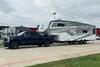
Toyhaulers are built differently - they usually have a much higher pin/tongue weight than other trailers their size due to the fact that they expect you to place thousands of pounds in the rear. When you pull them empty they are VERY heavy up front.
Don't even consider an F250. In fact, get the long bed for the added fuel tank capacity and extra 1,000lbs GVWR.
Don't even consider an F250. In fact, get the long bed for the added fuel tank capacity and extra 1,000lbs GVWR.