When you click on links to various merchants on this site and make a purchase, this can result in this site earning a commission. Affiliate programs and affiliations include, but are not limited to, the eBay Partner Network.
I am really HATING to ask for opinions on this issue.
Yep... wore through inner front brake pad before changing, and the rotor surface is slightly scraped. I pulled the tires this evening to inspect the rotor surface (I heard the scraping the other day and this is the first opportunity I've had to pull the tires. I HAD to drive the truck gently a couple of times while resolving a spare AND main tire replacement on my wife's car, and simply had no other way to get around. Once I heard the scraping the first time, I rode the brakes very very very gently and tenderly with minimum pressure and extra long stopping distances (milking it).
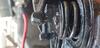
Below are the pictures of the damaged surface.
An in-kind replacement (Napa Adaptive One coated rotor) is $280. It's only 3-1/2 years old and is in otherwise perfect condition.
I know the standard answer is to replace the rotor and pads. However, I'm wondering just how serious the risk is with the relatively minor extent of damage, and am tempted to replace only the pads and let this one (inner PS pad) get worn to mate the rotor surface.. Flame suit is on, so you can fire away.
You can try it but you'll probably be back at it pretty soon. It's going to chew through the pad quickly on the inside surface. The uneven wear may or may not cause you troubles.
I can tell you from experience that the rough area of the rotor will grind away the pad and not provide the proper friction surface that you need for 100% braking performance. The smooth part of the pad will be the only part that will be stopping the vehicle and the rest of it just get's shaved away, but not really making good contact with the surface of the rotor. MINIMUM get them resurfaced. Best to get them replaced so you have good heat sink during heavy braking.
If you've got a disc sander or worn flap wheel you can soften up some of the rough stuff a little. Would help from chewing up those new pads as quick. You don't want to get aggressive with it, just knocking down the highs with the abrasive as flat with the part as you can manage and no more than the weight of the tool for pressure. You could probably even hand sand if that is more your speed.
If you don't get it nice and smooth, the pad surface will end up mirroring what the rotor looks like. I've NEVER done a brake job where I put good pads on a scraped rotor, but I've pulled one or two apart that someone else did and I can tell you that the only effective braking surface that you will have is the part that makes contact with the smooth part of the rotor. Any other part of the pad that touches the rough part will simply grind away and not really provide the needed friction to stop the vehicle. Not such a big deal if you're driving empty, but if you're loaded up and/or pulling a trailer you only have a fraction of the braking power that the truck was designed to have.
If you've got a disc sander or worn flap wheel you can soften up some of the rough stuff a little. Would help from chewing up those new pads as quick. You don't want to get aggressive with it, just knocking down the highs with the abrasive as flat with the part as you can manage and no more than the weight of the tool for pressure. You could probably even hand sand if that is more your speed.
Maybe I should clarify what I wrote here. If you are in a bind for the time and/or funds necessary to source the correct parts then the method I described can get you back on the road and help prevent the new pads from disintegrating as quickly if done correctly.
I had similar happen to my rear discs,i changed them.
And trying to observe brake wear better in the future..
I have grinded wear ridges off from the disc,If it was otherwise on good condition.
This I find surprising. The Captain of team DIY hasn't resurfaced his own rotors? I figured you'd have smelted and cast complete new parts or something. After you mined the ore of course.
If you've got a disc sander or worn flap wheel you can soften up some of the rough stuff a little. Would help from chewing up those new pads as quick. You don't want to get aggressive with it, just knocking down the highs with the abrasive as flat with the part as you can manage and no more than the weight of the tool for pressure. You could probably even hand sand if that is more your speed.
Originally Posted by cleatus12r
You don't need brakes.
Seriously, a customer vehicle would get new rotors. My junk? New pads and drive it.
You guys are in bad company on this. I only replace rotors when they start shaking my pedal more than I'm willing to tolerate. I like udsuth's idea to smooth them up a little. My theory on scored rotors is that they have more surface area and will enhance braking action once the pads wear into the grooves but those rough edges will grind down the pads.
You guys are in bad company on this. I only replace rotors when they start shaking my pedal more than I'm willing to tolerate. I like udsuth's idea to smooth them up a little. My theory on scored rotors is that they have more surface area and will enhance braking action once the pads wear into the grooves but those rough edges will grind down the pads.
Can't be too bad. I've only replaced brakes one time on any of my vehicles during the span of owning them - and I don't sell vehicles. Heck, my 91 Oldsmobile got front pads when I acquired it at 141K 17 years ago. It turned over 294K yeterday and the brakes (original rear shoes too) will make it through this winter easily. I might put new ones on it this spring before it gets parked for the summer just so I have a reason to grease the slide pins and inspect the undercarriage! MIGHT. I have yet to put rotors on anything I've owned for any length of time but I have put a few sets on when first getting a vehicle....most people aren't as nice to brakes as I am.
Since you're taking it apart anyway why not take the rotor off and have it turned at a shop. I know, kind of a hassle. I'd give you a pass on it if it were a rotor on a DRW rear axle or a twin I-beam front setup where it's a bigger chore to get it off. They'll have a tool to measure the thickness. If it's a front rotor I think 36mm is the discard point.
Rezvani's Latest Post-Apocalyptic Monster Is a Ford F-150 Raptor Underneath
Slideshow: Called the Fortress, the 850-horsepower pickup combines Raptor underpinnings with military-inspired features, survival equipment, and a starting price of $285,000.