When you click on links to various merchants on this site and make a purchase, this can result in this site earning a commission. Affiliate programs and affiliations include, but are not limited to, the eBay Partner Network.
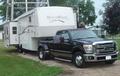
Saw this article Broken Ram 3500 Dually and thought I'd share it here. Interesting article and it sounded like the owner didn't have a clue about truck capacity or weight of the camper. He even stated he never bothered to get it weighed either. Guess he learned a very expensive lesson.
This has been a very common problem with Ford trucks as well. GM went to a much stronger fully boxed frame for its 2500/3500 trucks starting in 2011. Ram beefed up the frames on the 3500 starting in 2013 and in 2014 did the same for the 2500 trucks. Ford did not do this for its super duty pickups until 2016.
This was a design defect and not the result of overloading the truck beyond its specified load capacity. For many people wanting to use a truck for a slide in camper the best bet was the Ford F-450 CC this has always had a much stronger frame. Current generation of F-150 now have a fully boxed frame and are better able to support their payloads.
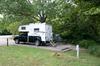
Take a close look at the back of the camper, there's a motor cycle mounted back there and it looks like there was another one back there also, you can see the cover that probably covered them both sitting on top of the remaining one. That would be a lot of weight hanging on the back of camper or hitch extension transferring all the weight hanging off the back of the truck with probably none of the camper weight transferred to the front the like it's supposed to. If you ever looked at the manual section on this type of camper they are very specific about camper balance so weight gets shifted to the front.
Take a close look at the back of the camper, there's a motor cycle mounted back there and it looks like there was another one back there also, you can see the cover that probably covered them both sitting on top of the remaining one. That would be a lot of weight hanging on the back of camper or hitch extension transferring all the weight hanging off the back of the truck with probably none of the camper weight transferred to the front the like it's supposed to. If you ever looked at the manual section on this type of camper they are very specific about camper balance so weight gets shifted to the front.
I’ve never seen this before. Not sure that’s a motorcycle, maybe it’s an electric bike (fat tires). But even if it is it’s not big, or heavy enough to be the straw that broke the Rams back. 😂
In any event that is a 3500 Dually. No way this should have happened. But is a Dodge and I am for sure sending that picture to all my Dodge friends.
I’ve never seen this before. Not sure that’s a motorcycle, maybe it’s an electric bike (fat tires). But even if it is it’s not big, or heavy enough to be the straw that broke the Rams back. 😂
In any event that is a 350 Dually. No way this should have happened. But is a Dodge and I am for sure sending that picture to all my Dodge friends.
Load that camper on your Ford or Chevy 1 ton dually; then do as the article says…….AVERAGE 55-60 MPH on those Baja highways and see how that pans out for you. In order to “Average” that speed through the peninsula means he was topping out around 75-80. Either that or they don’t know what “average” speed means. On a recent trip from western AZ to E. Texas and back with damn little town / city driving; mostly interstate and 4 lane divided highways, almost 2750 miles total, my average speed (Total miles divided by total driving hours) came out at 54 MPH.
The truck os NOT a short bed as the article says.
4100 lb payload for that truck seems to be way off. I have an ‘18 Laramie longhorn, HO Cummins with the Aisin trans, loaded to the nuts with all options except for sunroof and my payload is right around 5500.
As usual…….something is not being told in this story, or something is being embellished!
IMO, that kind of load should not have caused frame failure under most conditions. I believe I see an exhaust on the left side of the motorcycle. I would guess the MC to be a couple of hundred lbs and I question what had been in the other bike slot and for how long and under what conditions. Reading the owner's take on the situation, he wants an adjustment from Dodge. I do not see that happening. His public statements support his ignorance and probably misuse of the equipment. As stated here, he did not know what it weighed. If it were me, I would find a great welder, have the frame inspected and fish plated, and go on down the road with a little less or much better-balanced load.
When I had a 3000 plus pound Lance slide-in camper on my 2011 GM truck I did a lot of research and spent time checking out multiple camper and RV websites. In 2010 it was common to see pictures of trucks with the frames failing at this location and usually it was a Ford truck. The Ford trucks had far more frame flexing and this was worse with dual rear wheels where having the wheels further away from the frame put a leverage load on it.
Manufacturers go to using 4 tires at the rear as it is the cheapest way to increase payload capacity for light trucks but this approach also increases the chance of a frame failure. The smart money is in going to a F-450 pickup with its 19.5 wheels and tires.
Porpoising is a very real problem with a heavy camper load in the bed of the truck. Part of it is from the overhang of the camper that moves the center of gravity up and forward of the rear axle. With my truck I needed to put on adjustable Rancho shocks and keep increasing the dampening at the front wheels until the porpoising was no longer a problem. At the rear axle I added overload springs and also used the Ranch shocks and had them at double the resistance setting of the front shocks. Most camper owners do not go to this amount of effort and would be better off buying a motorhome where the engineering work was done by its manufacturer.
People buy "camper special" trucks and wrongly assume that they are modified for a slide-in camper when all that is done is to provide a higher output alternator and no suspension changes are made.
This Hennessey Takes the Expedition Tremor's Off-Roading Capability to the Next Level
Slideshow: The VelociRaptor Expedition gains a lift, upgraded suspension, Brembo brakes, and trail-ready equipment while retaining the stock 440-horsepower EcoBoost V6.
Rezvani's Latest Post-Apocalyptic Monster Is a Ford F-150 Raptor Underneath
Slideshow: Called the Fortress, the 850-horsepower pickup combines Raptor underpinnings with military-inspired features, survival equipment, and a starting price of $285,000.