





Tire Pressure?

Thread Starter
|
Mountain Pass
Joined: Jul 2020
Posts: 156
Likes: 13
From: Wichita
Tire Pressure?
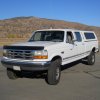
Hey all, been noticing my tires being eaten up. Was wondering what tire pressure you guys use for front or rear? I drive a 1993 F250 351W extended cab, longbed. It never hauls loads. Im begining to believe that 51 in front and 80 in the back is a bit much.

Lead Driver


Joined: Jul 2017
Posts: 9,601
Likes: 1,174
From: San Jose, CA
In what way are the tires being eaten up? Tire pressure issues have very distinct wear patterns. Defective tires have others, as does poor shock absorber performance.
And then of course there are alignment issues…
And then of course there are alignment issues…

Cargo Master
Joined: Nov 2009
Posts: 2,190
Likes: 620
With the 31x10.50-15's on my F150, for instance (BFG AT), I run between 35-40 PSI empty most of the time, because thats where reading the contact patch tells me I should be.
Lead Driver
Joined: Jul 2017
Posts: 9,601
Likes: 1,174
From: San Jose, CA
Agree with the others. Your 80 psi in the back is for a full loading and not likely anywhere near the real world load you're carrying with an empty bed.
However, once you start lowering the pressure (by quite a bit in your case) you'll need to remember that on the off-chance that someday you need to haul a load of firewood for the family or a truckbed full of sand for the garden.
In any scenario where you're loading up, you'd better re-load your tires too. The numbers on the sidewall reflect their total carrying capacity (each) at the stated pressure. In your case is it 80 or 85 psi that's listed on the sidewall? Given that with an empty bed a SuperCab long bed it probably putting maybe 1100-1500 lbs on each tire at the most, it's way below the 2750 or 3350 or whatever pound rating your tires have.
And just for giggles (and our info) what are the actual ratings on the sidewalls of your tires? Are they super heavy duty like would have come with the truck, or could they have been replaced with more pedestrian models by a previous owner for a more comfortable ride on the street?
Just curious.
Paul
However, once you start lowering the pressure (by quite a bit in your case) you'll need to remember that on the off-chance that someday you need to haul a load of firewood for the family or a truckbed full of sand for the garden.
In any scenario where you're loading up, you'd better re-load your tires too. The numbers on the sidewall reflect their total carrying capacity (each) at the stated pressure. In your case is it 80 or 85 psi that's listed on the sidewall? Given that with an empty bed a SuperCab long bed it probably putting maybe 1100-1500 lbs on each tire at the most, it's way below the 2750 or 3350 or whatever pound rating your tires have.
And just for giggles (and our info) what are the actual ratings on the sidewalls of your tires? Are they super heavy duty like would have come with the truck, or could they have been replaced with more pedestrian models by a previous owner for a more comfortable ride on the street?
Just curious.
Paul

Cargo Master


Joined: Mar 2010
Posts: 3,331
Likes: 292
From: Laramie, WY
Look up a load inflation table. There's a linear relationship between load carrying capacity and tire pressure for a given tire size & construction type (P or LT). 80 PSI s certainly too much for empty rear end. Wears out the centers, rides poorly, and reduces traction.
If you know your axle weights and have the load inflation table for your tires, you can look up the pressure required to safely carry the load (all the way to rated tire speed).
If you know your axle weights and have the load inflation table for your tires, you can look up the pressure required to safely carry the load (all the way to rated tire speed).
Trending Topics

i ain't rite
Joined: Mar 2005
Posts: 65,511
Likes: 5,567
From: Marlboro Mental Hospital.

for empty running, i rub a 1 inch wide chalk line across the tire. than go for a ride around the block with slow turns.
keep applying chalk to the line until it is all wore off the tire. this will be your empty running tire pressure.
for my diesel trucks this works out to 45 front and 30 rear.
for the gas trucks, 35 front and 30 rear.
if i need to haul a load i air up to 70 lbs.
keep applying chalk to the line until it is all wore off the tire. this will be your empty running tire pressure.
for my diesel trucks this works out to 45 front and 30 rear.
for the gas trucks, 35 front and 30 rear.
if i need to haul a load i air up to 70 lbs.
FTE Stories
Ford Trucks for Ford Truck Enthusiasts

10 Things Every Truck Owner NEEDS (2026 Edition)
Michael S. Palmer
Rezvani's Latest Post-Apocalyptic Monster Is a Ford F-150 Raptor Underneath
Verdad Gallardo
Top 10 Most Expensive Ford Trucks Ever Sold on Bring a Trailer
Joe Kucinski
2027 Ford Super Duty Buyer's Guide (Every Model, Engine, & Package)
Brett Foote
Top 10 Ford Truck Tragedies
Joe Kucinski
AEV FXL Super Duty - the Super Duty Raptor Ford Doesn't Make
Brett Foote
Lobo Vs Lobo: Proof the F-150 Lobo Should Be Even Lower!
Michael S. Palmer
Ford's 2001 Explorer Sportsman Concept Looks For a New Home
Verdad Gallardo
10 Best Ford Truck Engines We Miss the Most!
Joe Kucinski
5th Wheeling
Joined: Sep 2012
Posts: 45
Likes: 6
Needed (cold) pressure is all about load on tire, and maximum speed used, wich you wont go over for even a minute.
Now for a normal used car, the loads and used speeds vary.
Determining the loads on tires is the most tricky part in it all, and your responibility.
I can make you a pressure/axleload list.
In that I give 90% of the axleload calculated with my determined extra tight formula, and for max speed 160kmph/99mph.
I determined this to give maximum reserve with still acceptable comfort and gripp.
Need for that next, can be read from sidewall.
1 maximum load or loadindex for single load ( or do you have dualload axle behind?)
2. Kind of tire to determine the referencepressure.
Yust yesterday saw your sise in E-load LT with loadindex 125/122 At 80 psi. But can also be that you have a P-tire AT 35 psi or EUR system AT 36 psi.
3. Speedcode, less important, because will be Q or higher, wich all have referencespeed of 160kmph/99mph.
For the reference- pressure and - speed, the tiremakers calculated the maxload, and there is a system to calculate for other speeds and load.
The carmaker nowadays only gives recomended pressure for GAWR's and maximum technical carspeed. Your GAWR rear is higher then front.
Or they yust give referencepressure and dont calculate anymore.
Edit: Sorry placed this in the wrong topic, this was the related topic to the one I found.
Now for a normal used car, the loads and used speeds vary.
Determining the loads on tires is the most tricky part in it all, and your responibility.
I can make you a pressure/axleload list.
In that I give 90% of the axleload calculated with my determined extra tight formula, and for max speed 160kmph/99mph.
I determined this to give maximum reserve with still acceptable comfort and gripp.
Need for that next, can be read from sidewall.
1 maximum load or loadindex for single load ( or do you have dualload axle behind?)
2. Kind of tire to determine the referencepressure.
Yust yesterday saw your sise in E-load LT with loadindex 125/122 At 80 psi. But can also be that you have a P-tire AT 35 psi or EUR system AT 36 psi.
3. Speedcode, less important, because will be Q or higher, wich all have referencespeed of 160kmph/99mph.
For the reference- pressure and - speed, the tiremakers calculated the maxload, and there is a system to calculate for other speeds and load.
The carmaker nowadays only gives recomended pressure for GAWR's and maximum technical carspeed. Your GAWR rear is higher then front.
Or they yust give referencepressure and dont calculate anymore.
Edit: Sorry placed this in the wrong topic, this was the related topic to the one I found.

Thread
Thread Starter
Forum
Replies
Last Post