When you click on links to various merchants on this site and make a purchase, this can result in this site earning a commission. Affiliate programs and affiliations include, but are not limited to, the eBay Partner Network.
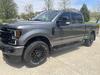
Super Duty Newbie here. Can someone give me a “For Dummies” explanation on locking hubs? My F250 was delivered a few days ago and I haven’t taken delivery yet. This is a picture of my wheel though. Is there a way to tell if they’re currently in auto or lock? Is there some indicator on the dash? I didn’t want to fool with trying to turn the ****. Judging from the position of the arrows, I would guess they are currently set to auto. Under what conditions would they need to be changed from auto to lock, or vise versa? What’s the general purpose of them?
Looks like they're in auto, leave them there unless you ever need 4wd and they don't engage. the manual setting is only for use in case of a malfunction.
That is auto. It is the default for 99% of people. If the vacuum system that operates the auto hubs fails you could manually switch them to the lock position and still have 4wd. There is no dash indicator for the hubs. Best to give them a few seconds at least to engage after turning the switch.
I personally do not like the auto system. It is slow to respond, especially disengaging. I almost always end up backing up 10-20 feet to get it all to disengage. When plowing I lock the hubs and can switch in and out of 4wd using the switch that operates the t-case. Then I know I can get on the power pretty quickly without having to worry about a hub slamming into engagement. I would have killed for a manula lever t-case and manual hubs this time around. No longer offered...
Below every thread it says "related topics" and shows similar threads. Just scroll through some of those and you'll probably find some helpful information.
I used to manually lock the hubs each winter on my 2011 F350 plow truck just because then I knew I wouldn't have to worry about them being locked or not (was having intermittent problems with them not locking when on auto")
The **** on your dash does 2 things when your hubs are in auto. It locks the hubs via vacuum engagement, and engages the transfer case to start turning. If the vacuum system malfunctions and doesn't lock the hubs, you can hop out of the truck and turn the hubs to "lock" and turn the **** to engage the transfer case. Or you can drive around in "lock" and not worry about whether the vacuum is going to fail, and turn the **** to engage the transfer case.
It is a good idea to exercise the selector on each hub because they do get very very very hard to turn if you don't, or at least here in the Northeast.
auto as in the picture except in snow or really cold temps where the vacuum may fail.
Once a month turn them to lock and drive a few miles to keep it all lubed up. (just don't turn the switch on the dash.
Otherwise as stated you turn them to lock them in when conditions don't allow a bit of movement to get them engaged.
Fascinating. I've been turning my levers back and forth whenever I wash the truck because I heard they can get stuck. Sounds like I should probably drive home with them in "lock" as well. A drawing of that assembly sure would be nice.
Fascinating. I've been turning my levers back and forth whenever I wash the truck because I heard they can get stuck. Sounds like I should probably drive home with them in "lock" as well. A drawing of that assembly sure would be nice.
Found a few pictures, looks like the hubs have inner and outer rotating spline assemblies that get locked together or not. Would anybody care to elaborate for the curious?
Super Duty Newbie here. Can someone give me a “For Dummies” explanation on locking hubs? My F250 was delivered a few days ago and I haven’t taken delivery yet. This is a picture of my wheel though. Is there a way to tell if they’re currently in auto or lock? Is there some indicator on the dash? I didn’t want to fool with trying to turn the ****. Judging from the position of the arrows, I would guess they are currently set to auto. Under what conditions would they need to be changed from auto to lock, or vise versa? What’s the general purpose of them?
Clockwise rotation to stop, "lock".....Counter clockwise rotation to stop, unlock, or "auto". Picture the wheel able to connect or disconnect from the axle that can drive it. Super duty 4 wheel drive has a transfer case at the rear of the transmission, this does as it says, it can transfer power to a driveshaft that goes to the front differential which turns a left and right axle shaft connected to your front wheels. When you switch to 4 wheel drive the transfer case will engage and spin driveshaft to front, and will activate a mechanism in that "locking", "unlocking" hub that locks the front axle shafts to the wheels.
So two different systems working here.... Hubs, wheels attaching or detaching to front axle shafts.......... and transfer of power to front (rear always the same no connect or disconnect) . Picture hubs as lock or unlock with out auto hub system. Lock is wheels connected, won't slip out or partially engage. Unlock is not connected. You turn the selector in cab to 4 wheel, transfer case spins driveshaft, to differential, to front axle shafts, hubs unlocked, wheels disconnected, locked connected.
You don't want to drive around all the time with all that rotating mass being used when you don't need it. When you don't need 4 wheel if you have the hubs locked and the selector in the cab on off (2 wheel drive), the front wheels rotate by driving down the road, this will spin the front axle shafts, front differential, driveshaft to transfer case and part of the gears in the transfer case, major sucking of power and waste of parts.
You used to have to manually shift the transfer cases with a lever on the floor, and get out and manually turn the hubs. Auto hubs are a way of not having to get out and having everything disconnected or connected.
4 wheel low is just a gear reduction in the tranfer case.
This Hennessey Takes the Expedition Tremor's Off-Roading Capability to the Next Level
Slideshow: The VelociRaptor Expedition gains a lift, upgraded suspension, Brembo brakes, and trail-ready equipment while retaining the stock 440-horsepower EcoBoost V6.
Rezvani's Latest Post-Apocalyptic Monster Is a Ford F-150 Raptor Underneath
Slideshow: Called the Fortress, the 850-horsepower pickup combines Raptor underpinnings with military-inspired features, survival equipment, and a starting price of $285,000.