When you click on links to various merchants on this site and make a purchase, this can result in this site earning a commission. Affiliate programs and affiliations include, but are not limited to, the eBay Partner Network.
I’ve never taken any ‘precautions’ welding on 7.3 SuperDuty trucks. We are talking about a few dozen muffler deletes and various other welding escapades. Not a single issue ever.
Disconnecting the batteries only is futile. Many systems use a ground path to complete circuits to the PCM and the batteries are not in the loop. Removing the PCM from the truck would be the only way to protect it.
This was my recent fun welding nuts on what was left of the exhaust manifold studs. 16x plus several extra times for welds/nuts that didn’t remove the studs.
Seriously though if you are concerned about electrical current here is what I use, I got it from Harbor Freight, just grind off some paint next to the weld area and stick it on then place your ground clamp on the stud. Works great for things that are hard to clamp to also.
I have the same doohickey, with emphasis on the hickey. Or hiccup.
The thing works okay on a flat surface, such as bigb56's beautiful metal shop table, as long as the welding lead connected to the spring loaded ground post inside the donut hole of the magnet is well supported by the table itself.
But if the cable is draped off the table, then the spring may not be strong enough to keep the base of the ground stud in full and flat contact with the work.
Skinny ground cables and stamped clamps, or light weight cables with an eyelet on the end that is retained to the ground stud by the two nuts provided, are less likely to cause the ground stud base to partially lift or tilt away from the work, as permitted by the spring to the limit of the upside down metal cup height.
But heavy ground cables, with all cast copper ground clamps, and/or vertical or overhead use of the magnetic ground stud, have a greater possibility of tilting or pulling the ground stud base away from the work, creating an air gap that the arc may jump across.
The problem is that air gaps are a very effective means of adding resistance, and since electricity follows the path of least resistance, the current may explore the rest of the vehicle before deciding that jumping the gap is the quickest way home.
I took a photo of the doohickey with the nuts run down to the end of the ground stud, to better reveal the relatively weak spring that is entirely responsible for making and maintaining the base of the ground stud's contact with the work.
Also shown are my Tweco Senior, and Lenco Flat Jaw work clamps... both of which have seriously strong springs... the Lenco on the right in particular. I put heater hose on the end to make it easier for me to squeeze the jaw open, the spring is so strong.
And I took the liberty to annotate bigb56's photo below, to explain the issue with using the doohickey in some (but not all) situations.
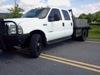
For use on the top side of ShovelheadRob's flat tub, the doohickey would not likely present a problem. But if welding mudflap bracket from the underside of the bed, I would recommend just clamping the work clamp of the welder directly to a cleaned off section of the metal that is being welded, and bypass the intermittent resistance risk of the doohickey.
I started one fire when I forgot to get rid of the solvent soaked rags on the table, by the time I felt the heat it was a pretty good blaze. Fortunately easy to put out, just smoked up the shop real bad. That doesn't count setting yourself on fire, that goes with the territory.
I have the same doohickey, with emphasis on the hickey. Or hiccup.
The thing works okay on a flat surface, such as bigb56's beautiful metal shop table, as long as the welding lead connected to the spring loaded ground post inside the donut hole of the magnet is well supported by the table itself.
But if the cable is draped off the table, then the spring may not be strong enough to keep the base of the ground stud in full and flat contact with the work.
Skinny ground cables and stamped clamps, or light weight cables with an eyelet on the end that is retained to the ground stud by the two nuts provided, are less likely to cause the ground stud base to partially lift or tilt away from the work, as permitted by the spring to the limit of the upside down metal cup height.
But heavy ground cables, with all cast copper ground clamps, and/or vertical or overhead use of the magnetic ground stud, have a greater possibility of tilting or pulling the ground stud base away from the work, creating an air gap that the arc may jump across.
The problem is that air gaps are a very effective means of adding resistance, and since electricity follows the path of least resistance, the current may explore the rest of the vehicle before deciding that jumping the gap is the quickest way home.
I took a photo of the doohickey with the nuts run down to the end of the ground stud, to better reveal the relatively weak spring that is entirely responsible for making and maintaining the base of the ground stud's contact with the work.
Also shown are my Tweco Senior, and Lenco Flat Jaw work clamps... both of which have seriously strong springs... the Lenco on the right in particular. I put heater hose on the end to make it easier for me to squeeze the jaw open, the spring is so strong.
And I took the liberty to annotate bigb56's photo below, to explain the issue with using the doohickey in some (but not all) situations.
For use on the top side of ShovelheadRob's flat tub, the doohickey would not likely present a problem. But if welding mudflap bracket from the underside of the bed, I would recommend just clamping the work clamp of the welder directly to a cleaned off section of the metal that is being welded, and bypass the intermittent resistance risk of the doohickey.
Good point and I'm pretty sure I know how that happened, I sometimes use it on narrow stock and I probably didn't center it on the narrow stock, just stuck it on the edge without thinking about how it works.
I have the same doohickey, with emphasis on the hickey. Or hiccup.
The thing works okay on a flat surface, such as bigb56's beautiful metal shop table, as long as the welding lead connected to the spring loaded ground post inside the donut hole of the magnet is well supported by the table itself.
But if the cable is draped off the table, then the spring may not be strong enough to keep the base of the ground stud in full and flat contact with the work.
Skinny ground cables and stamped clamps, or light weight cables with an eyelet on the end that is retained to the ground stud by the two nuts provided, are less likely to cause the ground stud base to partially lift or tilt away from the work, as permitted by the spring to the limit of the upside down metal cup height.
But heavy ground cables, with all cast copper ground clamps, and/or vertical or overhead use of the magnetic ground stud, have a greater possibility of tilting or pulling the ground stud base away from the work, creating an air gap that the arc may jump across.
The problem is that air gaps are a very effective means of adding resistance, and since electricity follows the path of least resistance, the current may explore the rest of the vehicle before deciding that jumping the gap is the quickest way home.
I took a photo of the doohickey with the nuts run down to the end of the ground stud, to better reveal the relatively weak spring that is entirely responsible for making and maintaining the base of the ground stud's contact with the work.
Also shown are my Tweco Senior, and Lenco Flat Jaw work clamps... both of which have seriously strong springs... the Lenco on the right in particular. I put heater hose on the end to make it easier for me to squeeze the jaw open, the spring is so strong.
And I took the liberty to annotate bigb56's photo below, to explain the issue with using the doohickey in some (but not all) situations.
For use on the top side of ShovelheadRob's flat tub, the doohickey would not likely present a problem. But if welding mudflap bracket from the underside of the bed, I would recommend just clamping the work clamp of the welder directly to a cleaned off section of the metal that is being welded, and bypass the intermittent resistance risk of the doohickey.
I have one of these, but hate it. I bought it because I was cheap, and should have bought
I recently bought one of the magnets for my little 110 volt flux core welder. Sometimes I use it for welding on things that it is hard to get a clamp on, so I thought it would work good to have a magnet so I could just stick the ground to the material. I am not super impressed with its performance so far. It is especially an issue because the welder I am using it with, I am usually welding at lower power levels, so a good ground is extremely critical.
I once learned a valuable lesson, in the name of catching yourself on fire. I had a really nice pair of Carhartt canvas "dungarees", had only worn them a couple of times. I was welding on the side of a dump truck bed, laying down a 30" bead or so on a cracked. My leg was feeling warm. A coworker came in and started yelling at me. I looked down to see my pant leg in flames! Turns out canvas is a terrible material to weld in!
Just a quick update, my anti-zap surge protector arrived in a few days from Amazon, last weekend I got to try it out and welded up the crack. The truck works exactly as it did before so it either worked or wasn't necessary, for the cost I'm happy with the purchase.
While I had the mig out I added a couple of welds to where the bed sides attach to the rear corner posts, one had become detached which was hardly surprising as the other side was only held with a tack....a bit disappointing given the apparent high standard of the rest of the Fontaine conversion.
Talking of which @Y2KW57 I've only just spotted in this picture how far forward the 5th wheel hitch is mounted,
much further forward than the gooseball.
My hitch which clamps to the gooseball pretty much centres on the axle. Why did Fontaine mount the rails so far forward?
Talking of which @Y2KW57 I've only just spotted in this picture how far forward the 5th wheel hitch is mounted,
much further forward than the gooseball.
My hitch which clamps to the gooseball pretty much centres on the axle. Why did Fontaine mount the rails so far forward?
How far is "far forward"?
Can you tell by the photo? (I can't)
Camera lensing at wide angles tends to distort perspective and relative appearance of size between objects that are nearest to the lens, and are thus magnified, versus objects further away from the lens, which are minimized.
As I compare both photos between your photo and the earlier photo that you are comparing, both 5th wheel hitches appear to my eyes to align laterally with the wheel wells more or less comparably.
Camera lensing at wide angles tends to distort perspective and relative appearance of size between objects that are nearest to the lens, and are thus magnified, versus objects further away from the lens, which are minimized.
As I compare both photos between your photo and the earlier photo that you are comparing, both 5th wheel hitches appear to my eyes to align laterally with the wheel wells more or less comparably.
Doh! I've just enlarged your photo, I was tired when I looked & commented, I mistakenly thought that the pieces of timber behind the wheel wells were the wheel wells.........
I recently bought one of the magnets for my little 110 volt flux core welder. Sometimes I use it for welding on things that it is hard to get a clamp on, so I thought it would work good to have a magnet so I could just stick the ground to the material. I am not super impressed with its performance so far. It is especially an issue because the welder I am using it with, I am usually welding at lower power levels, so a good ground is extremely critical.
I once learned a valuable lesson, in the name of catching yourself on fire. I had a really nice pair of Carhartt canvas "dungarees", had only worn them a couple of times. I was welding on the side of a dump truck bed, laying down a 30" bead or so on a cracked. My leg was feeling warm. A coworker came in and started yelling at me. I looked down to see my pant leg in flames! Turns out canvas is a terrible material to weld in!
I'll raise you a flannel shirt. I was 17 when I learned that lesson. Grinding sparks caught the front shirt tales and by the time I realized what happened there where only the top 2 buttons left of the front of my shirt. Luckily I was was wearing a tee underneath so my manly chest hair(singular on purpose) was safe.
This Hennessey Takes the Expedition Tremor's Off-Roading Capability to the Next Level
Slideshow: The VelociRaptor Expedition gains a lift, upgraded suspension, Brembo brakes, and trail-ready equipment while retaining the stock 440-horsepower EcoBoost V6.
Rezvani's Latest Post-Apocalyptic Monster Is a Ford F-150 Raptor Underneath
Slideshow: Called the Fortress, the 850-horsepower pickup combines Raptor underpinnings with military-inspired features, survival equipment, and a starting price of $285,000.