When you click on links to various merchants on this site and make a purchase, this can result in this site earning a commission. Affiliate programs and affiliations include, but are not limited to, the eBay Partner Network.
Well I got the bolts cut and went on to the passenger side. Dreaded ac line fiasco but got the forward spring bolt out. The rear... Idk what's going on. I broke torque on the spring to shackle. The shackle to frame feels like the bolt is rust welded to the bushing and is turning the bushing. The nut is free turning and almost off. The bolt just will not come out. Any ideas?
Probably going to have to get medieval on it. The replacement shackle (see link below) comes with new bolts.
*****. I have a trip next week. This is going to put a damper on me getting the front springs done before the weekend. BTW I'll post photos when I'm done. Trying to keep up with them.
OK I got the replacement shackle today. I attempted to remove the bolt with non destructive means to no avail. I used an air impact, put a wood splitting wedge in between the bolt and the frame and hammered with a sledge and put a couple box wrenches on the end to provide force via the frame to force the bolt to turn.. Nada. All of this after soaking with PB Blaster. Cutting looks like it would be rough with a Sawzall and I don't have a cutting wheel. Is heat the best option? Id have to buy something.
I need this swap complete by the end of the weekend 😬😬
Any help is appreciated!
FYI the reason for all this work is to keep cost low.
Here's what I have with the 2 degree shim.
Side note: the shim isn't flat against the springs but I guess it wouldn't be just seemed odd. Does it compress and conform under the full weight of the vehicle?
Did you put the shim in backwards? I did fat side toward the rear of the truck.
Did you put the shim in backwards? I did fat side toward the rear of the truck.
From what I understand you want to ensure the angles on a non cv axle to be close front and rear. This shim is supposed to essentially point the drive shaft down to make it parallel with forward end of the drive shaft ujoint. To do this fat part forward forces pumpkin down. If I'm mistaken please someone correct me!! Nows the time. First time doing this.
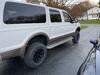
FYI I apologize for not introducing myself. I have 4 kids with a Mazda cx5 and an 87 Toyota pickup. Not optimal to get the entire family out. Long story short, I found the excursion and realized it's the best family vehicle ever made lol. I would have preferred diesel but I don't haul so not worth the extra cash. It came with a "4" lift. Front 03202 bds springs and rear block on top of the stock block... It appears anyway. I'm trying to make it smoother ride so the kids don't rattle their teeth out in their car seats. I figured this pirate pro comp setup is a good base and I can go from there. Any who, it's a big white whale lol hense my callsign. I frequent this forum for accurate and verified information regarding my ford. It'd invaluable. Thanks for all that you guys do.
Last edited by MobyDick!; Nov 18, 2021 at 06:06 PM.
I couldn’t find a clear answer on this when I did mine a couple months ago. I did fat side rear on the front suspension to add caster, and fat side toward the rear on the rear suspension to roll the differential down slightly to keep the driveshaft angle close to it was at stock height. So far, no apparent driveshaft related vibrations, but I’ve seen both ways recommended by different people.
Originally Posted by MobyDick!
From what I understand you want to ensure the angles on a non cv axle to be close front and rear. This shim is supposed to essentially point the drive shaft down to make it parallel with forward end of the drive shaft ujoint. To do this fat part forward forces pumpkin down. If I'm mistaken please someone correct me!! Nows the time. First time doing this.
I couldn’t find a clear answer on this when I did mine a couple months ago. I did fat side rear on the front suspension to add caster, and fat side toward the rear on the rear suspension to roll the differential down slightly to keep the driveshaft angle close to it was at stock height. So far, no apparent driveshaft related vibrations, but I’ve seen both ways recommended by different people.
Which style drive shaft do you have? The regular two u-joint or the double cardan?
The bolded statement above makes no sense. If you put the fat part of the shim towards the rear, then you rolled the differential up , not down.
Here's a pic I pulled off a google image search that may help you better understand.
.
.
.
Finished installing the springs on the rear. All that's left is torque with the weight of the vehicle. Still researching that as I have seen several different methods.
Took me all week working a couple hours at a time when I got home from work.
I needed to go buy 6 ton Jacks as the 3 tons were not even close. Discussing block on top of an aluminum block looks like Still gotta cut the passenger side Ubolts.
I have what I think is the original driveshaft. I did the joints in it prior to doing the lift. One joint on each end with a slip joint nearer to the transfer case.
In my mind, with the fat side of the shim toward the rear of the truck, I would have pointed the pinion/flange of the rear differential down or toward the ground. In looking at this link (https://www.therangerstation.com/tec...onangles.shtml) toward the bottom above the “what have we learned” I see a picture that now leads me to believe fat side toward the rear did in fact point the pinion/flange up.
I’m going to pick up an angle finder and figure out what my angles are before I go through the considerable hassle of flipping the shims around. I only wish I had measured everything prior to the swap.
I saw from another post, that you did the same springs. Did you use shims for the rear axle? Did you check angles by chance? If so, which way did you install them?
Originally Posted by Antonm
Which style drive shaft do you have? The regular two u-joint or the double cardan?
The bolded statement above makes no sense. If you put the fat part of the shim towards the rear, then you rolled the differential up , not down.
Here's a pic I pulled off a google image search that may help you better understand.
.
.
.
I have what I think is the original driveshaft. I did the joints in it prior to doing the lift. One joint on each end with a slip joint nearer to the transfer case.
In my mind, with the fat side of the shim toward the rear of the truck, I would have pointed the pinion/flange of the rear differential down or toward the ground. In looking at this link (https://www.therangerstation.com/tec...onangles.shtml) toward the bottom above the “what have we learned” I see a picture that now leads me to believe fat side toward the rear did in fact point the pinion/flange up.
I’m going to pick up an angle finder and figure out what my angles are before I go through the considerable hassle of flipping the shims around. I only wish I had measured everything prior to the swap.
I saw from another post, that you did the same springs. Did you use shims for the rear axle? Did you check angles by chance? If so, which way did you install them?
Then your mind is working opposite of reality. There is no belief needed, installing the fat part of the shim toward the rear of the truck tilts the pinion angle up. I'm sure if you think about it, and maybe draw some simple pictures on a note pad, you'll come to that understanding.
Yes I used the same springs, but I didn't need the shim at all in the rear because my truck came stock with the double cardan rear drive shaft, so the pinion angle has different requirements.
.
.
.
Rezvani's Latest Post-Apocalytic Monster Is a Ford F-150 Raptor Underneath
Slideshow: Called the Fortress, the 850-horsepower pickup combines Raptor underpinnings with military-inspired features, survival equipment, and a starting price of $285,000.