When you click on links to various merchants on this site and make a purchase, this can result in this site earning a commission. Affiliate programs and affiliations include, but are not limited to, the eBay Partner Network.
Ugh. Was not expecting rust when I opened the master reservoir cap to check the fluid.
I mightyvacc'd it, then mopped up what I could and put in some fresh DOT3.
I don't *have* to drive it right now, planning to order a new master.
1) It's been a while since I owned a vehicle with a cast iron master res. I rather like the plastic ones on the newer vehicles....does anyone know of a plastic/aluminum style master for our trucks?
2) when I flush the system (will plan to replace the 3(?) rubber lines at the wheels/axle, the rear wheel cyls, and do a caliper rebuild kit on the fronts), is there anything else in the plumbing that I should worry about having been contaminated? proportioning valve? (new to me truck, where is that valve?)
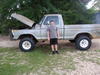
Oh, yes- it's a 77-F150 RWD, and yes, it is a real "J" code (valve cover sneaking into picture)....
thanks!
If you have water clear up into the master, it's a sure bet the rear wheel cylinders are full of rust as well. I see you plan to replace them. You can rebuild them if you like but it depends on your desire for a new hobby I suppose....
Regular brake bleeding in high humidity/low use situations is the key to preventing rust in the master.
Good luck and double check your work at low speeds......
Last edited by 85e150; Oct 4, 2021 at 10:40 PM.
Reason: correction
Your metal lines may need to be replaced as well. If the rear cylinders are full of rust, then the lines are probably rusting from the inside out. Look at a full kit instead of piece by piece.
It it were me, I would just replace the front calipers with new. I bought a kit to rebuild ours, and once we had them off, realized it just wasn't worth the investment of time. If you do go new, paint them before you install. I am still kicking myself for not painting ours.
I appreciate the input. My initial thought was that i could 'blow out' the lines, and that would be good enough for the hard lines.
But it sounds like the bent tubing is now suspect for rust breaches as well? Were the factory lines stainless?
When you replace the lines use the Napa Copper/Nickel lines. They are easy to work with. When you have all the parts it's a day worth of work and well worth it.
FYI: the brake fluid looks like that from water. Brake fluid absorbs water from the air fairly rapidly. Every time you open the master you are contaminating it.. FACT!
Your existing MC has a 1'' bore, but if memory serves me, the only aluminum/plastic ones that would fit, either have proportioning valve fittings on the rear port, or have a shape that is too ugly.
The larger bore won't improve breaking, but you might feel a slightly less firm pedal.
The angle of the reservoir doesn't look too bad when it is installed in the truck.
I think that the existing brake warning light circuit is crap, so the ground wire connected to the existing combination valve can be connected to one side of the reed switch located at the bottom of the plastic reservoir, and a ground wire to ground can be connected to the other side.
The warning light comes on when the fluid level drops to +/- 1/2 level.
The combination valve can be found on a cross member.
I put mine in the bin and used a proportioning valve only on the rear circuit. Surprisingly, this was the best 'upgrade'. (I used a T connection for the front lines.)
In addition to the 3 rear rubber lines, I'd replace the front 2 as well.
Can only tell ya my story, I tried to piece meal my entire brake system and every time i thought it was working well, the pieces that i hadn't replaced failed and connecting 45 year old stuff with new stuff doesnt work well. Eventually I said F it and replaced every component i hadn't already replaced, MC, Booster, LInes, Prop valve, etc....... and only then did my brakes work properly and no leaks..... Old flare fittings are just a pain to seal up, most are pitted and only seal on the line they came off of...I would bet dollars to donuts that your rubber lines are rotted out, my last culprit was the rear frame to axle line, its hiding up there and out of sight out of mind, it was my last leak... In-line tube makes a kit for your truck and you can get everything else pretty easily.....
If you plan on forming the lines yourself, Ni-Cop. Stainless is hard to flare, even harder than regular steel.. I would only use a pre-formed kit if you want to use stainless. To make bleeding easier there are bleeder screws designed with a check valve that will allow you single person bleeding.
You being in the valley doesn't help your moisture problem. The lines may be rusting internally, but to really check the integrity of the system, just press on the pedal as hard as you can, (two foot it). If the pedal sinks, you have a problem. You could burst a metal line or hose that is compromised that way, just find a slow leak, or bypassing master cylinder.
the ground wire connected to the existing combination valve can be connected to one side of the reed switch located at the bottom of the plastic reservoir, and a ground wire to ground can be connected to the other side.
Sorry, I'm talking crap, and basing that comment on my own customized wiring/gauges/warning lights.
If you do wire up the reed valve switch, the two existing wires to the combination valve would be used, and those are not ground wires.
Sorry, I'm talking crap, and basing that comment on my own customized wiring/gauges/warning lights.
If you do wire up the reed valve switch, the two existing wires to the combination valve would be used, and those are not ground wires.
No worries, I'd probably leave the warning on the combi valve. But if I do go down the route of replacing everything, then I'm replacing the combi valve as well (actually, this seems prudent on a 45 yo vehicle anyway, as I don't believe they are serviceable?) and so I'll likely be adapting to the Master Power (brand--I know there is another thread with a disc/disc conversion talking about how to wire the switch) switch or something similar.
________________
Originally Posted by jakeharp
Can only tell ya my story, I tried to piece meal my entire brake system and every time i thought it was working well, the pieces that i hadn't replaced failed and connecting 45 year old stuff with new stuff doesnt work well. Eventually I said F it and replaced every component i hadn't already replaced, MC, Booster, LInes, Prop valve, etc....... and only then did my brakes work properly and no leaks..... Old flare fittings are just a pain to seal up, most are pitted and only seal on the line they came off of...I would bet dollars to donuts that your rubber lines are rotted out, my last culprit was the rear frame to axle line, its hiding up there and out of sight out of mind, it was my last leak... In-line tube makes a kit for your truck and you can get everything else pretty easily.....
Yeah definitely replacing rubber flex lines, as in my experience, those rupture/leak first. But I understand the integrity of the hard lines is suspect too. I'll try and find this inline tube you refer to (exploring options, might go self-fab, haven't fully decided yet...) when you bring up pitting (I hadn't previously thought about that) I'm assuming pitting at the combi valve is an issue as well?
________________
Originally Posted by 54Hydro
If you plan on forming the lines yourself, Ni-Cop. Stainless is hard to flare, even harder than regular steel.. I would only use a pre-formed kit if you want to use stainless. To make bleeding easier there are bleeder screws designed with a check valve that will allow you single person bleeding.
You being in the valley doesn't help your moisture problem. The lines may be rusting internally, but to really check the integrity of the system, just press on the pedal as hard as you can, (two foot it). If the pedal sinks, you have a problem. You could burst a metal line or hose that is compromised that way, just find a slow leak, or bypassing master cylinder.
Hey, there-
Yep, not as dry here as out East where you are. This truck spent it's life in/around seattle, so even wetter!
I sure like the ductile properties of the Ni-Cop if I make the lines myself.
I guess some remaining questions I have (to you or others who have done this):
because the tubing is more flexible, does it ever fell like a spongy-er pedal vs. stainless?
how does the ni-cop age? thoughts after 5-years? 10?
ultraranger used to post his swap using a late 90's Explorer master cylinder. It has metric fittings, so you'll have to create your own lines with metric and then standard nuts.
You can search his posts for the part numbers used.
I did this swap to my 74 F350 dually. https://www.ford-trucks.com/forums/1...l#post18056389
Rezvani's Latest Post-Apocalyptic Monster Is a Ford F-150 Raptor Underneath
Slideshow: Called the Fortress, the 850-horsepower pickup combines Raptor underpinnings with military-inspired features, survival equipment, and a starting price of $285,000.