When you click on links to various merchants on this site and make a purchase, this can result in this site earning a commission. Affiliate programs and affiliations include, but are not limited to, the eBay Partner Network.
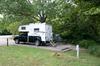
2020 F350 SRW with an AF 865. It sits on a rubber bed mat only. I have been on some rough roads, enough to actually feel like maybe the camper bounced pretty good, it has never hit. About 1-1 1/2" clearance at the antennas.
That is one beautiful setup right there.I think it needs saying that the clearance required will be based on the make of your camper too. For instance the Artic Fox above is a fantastically designed, engineered and aluminum tube constructed camper, it will be very rigid and less apt to flex down and strike your cab IMHO.
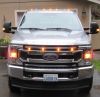
Well, just measured my new 2021 f350 CC/LB. From a rib in the bed to the top of the antenna (the highest point on the roof) is 46.5"
My new NL 10.2, bottom of camper to bottom of cabover is 46" so I'm at a deficit of a 1/2" right out the gate. Gonna take more then the 3/4 stall mat, 3/4 ply, and truck bed mat I'd had planned on, to get my minimum 3" over the antenna.
I think a sandwich of 1.5" structural foam board glued between two 1/2" sheets of Baltic Birch ply is going to be the way to go. Stall mat under that, truck bed mat on top. Solid, but lighter than making a torsion box or 2x4 grid frame. Make it in two 4'x4' sections for easier wrestling and storage. Maybe drill a grid of 1.5" holes to reduce the weight further.
Loaded my camper the other day for the 1st time in a year and a half due to COVID and mine measures 3" at the center of the roof with just the Ford rubber bed mat.
It probably depends on your vehicle and driving style. If you're doing Rubicon 5" if doing fs roads let your conscious be your guide.
I'd start with a tape measure.
I'm in the middle of mounting our old truck camper (2006 Northstar TC800 pop-up) on the new truck (2022 F350 CCLB). I made a riser using 2" high compressive strength foam board (25 psi / sq in) and a sheet of 19/32" plywood, all screwed to the underside of the camper. There is also an old Deezee bed mat in the bed, which I kept from the old truck (around 1/4-3/8").
I loaded the camper into the bed today, and measuring clearance over the cab, there is a little bit more than 1 1/2" clearance (maybe 1 5/8") from the closest point on the cab roof to the underside of the cabover. Cab does not have clearance lights.
Thanks. If I can keep it close/tight to the cab, that'll help for center of gravity, etc - I just want to avoid the cabover slapping the roof on rough roads, dirt roads harsh bumps, that kind of thing.
I am sure suspension differences play a role, but if not for lights, we would have been fine at 1 1/2" of clearance.
Do you have a 2017+ truck? I have read that the current ones have much stiffer frames than the 2016 and earlier generations, due to being boxed the whole way. Our old GMC had C channel frame under the bed, and frame flex was noticeable in offroad driving (cab/body twist was visible).
It's not only the rough roads, but dips in the pavement as well. Even more so on the highway as you're adding more speed. I think an 1.5" ain't much, but that's me. I can understand your wanting to keep it as low as possible. At least if you do get a slap, it's hitting the wider flat roof, which presumably has some give. Rather then a small point of impact like a light or antenna.
Also keep in mind flex, if any, of the tiedowns as well as any give from your turnbuckles if they are the sprung type like Fastguns.
Like I said, I wanted about 3", just to be sure.
I guess this is where a gopro type cam would come in handy to have it film the gap as you travel various roads and speeds to see what it's actually doing, flex wise.
Do you have a 2017+ truck? I have read that the current ones have much stiffer frames than the 2016 and earlier generations, due to being boxed the whole way. Our old GMC had C channel frame under the bed, and frame flex was noticeable in offroad driving (cab/body twist was visible).
Our F350 is a 2012 model so no boxed frame. We started out with only about 3/4" and even then we only hit on really big pavement breaks. As I said, I am sure there will be variances in suspensions systems and truck campers in terms of how they ride. If you run an Internet search you will find some folks run a great deal of clearance and some almost none. I am sure others will post on this.
Thanks all - I think we'll try it out with the smaller clearance and see what happens. Neighbor said he used to put a bicycle inner tube between the cab and cabover on his old truck, and it helped prevent slap. I'll bring with a pump + tube for the shakedown drive, as that'll be easy to stuff in there if needed.
For tie-downs, I installed Torklift frame mounts, but kept the Happijac spring loaded tie-downs from the old truck. I bought threaded rod and couplers to extend the Happijac tie downs longer to reach the Torklift brackets. I need to move the driver's side tie down from the camper attachment to the jack bracket, because the gas door is blocked as it currently is. I'll use a trailer chain quick link for that. (I remove the jacks anyway while the camper is on the truck, to save the weight and get more ground clearance.)
Update: bouncing on the roof of the cabover (like pull-ups on the edge), the cabover section flexes more than I am comfortable with. I also measured more closely on the minimum cab to cabover clearance - it's 1.5" at closest.
I'm going to add more riser under the plywood. Heading to Home Depot for three 2x4x8, which I'll turn into six 46" cross pieces spaced underneath the plywood. That'll give another 1.5" of cab clearance, and I should be set.
I kind of wish I'd just planned to build a 4" riser from the start, and built in some storage. Oh well. At this point, I just want to be done with messing with it.
The actual height of the cab over bottom has slight variation over different manufacturers.
The cab clearance on our 2020 F-350 is about 3-1/2" above the pair of XM radio antennas. This is using 4" blue foam board with the 25 pounds per sq. in. non-compressibility. This is made to insulate under sidewalks so it can take a good loading.
I also cut and glued blocks of foam to the underside, inside the box framing. This gives us an insulation rating of R-40 in the floor ( R-20x2).
After trying different heights, and testing the movement of the camper vis a vis the cab I now think we could get it even closer to nirvana with a sandwich of 2" block of high test foam board; 3/8ths indoor/outdoor plywood over that with the Factory Ford bed mat on top.
The plywood will distribute the loading more evenly over the whole foam block. Having the foam 1st in the bed will be anchored with the weight of the camper pressing down and causing a slight conformity to the pattern of the bed floor like a lock.
One admonition about the foam. It's not wide enough to have a competent edge for the camper frame. A good idea is to split the foam the long way and the plywood to fit snugly against the fender wells. Put some kind of spacer in between.
Some on here cut it into 2 blocks; fore and aft and fill the entire bed. This locks in at least the front block.
Remember on newer 6-3/4 foot bed Fords to save your tail lights by having a front bumper of at least 2 inches.
Since our Northstar's water tank drain goes right through the floor, I cut a funnel shaped hole in the foam where the 1/2" drain hose peeks through. I don't want standing water next to pine camper framing.
You can get creative and supply some (maybe ripped) 2x4 or 2x6 guides against the fender wells to keep the camper from sliding from side to side. Sliding around puts undue pressure on the tiedowns, which, over time is not a good idea.
With the bottom controlled, you can use a bit less tie down tension.
We'd lose some R-value, but the package would be more compact and only slightly heavier.
However, the set up is working out fine, so we'll let sleeping dogs lay. Champfered water drain and foam front bumper to save your truck's tail lights. The foam is notched near the fender wells to keep them in place.
Thanks all - I think we'll try it out with the smaller clearance and see what happens. Neighbor said he used to put a bicycle inner tube between the cab and cabover on his old truck, and it helped prevent slap. I'll bring with a pump + tube for the shakedown drive, as that'll be easy to stuff in there if needed.
For tie-downs, I installed Torklift frame mounts, but kept the Happijac spring loaded tie-downs from the old truck. I bought threaded rod and couplers to extend the Happijac tie downs longer to reach the Torklift brackets. I need to move the driver's side tie down from the camper attachment to the jack bracket, because the gas door is blocked as it currently is. I'll use a trailer chain quick link for that. (I remove the jacks anyway while the camper is on the truck, to save the weight and get more ground clearance.)
And if by "old truck" your neighbour meant the days of thick steel, one can't necessarily carry over the ol' tricks with new trucks. Guys also used to do it for aerodynamic improvement......
This Hennessey Takes the Expedition Tremor's Off-Roading Capability to the Next Level
Slideshow: The VelociRaptor Expedition gains a lift, upgraded suspension, Brembo brakes, and trail-ready equipment while retaining the stock 440-horsepower EcoBoost V6.
Rezvani's Latest Post-Apocalyptic Monster Is a Ford F-150 Raptor Underneath
Slideshow: Called the Fortress, the 850-horsepower pickup combines Raptor underpinnings with military-inspired features, survival equipment, and a starting price of $285,000.