When you click on links to various merchants on this site and make a purchase, this can result in this site earning a commission. Affiliate programs and affiliations include, but are not limited to, the eBay Partner Network.
This topic is partly related to Ford SD Trucks.
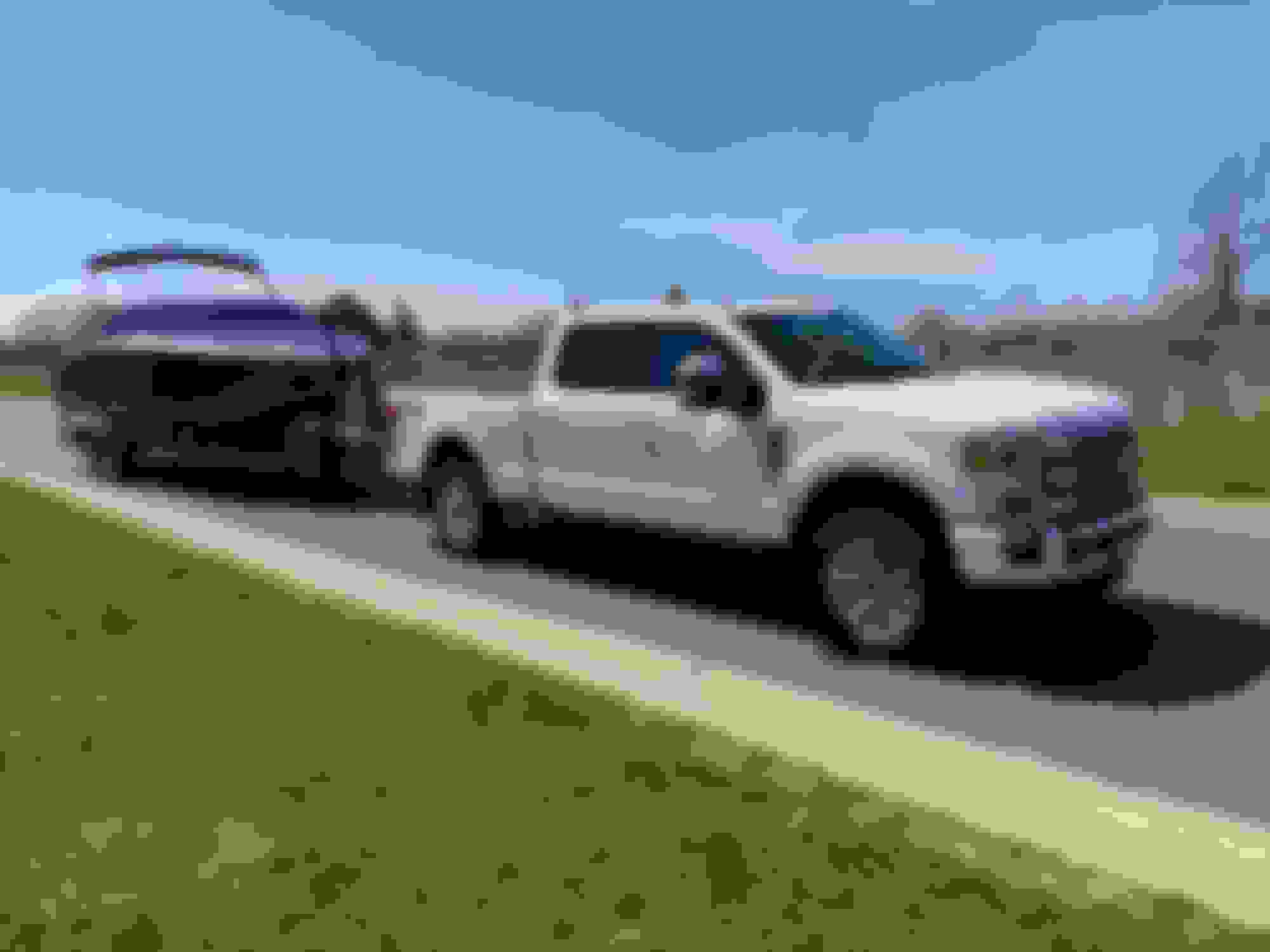
I have a 2020 F350 SD 6.7 CCSB, with the 5er and Gooseneck tow packages. One of the reasons I bought the truck was that I plan on towing a trailer with my restored Case 580C Loader Backhoe as well as other heavy loads below 10 thousand pounds- mostly flat sheets of steel and steel plate . The Case tractor weighs about 13 thousand pounds. all other loads will be much less weight.
My original plan was to buy a Gooseneck equipment trailer so the pin weight would be right over the rear axle. It sounded logically a much safer set up. After looking at a few trailers I began to wonder about the stresses that would be induced on the entire Gooseneck frame by that much weight causing flexing. I realize that many commercial operators run this set up without issues using a trailers that have a much greater weight rating than then class I am looking at. I am not a commercial operator and was looking at a 20 foot low bed.
My questions are probably more geared to those who tow heavy equipment. I have towed many trailers- Travel Trailers, Flat beds, Cargo, Horse and Boats using standard rear hitches. I am looking for some constructive opinions on a Gooseneck setups vs. a standard rear hitch, since a Gooseneck will be a completely new experience for me
A gooseneck tows nicer than a conventional hitch trailer. My preference would definitely be a gooseneck for your application. I'm not really understanding your concern. The heavier the load you're wanting to tow the greater the advantage is to going to a gooseneck.
Gooseneck equipment trailer for that weight and load, with suitable GVW trailer is definitely the way to go for a safe, easy towing experience. Your looking at a total weight of 480C and trailer in the range of 16,000 lb GVW.Google says base weight of the 480C is 11,777 lbs. and you really need to know how to load on and off a trailer, chain it down, and also if your hauling flat steel of significant weight how to tie it down properly.
You will want a dovetail gooseneck where the axles sit a little bit more forward. They weigh around 5,000.
Could be upwards of 18-20k with the trailer. Not a lot of info on that machine google searching but it was noted what someone found above.
You may need a CDL if not private or farm use. May be able to get the trailer in 14,000 gvwr and stay below 26k combined if you do not need that much registered.
Yep, the OP is likely going to have trouble with a single rear wheel F350 GVW limited of the truck, trailer, and GCWR and it’s likely the only way it will work is a gooseneck hitch with at least a 15,000 GVW. So close on limited that won’t be carrying extra buckets or a pail of oil. Depending on your state, yes, commercial endorsements or special insurance and tags are likely. The way we get around this in Canada is farm plates, special insurance and my brother has a class 1 licence which includes all the endorsements.
I would get a trailer with 7k axles at 14,000 gvwr instead of the standard 15,900 they come with to stay out of CDL in his 11,500 truck. You can probably also do this with 8k axles.
If he is in California (and a few other states) that is a different subject.
In Tx there is little benefit to farm plates unless you intend to actually use them and also be over 26,000 (the license change is much simplified).
He can also forget a toolbox or any significant cargo in the truck pulling this, its heavy but I’ve done similar in mine same as his but f250.
How about we keep the CDL crap out of this thread? OP asked nothing about it. I'd rather not see a 10-page argument about CDL laws for every state and Canada.
Having pulled both and then some, gooseneck. Weight is better distributed on the tow vehicle. I think a gooseneck is easier and more relaxing to tow with as well.
I tow a bunch of trailers depending on what I need to move. Except for the big box, I’m usually under 10k.
All are bumper pull because it’s a simple and easy hook up. For the heaviest loads in the box, I use a weight distribution hitch, and the truck pulls them safely and with ease.
It works perfect for me. I’ve never towed a goose, and never felt a bumper pull load that was anything other than perfect handling and smooth.
Heavier loads? I would consider a goose because of better frame load, but under 10K it won’t be a factor. IMO, it doesn’t seem like your tractor would be considered heavy.
My take on heavy towing .. 5 Axle tractor trailers use a 5th wheel hitch for safety and convenience ..
A goose neck hitch offers the same thing !! Weight distribution, resistance to wind push from traffic
going the other way .. All around better system !!
My take on heavy towing .. 5 Axle tractor trailers use a 5th wheel hitch for safety and convenience ..
A goose neck hitch offers the same thing !! Weight distribution, resistance to wind push from traffic
going the other way .. All around better system !!
Agree, a 5th wheel is a better system when towing very heavy. Overkill and unnecessary junk in the box when towing 10-12K.
5 axle tractor trailers use a 5th wheel because they are universal, and coupler loading up to 34,400 lbs on the rear axles won’t support heavy weight unless spread out over the slide plate. The 30+ inches of contact on the slide plate also offers stability. There is no weight distribution to a fifth wheel, simply weight over the axle.
Weight distribution hitches actually offer more rear spring torque when you snap them up. The ride however, sucks.
A gooseneck tows nicer than a conventional hitch trailer. My preference would definitely be a gooseneck for your application. I'm not really understanding your concern. The heavier the load you're wanting to tow the greater the advantage is to going to a gooseneck.
One concern was that there is flexing of the Gooseneck part of the trailer that could lead to cracking. Long time ago a friend told me he could feel the upside down “U” shape of the Gooseneck flex when stopping and accelerating from a stop.
Gooseneck equipment trailer for that weight and load, with suitable GVW trailer is definitely the way to go for a safe, easy towing experience. Your looking at a total weight of 480C and trailer in the range of 16,000 lb GVW. Google says base weight of the 480C is 11,777 lbs. and you really need to know how to load on and off a trailer, chain it down, and also if your hauling flat steel of significant weight how to tie it down properly.
Yep, the OP is likely going to have trouble with a single rear wheel F350 GVW limited of the truck, trailer, and GCWR and it’s likely the only way it will work is a gooseneck hitch with at least a 15,000 GVW. So close on limited that won’t be carrying extra buckets or a pail of oil. Depending on your state, yes, commercial endorsements or special insurance and tags are likely. The way we get around this in Canada is farm plates, special insurance and my brother has a class 1 license which includes all the endorsements.
I am confident of the tractor weight with the backhoe being close to 13K. I have the Extendahoe and larger bucket version plus the ROPS cage. The trailer I am considering has a 17k GVW, so I should have a bit of spare change to play with.
The SRW standard hitch at my weight was a concern. I neglected to mention in the original post that as far as long distance towing, it will be a one time tow of less than 1000 miles from SoCal to Southwest Oregon. I do have 3 buckets and a Case Box Scraper, but they will be transported on a different run up north. I had the tractor for many years, just completed a complete restore and only use the tractor around my property. It will be used the same way in Oregon.
I have a lot of oil drilling pipe left over from fencing that will need to be hauled up also, so I think in the long run a Gooseneck is the best choice. It is more versatile and will leave to door open to more future options. As I said, I want to avoid the CDL aspect of this. So if I keep the weight at minimum, don’t haul the extra buckets at the same time and the fact I just repainted the tractor- I am hoping I won’t look like a commercial operator and draw less attention for the first 750 miles.
Thank you to everyone who gave their comments and opinions. It was very helpful.
How about we keep the CDL crap out of this thread? OP asked nothing about it. I'd rather not see a 10-page argument about CDL laws for every state and Canada.
OP asked about GN trailers and towing heavy.
Those are federal laws so its worth mentioning.
Its should be one of the main deciding factors.
As seen discussion about location should prompt the OP into giving more detail if he wants a valid response on what trailer type.
In my area if you are over 26k registered and not properly licensed they will ticket you and/or make you have someone come get to get your load.
My original plan was to buy a Gooseneck equipment trailer so the pin weight would be right over the rear axle. It sounded logically a much safer set up. After looking at a few trailers I began to wonder about the stresses that would be induced on the entire Gooseneck frame by that much weight causing flexing.
Originally Posted by smikesF350
One concern was that there is flexing of the Gooseneck part of the trailer that could lead to cracking. Long time ago a friend told me he could feel the upside down “U” shape of the Gooseneck flex when stopping and accelerating from a stop.
Your concerns about the "flexing" and "stresses" on the "upside down U shape" of the gooseneck trailer can be resolved in the selection of the brand of gooseneck trailer that you end up purchasing.
Some brands of gooseneck trailers are built to sell. Other brands are built to last.
Yet other brands build both types... cheap ones that sell quickly because they appear to the new buyer's eyes as offering a better "value" as they are more affordably attainable than other models of equivalent deck length... and more expensive ones in the same deck length and GVW class that seem astronomical in price, but are constructed with features like torque tubes, high strength low alloy steel, more engineering sophistication in the neck geometry, etc.
The fact remains that with a conventional bumper pull trailer, the tongue weight is cantilevered 5 feet behind the support point where the rear axle contacts the ground. And with the gooseneck, the tongue weight is supported directly above, or an inch ahead of where the support point where the rear axle engages the ground. Your initial instinct on wanting that weight directly supported over the rear axle is a valid voice to listen to. Resolve your concerns about the goosneck construction by selecting a GOOD gooseneck trailer, not by price, but by reputation of quality, and by construction details in the specifications, and by reading candid reviews on hotshotter and farming forums.
As to your purpose... moving from SoCal to SoOr... if that move is one time, and permanent, then I advise that you turn in your CA license, get an OR license, and register your vehicles in OR first before you make the move. Also, since there is no sales tax in OR, you might want to purchase your trailer in OR, perhaps on the same trip when you established DMV residency, vehicle registration, and driver's license in OR, in order to reduce the number of trips and save time and fuel. Bring the empty trailer back to CA, and wait for your plates to come in the mail, forwarded to your CA address by a service or neighbor at your OR residence.
This way, when you make your multiple loaded trips of your big move, you will do so as an OR resident just passing through, operating under OR licensing law under state reciprocity. It is assumed that OR law is more lenient than CA law, even while Federal DOT law prevails regardless. But the purpose of changing state of principle residence is actually psychological warfare against the CHP officer on the side of the road. He/she will be confident (typically over confident) in their professed knowledge of the CA Vehicle Code, and will have access on their computer to look anything up they don't know. But they will not be so confident with out of state laws, and where it boils down to a judgement call by the officer on the side of the road to make you park it and call in a properly licensed driver, or let you go... they will likely let you go on good faith.
It will also help that you show evidence of the CA address that you are moving from, so that it is clear that the purpose of your trip isn't commercial or compensated. You are moving your own property. (Carry the title to any tractor that you haul, showing your name on the title).
This is all really important. In CA, officers on the side of the road will simply add the GVWR of your truck plus the GVWR of your trailer. If your truck's GVWR is 10,000 lbs GVWR, and the trailer you are considering purchasing is 17,000 GVWR, then it doesn't matter if that trailer is empty... you'll be leaving that rig on the side of the road until a properly licensed driver can come collect it for you.
Any trailer built sturdily enough to carry a 13,000 Case 580C backhoe will likely weigh at least 4,500 lbs empty, unless you get an aluminum deck ($$$$$), so shopping for a 17K GVWR trailer is not an unreasonable choice. It is simply an unlawful option to tow for holders of regular Class C driver's licenses. Some work around include having the trailer dealer you purchase the trailer from request a derated sticker from the trailer manufacturer. Many a trailer sold in CA is rated to 9,990 lbs GVWR on the sticker, while built identical to a 14K GVWR in actuality, which includes the axles and tires.
Restickering has the advantage of addressing the two different type of cops on the side of the road... those who merely add up GVWRS are satisfied that you are "under" the legal limit... and the smarter cops who actually know a thing or two about transportation safety, and look at the individual ratings of your tires and axles, and compare them to the actual weights they measured from the portable scale that they called in where they stopped you, or the weigh station they dragged you to... may be satisfied... because those guys know the sticker game, and actually care whether or not you are operating safely, and it could be that your actual weight is under the 26K limit, while your axle and tire weights are not exceeded.
You are right on the line... so any advantage you can squeeze from the timing and choices you make at this juncture might make the difference. And the funny thing is, they might not matter at all if you make the one time trip in the middle of the night and are never stopped. The problem is, what if you are. Or what if someone runs into you. Are you prepared. And that is why you are here, asking questions. To be prepared.
Your truck is similar to mine. Mine is right under 8,000lbs in weight. My 14k axle 25+5’ dovetail Big Tex dove tail I believe is 5400lbs in weight. If you can get by with a 20+5’ dovetail it should be right under 5000lbs (look it up).
Add in your 13,000 load to that to guestimate gross.
Research your state laws on licensing and registration. Check Oregon registration I think they go per 2,000 lbs so you would register for 14,000-16,000.
If your truck is 11,500 or 11,400 gvwr see if the trailer dealer will tag your trailer GVWR for 14,000 or 14,500. That will keep you under 26,000 if needed.
As far as gooseneck VS conventional your hitch probably is only good to 15,000 conventional which wont work. The downsides to a GN is the trailer tracks differently so you cant take sharp turns and you cant flex off road or you will hit your bed. I had to lift my trailer so I could get it level and clear the bed comfortably; you can also raise the neck.
This Hennessey Takes the Expedition Tremor's Off-Roading Capability to the Next Level
Slideshow: The VelociRaptor Expedition gains a lift, upgraded suspension, Brembo brakes, and trail-ready equipment while retaining the stock 440-horsepower EcoBoost V6.
Rezvani's Latest Post-Apocalyptic Monster Is a Ford F-150 Raptor Underneath
Slideshow: Called the Fortress, the 850-horsepower pickup combines Raptor underpinnings with military-inspired features, survival equipment, and a starting price of $285,000.