When you click on links to various merchants on this site and make a purchase, this can result in this site earning a commission. Affiliate programs and affiliations include, but are not limited to, the eBay Partner Network.
Anyone have experience with how far away you can mount the trailer TPMS module from the axles? I have a 40' gooseneck with triple axles and am wanting to mount the module underneath the gooseneck area and run the wire to the in-bed 12 pin plug. I guess I can test and do some trial and error, but would rather not play guessing games if I can avoid it.
In the instructions it states you can mount the module in a tag trailer a-frame, so I assume this "might" work. Distance to the rear axle is probably the only real concern.
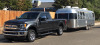
I was a little suspect of the signal strength on our trailer (Airstream), due to the belly pan of full aluminum. I was unsure if the signal would travel through that much metal, sometimes cell coverage is not that great inside. I mounted the module on the belly pan, closer to our axles. I was able to 'hide' it behind a sewer hose holder to try to protect it from any road debris.
Personally, I would mount it as close to the axles as possible. Let the wiring included carry the signal as much as it can. Perhaps some 'protection' of the module if you don't have a place to hide it also?
It isn't so much protecting the module, but running the wires to truck without it looking terrible. I would rather not have exposed wire visible if possible (same reason I won't use the Ford trailer camera). My thought was to mount it in the frame under the riser, behind the hitch, out of sight and out of mind. Just not sure I have enough range from that location. I might try it with zip ties, or something to loosely mount it and see if the rear axle sensors pick up.
Yes, probably some empirical testing would be good. Any thoughts of routing it into your storage area and getting closer to the axles that way? It would have to then get its signal through the floor instead of a lot of metal from the gooseneck. Let us know how to goes!
I had to mount mine as close to the axles as possible, probably 5’ forward of. Learned after all the install that instructions warned against steel carcass tires, which I think I have. Was hard to get to initialize. Works most of the time but periodically has a cool-hand Luke moment. This on my 40’ Redwood 5th wheel.
If you have tpms tool it should activate the senors easily. My system works great always .after the trailer sits awhile takes about 50ft or so to wake sensors
Last edited by FDNYL136; Feb 23, 2021 at 08:58 AM.
Reason: Pic
I had the same question when I installed my TPMS sensors in my tires. I have a 40ft fifth wheel and before trying to install, I just plugged the TPMS monitor in while laying in the bed of the truck. It picked the sensors up perfectly during a quick weekend getaway a couple weeks ago. I did not measure the distance but know I can place it all the way forward if needed. Now I am comfortable mounting it anywhere on my trailer once the weather gets better. I am sure I will place it as close to the axles as possibly allowed by cable length and mounting location.
I had the same question when I installed my TPMS sensors in my tires. I have a 40ft fifth wheel and before trying to install, I just plugged the TPMS monitor in while laying in the bed of the truck. It picked the sensors up perfectly during a quick weekend getaway a couple weeks ago. I did not measure the distance but know I can place it all the way forward if needed. Now I am comfortable mounting it anywhere on my trailer once the weather gets better. I am sure I will place it as close to the axles as possibly allowed by cable length and mounting location.
Thank you! That was exactly what I planned to do as well. If it works in the bed, reliably, I even considered just leaving it back there but wasn't sure it would actually work. I think that answers my questions, although I still plan to test it to be sure.
I would definitely put mine in the bed and store it in the camper or truck when not in use except that I need to tie into the cable with my camera feed closer to the back of the camper when I actaully install everything on the camper. On my trial trip I just zip tied the sensor to the bed tiedown in the corner under the plug.
Just an update.... I left the harness in the bed and drove from Atlanta to Austin, TX, and then back. I had only a single instance where a center tire disconnected for about 45 seconds, and the truck alerted me to the error. I was just about to pull off an exit when it came back online, otherwise the sensors connected and reported perfectly. This works for me and solves so many headaches of trying to mount this module and harness on the trailer.
This won't work for everyone, particularly those using the rear camera system, but worked great for me. Also, the Furrion Vision S 7" wireless camera also worked fantastic on my 40' gooseneck, and allowed me to keep an eye on traffic behind me.
Just an update.... I left the harness in the bed and drove from Atlanta to Austin, TX, and then back. I had only a single instance where a center tire disconnected for about 45 seconds, and the truck alerted me to the error. I was just about to pull off an exit when it came back online, otherwise the sensors connected and reported perfectly. This works for me and solves so many headaches of trying to mount this module and harness on the trailer.
This won't work for everyone, particularly those using the rear camera system, but worked great for me. Also, the Furrion Vision S 7" wireless camera also worked fantastic on my 40' gooseneck, and allowed me to keep an eye on traffic behind me.
Thanks for the info. I'm going to try to mount my TPMS sensor on the face of the trailer hitch crossbar under the rear bumper. I'm not using the Ford camera since I have the Furrion wireless. I am going to use the yaw sensor for the backup assist with the 5th wheel. Mainly because the backup assist feature was included with the truck and I really want to check it out
This Hennessey Takes the Expedition Tremor's Off-Roading Capability to the Next Level
Slideshow: The VelociRaptor Expedition gains a lift, upgraded suspension, Brembo brakes, and trail-ready equipment while retaining the stock 440-horsepower EcoBoost V6.
Rezvani's Latest Post-Apocalyptic Monster Is a Ford F-150 Raptor Underneath
Slideshow: Called the Fortress, the 850-horsepower pickup combines Raptor underpinnings with military-inspired features, survival equipment, and a starting price of $285,000.