When you click on links to various merchants on this site and make a purchase, this can result in this site earning a commission. Affiliate programs and affiliations include, but are not limited to, the eBay Partner Network.
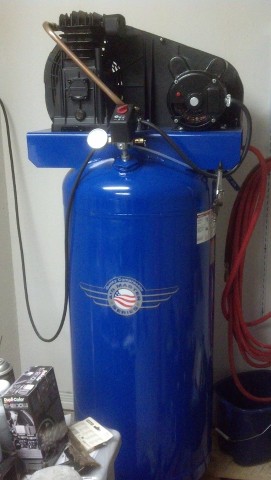
I'm guessing this compressor would run on 220/240 VAC single phase power? Will your compressor be permanently mounted or movable as needed? The only real concern in not hard wiring it in place would be using properly sized wiring and plugs/receptacles of top quality if you opt to use a "portable" cord and plug.
The welder or any other 60 amp connector should be just fine for this application. Read your motor plate for the amp draw on the existing electrical configuration---it shouldn't exceed 25 amps at 220/240 VAC.
I'm guessing this compressor would run on 220/240 VAC single phase power? Will your compressor be permanently mounted or movable as needed? The only real concern in not hard wiring it in place would be using properly sized wiring and plugs/receptacles of top quality if you opt to use a "portable" cord and plug.
The welder or any other 60 amp connector should be just fine for this application. Read your motor plate for the amp draw on the existing electrical configuration---it shouldn't exceed 25 amps at 220/240 VAC.
Exactly! I assumed a 110V, that's why I asked what voltage.
5hp should not draw any more current that a 12 wire should not be able to handle, although post the specs of what it says it needs and I can walk you thru it, overall simple process 110 or 220.
I wired up a clothes dryer pigtail to mine so I could disconnect when ever. Ran the wires thru the wall of the laundry room that eats up space in my garage.
Single phase 240 just like the dryer. Works great and is semi permanent. Just plug in the machine required for use.
I wired up a clothes dryer pigtail to mine so I could disconnect when ever. Ran the wires thru the wall of the laundry room that eats up space in my garage.
Single phase 240 just like the dryer. Works great and is semi permanent. Just plug in the machine required for use.
I did that exact same thing when temporarily wiring a Delta Unisaw running on 220 VAC at less than 15 amps. I used a 14 gauge 3-conductor extension cord with the dryer connector on one end, another household incompatible connectors feeding the table saw. Didn't want my 120 VAC tools running on 220!
I'm a bit late to this thread. Hard wire it. The plug and receptacle is not rated for a motor. Motors have high startup current.
I would recommend MC cable or flex. SO cable would be fine to.
How do you think dryers move? Same deal. As long as the rated current/wattage is similar, it'll be fine. The average circuit breaker has no problem with inrush current as it is fractions of a second. If all else fails, check the temperature derating chart for the breaker in question.
Dryer motors are much smaller than compressor motors. Circuit breakers are built to hand FLA. Plug and receptacles are not.
A rule of thumb. If a compressor doesn't have wheels it should be hard wired. How often do you need to move an 80 gallon compressor to justify a plug and receptacle? There are no advantages to plugging it in.
You're mistaken about that. The advantage is not having to hire you to do the job. I took electricity/electronics in college and I know enough to be able to DIY on something so simple. I've had my compressor set up this way for years without issue. The other advantage is being able to use different machines with the same receptacle.
It's cheaper and easier to hardwire it. 3 wire nuts is cheaper than a plug and receptacle.
Not when your compressor is in the garage at the front of the house and the service panel is at the back. You have to add up the cost of the wiring and the conduit. Most modern homes will already have the receptacle installed so all you need is the pigtail which costs less than $20 and what's easier, mounting conduit to run the wiring thru then disassembly of the breaker panel to access the buss or simply plug it in?
Rezvani's Latest Post-Apocalyptic Monster Is a Ford F-150 Raptor Underneath
Slideshow: Called the Fortress, the 850-horsepower pickup combines Raptor underpinnings with military-inspired features, survival equipment, and a starting price of $285,000.