When you click on links to various merchants on this site and make a purchase, this can result in this site earning a commission. Affiliate programs and affiliations include, but are not limited to, the eBay Partner Network.
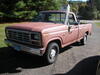
1) What's the big black box aft of the battery? I see a Ford oval on the front, so it's not aftermarket.
2) Do you keep a pair of comfortable walking shoes in the cab? You're going to need them when (not if) that 'emergency' battery terminal (on the negative cable) leaves you stranded. Definitely don't be knocking over any liquor stores unless you leave the engine running...
The starter with no solenoid is the one that showed up for the 400 but the starter with the solenoid is the one that I had and they said that belonged to 75 460 this truck started a couple of times so I know what the truck had kind of worked. from the battery, the positive terminal goes to the solenoid on the fender and then out of the other terminal goes down to the solenoid on the starter then my negative terminal has a cable that goes straight down and goes the starter through one of the mounting bolts. that doesn't sound right to me. I need to know if the starter with no solenoid would have a spot for both cables. because I'm pretty sure that solenoid on the fender is the only one supposed to be there.
The starting system is pretty simple. Your truck should not have a solenoid on the starter, period! Some one in the past added a newer high torque starter. Your starter solenoid is the black one on the inner fender.
Your positive battery cable needs to go to the large post on your solenoid with the loose nut and small yellow wire/fusible link on it.
Now the one big black cable on your solenoid that says Motorcraft on it should go down to the starter and go to the only wire hook up that should be on your starter. That's the only wire that should be hooked up to your starter.
Now usually the negative cable on the battery will bolt to your engine block and there should be some kind of ground strap somewhere that goes from your engine to the body & chassis. Sometimes people have issues with poor grounds will run the negative cable to a starter mounting bolt.
the starter with the solenoid is the one that I had and they said that belonged to 75 460 this truck started a couple of times so I know what the truck had kind of worked.
The $64,000 Question(s):
Which type of starter do you want to use? Do they both bolt up and engage properly with the flywheel? If so, please pick one and we can tell you how to connect it.
Or does only one style bolt up and engage? If so, you are limited to that type. Remember, you must match the starter to the engine/bellhousing//flywheel, whatever year/model that was. We can't realistically tell you what is correct (or an upgrade) for this mystery engine unless you do some more sleuthing, such as researching block numbers. Whether the starter is correct for a 1981 truck is immaterial.
The wiring is easy to adapt to either style as needed. Please keep in mind you may also have some secondary fault in play, too. This is typically something like a bad battery cable, starter relay (for the type that requires the fender mount relay), or ignition switch. Please note I did NOT say to rush out and replace the battery cables, starter relay, and ignition switch. These components can be easily tested to pinpoint the fault.
If you want to skip the research for what is original to this engine/bellhousing/flywheel and just go with the style you say worked at least a couple of times, just say so. It's very easy to adapt the truck's wiring to match the starter type. Right now it looks like the wiring is a mishmash of both styles.
More details about the two types of starters here, at the first couple of pics. This has important distinctions about how each style is powered and is controlled.:
Sorry if I sound kind of harsh, but this thread is slowly turning into a dumpster fire. Lots of info scattered about, no real understanding of how you want to proceed, and plenty of unanswered questions. You're in the driver's seat, so please let us know. And remember, stick to one thread, please. I've seen at least three started by you on the same general starting problem.
Also, please specify what happens when this one starter kinda sorta worked and then quit. Do you get any noise at all from it? Even a click? Does it sound like it's trying to do something? Or does it just crank really slowly? For the moment, we are not concerned with whether the engine actually runs. We are just trying to get the starter reliably spinning the crankshaft at a good clip. After that, we can move on to any problems if the engine doesn't run once this very basic prerequisite is met.
Sorry if I sound kind of harsh, but this thread is slowly turning into a dumpster fire.
It definitely has and that's my fault cause I'm letting this truck confuse the heck out of me. I currently have the starter with the solenoid hooked up on the truck the exact same way the other one came off and I'm still getting nothing. I'm pretty sure when the owner before me was swapping the engine they added a high torque starter. When the person at the auto parts store pulled up the starter I needed it looked nothing like the one I have. I'm going to return the starter I have now (the one with the solenoid) and get the one without a solenoid. I'm not very sure how to hook the starter up but I'm pretty sure only one wire goes the starter but I would appreciate some clarification. The starter that was on it that worked a couple of times worked very unreliably when it wasn't working all I would get was 1 click and sometimes it sounded like it was just winding up so I decided to change it cause there was also a crack on it. I have voltage drop tested both wires going to the starter and they looked pretty good.
The starter that was on it... I decided to change it cause there was also a crack on it.
All right, making some progress on extinguishing the dumpster fire.
Was this starter cracked on the ears for the mounting bolts? That's usually a sign of the pinion gear not meshing properly with the flywheel ring gear. If the pinion gear is too small and only the tops of the teeth are catching the ring gear, this pushes the pinion gear away and a LOT of side force can be generated. This twisting force is what breaks the ears. Look at the wear pattern on the teeth of the damaged starter. I bet you will see wear only near the tips, not on the face of each tooth where it should be.
So hopefully the teeth mesh properly with the new starter. I agree with the other comments to go with the Positive Engagement style starter:
This is the type with the angled cover on the side, NOT the round solenoid separate from the starter body. The big concern, in my over-inflated opinion, is how well the gear teeth match up to the ring gear. There were many gear variations over the years, both on the starter itself and the matching ring gear. I do not know how to determine exactly what is correct. All I can suggest is to try what you have a few times and then remove the starter and examine the wear pattern. Once again, you want to see contact on the flat face of each gear tooth, not just out on the tips.
Next, we will have to configure the heavy cables to match this positive engagement starter. Remember, from the link in my previous post, on/off control of the starter is done via the fender-mounted starter relay. That big relay makes and breaks the massive flow of current to the starter. Here's how you will need to configure the cables, basically back to the factory configuration:
1) From the battery (+) post to one of the big relay terminals, you will have a short heavy cable. Either relay terminal is fine, but it's generally easier to use the terminal nearest the battery. This same relay terminal is also used as a junction point for most of the vehicle wiring. You should have several smaller wires (fusible links) with big ring terminals that connect here.
2) From the opposite relay terminal to the insulated terminal on the starter, you need a long heavy cable. This is the one that actually carries the massive flow of electrons to power the starter.
3) From the battery (-) post, you need a heavy ground cable to the engine block AND frame. The original configuration has a long cable with an ear in the middle of the run. This ear attaches to the frame to provide the ground there. The far end of the cable attaches somewhere on the engine block. I prefer to use one of the starter mounting bolts if at all possible, otherwise somewhere on the main block casting itself is okay. If you don't have special cable with the ear in the middle, you can use two shorter lengths. Bolt them together in the middle at the frame.
That's it for the heavy cables. Before doing anything with those cables, please first pay attention to the starter relay on the fender.
Do yourself a YUGE favor and connect a ground jumper between the one of starter relay mount bolts and the battery (-) terminal. This ensures the big magnetic coil inside the relay has a good ground. From the factory, this ground was via the inner fender, a marginal path at best. The ground jumper bypasses all of that.
Next, test the control circuit to the starter relay. You don't even need the long heavy cable between the relay and starter just yet. You will need the short heavy cable between the battery (+) post and the relay, plus the smaller wires that connect here. One of these smaller wires is the source of power for the starter control circuit, so it must connected. Your starter relay will have one or two smaller terminals. Look for the one labeled S. This should have a small red wire on it, usually with a 90 degree insulated boot. Place a finger on the start relay. Have a helper turn the key to the Start position. This will energize the small red wire and the relay should make a loud satisfying clunk. Release the key and the relay should clunk again, although usually not as strongly. You should definitely feel it both times. Note I didn't ask yet if the starter did anything. For the moment, I don't care if the starter is even installed, let alone connected. I'm just concerned if the starter relay responds properly to the key.
We can continue the troubleshooting from there, but do this basic test of the starter relay first and we'll go from there.
FWIW, Here's the battery - cable that goes to the engine block, I have posted other photos above that may help. If you need cables, NAPA has them, you can see them on the website under, (battery cables) for your local NAPA. I'll be replacing mine in Spring time.
The shielded cable in the picture is the cable from the solenoid to the starter.
OP can you post a picture of where your + battery is going ? It may help us less educated follow your issue. kr98664 seems to have all the direction your going to need. I'm just trying to keep up.
On the V8's the negative battery cable usually bolts up to the block on the front pass side corner. That is after it goes through that band clamp shown in the photo above.
On the starter with the solenoid. Do you have anything connected to one of the small terminals on it? The small terminals on the solenoid on the starter? If you don't have any little wires, it's not going to even try to work.
On the starter with the solenoid. Do you have anything connected to one of the small terminals on it? The small terminals on the solenoid on the starter? If you don't have any little wires, it's not going to even try to work.
That's why I'm confused why the last starter I had that looked exactly like the one I bought worked somehow.
Rezvani's Latest Post-Apocalytic Monster Is a Ford F-150 Raptor Underneath
Slideshow: Called the Fortress, the 850-horsepower pickup combines Raptor underpinnings with military-inspired features, survival equipment, and a starting price of $285,000.




 Lots of info scattered about, no real understanding of how you want to proceed, and plenty of unanswered questions. You're in the driver's seat, so please let us know. And remember, stick to one thread, please. I've seen at least three started by you on the same general starting problem.







