When you click on links to various merchants on this site and make a purchase, this can result in this site earning a commission. Affiliate programs and affiliations include, but are not limited to, the eBay Partner Network.
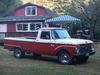
set out this afternoon to adjust the manual choke on my ‘65 F-100. I have a ford carburetor, not sure if it’s original to the truck. I have a Ford service manual that tells me to close the choke, and insert a gauge/drill bit(.375-.400 in) into the body of the carb along the downward portion of the choke plate. Then i’m supposed to adjust the plastic nut adjacent to the swivel to just touch the swivel. I assumed this would relieve pressure on the little spring just under that nut to allow the choke to stay partially open when the pull **** on the dash is pulled back at startup. Well, adjusting that plastic nut had no affect on the choke status. Some questions: is the choke actually supposed to be very slightly open at startup for a cold engine?(or am I just misinterpreting the manual). What is the swivel the manual is talking about?
Don't know anything about the book but I have always adjusted manual chokes by loosening the cable at the carb, making sure the **** is pushed all the way in and making sure the choke plate is 100% open on the carb and the tighten the screw back on the cable. When you operate the choke you pull the know out as far as you think it needs to be. Stop would be completely closed then when the motor starts you push it in enough to keep it running and not flood it out. I have done it this way for almost 50 years and it has always worked for me
That’s what I have done on my cars before fuel injection took over. Simple and to the point. But since my retirement I wanted to get back to playing with some vintage vehicles and bought this F-100. Along with a service manual. As the carb has been stumbling a bit, I thought i’d just adjust things to spec so I followed the advice in the manual and, frankly, the process just raised more questions than problems solved.
Hi docinatl, I have a manual choke on my '65 F-100. It has the trusty 240 in it. I put a pair of cast iron headers on it. Wow...what a diference just doing that has made. I made an intake mnfld heating plate out of 1" thick aluminum. I bolted this right to where the old log exh. mnfld used to warm up the intake. I made the 1" alum. plate the same shape as the underside of the intake &exh. mnflds is. I drilled a hole all the way through. The same size that was the exact tap size needed for a 3/8" NPT. Then I could run 3/8" nipples, which is the right size for 5/8" heater hose. Works great.
The way skidoorulz said he sets up his choke is the way I do that too. Hope you find other projects that please you. There is a tremendous source of knowledge/experience here. Weccome, Pete
It does seem this drill bit shank business (used as a gauge) outlined in the shop manual when setting up the choke plate is done with an eye to having a certain specific initial minimum gap measurement even when the choke **** is pulled all the way out completely. That's how I see it too.
When the engine is cranking the plate will then pivot slightly open a bit farther, but only a certain amount, due to air flow working against the spring tension of the choke plate rod. There aren't really all that many adjustments or settings on a carbutetor, sometimes they seem pretty crude, other times they are pretty specific, adjustments measured to +/- 32" of an inch, but what I have found is that every single adjustment is very important. I have also found it's best to set everything to factory book spec even when I don't really understand why (or maybe especially when I really don't understand why.)
I read somewhere the choke plate on a carburetor doesn't really restrict all that much air, that isn't what it's designed to do. What it really does, is increase the velocity of the air through the venturi and this "pulls" a lot more fuel into the air flow than otherwise would be the case, richening the air/fuel mixture.
Closed choke plate increases the velocity! Thanks Tedster...this makes a lot of sense. I love it when things fall into place and make sense.
Ponder this for a minute. In the old detective novels I used to read, When someone was getting choked around the neck they were said to be getting "throttled".
Not understanding what Im doing seems to cover quite a bit of my experiences! but I do respect the engineers that designed these complex items so I feel like my best bet is to set things(like a carburetor) to written specifications. I also respect and appreciate all the help available on this forum as I am earnestly trying to learn more about my caretaker role in maintaining this vintage contraption. I have no friends or colleagues who are even remotely interested in this stuff so I am totally on my own and trial and error, mostly error, is my diagnostic technique of the moment.
Whining aside, I do have another question: in watching internet videos on carb adjustment, many show the use of a vacuum gauge. I'm sure you all know how this works. In trying to find where to hook up my vacuum gauge, however, there doesn't seem to be the convenient, easily photographed port that appears in the videos. So my question is: Is the plug noted by the yellow arrow a vacuum source for my carb adjustment? Or is this an area I should leave alone for now? thanks in advance! Engine is a 352, viewed from the passenger side. Believe the engine is original to the truck. PO claims to have rebuilt the carb recently(within the last year)
First, the drill bit procedure is for Ford carbs that use an automatic choke. On the manual choke you have, and I have, I just pull it to where I feel it should be when starting. I simply push the choke all the way in with it loose on the carb and the plate is fully open before locking down the wire. Then pull out to start.
That big plug in your intake is where a vacuum tree would go to supply vacuum to an automatic tranny and a power steering booster. The fitting could be simple or involved. The fitting below is two parts. My Cougar is similar to this as I need ports for transmission, booster, and the headlights. My truck has the lower steel half with two ports and one large plug. One for transmission, one for booster, and one empty which is where I hook my vacuum gauge.
That big plug in your intake is where a vacuum tree would go to supply vacuum to an automatic tranny and a power steering booster. The fitting could be simple or involved. The fitting below is two parts. My Cougar is similar to this as I need ports for transmission, booster, and the headlights. My truck has the lower steel half with two ports and one large plug. One for transmission, one for booster, and one empty which is where I hook my vacuum gauge.
[/QUOTE]
What is a power steering booster? I think you meant Brake booster.
Using a certain size drill bit shank as a gauge to set the closed choke plate clearance was also specified for setting manual choke carburetors.
It must have been considered important, or they wouldn't have taken the time to set it up as a specific procedure in the manual, and paid someone to draw pictures and the rest of it. I've always kind of thought carburetors were kind of "sloppy", but when I started messing around with a wideband AFR O2 sensor I started to appreciate just how precise they really are. Just tweaking an idle mixture screw a smidge will move the AFR a whole point. They are very finely engineered.
To answer your question, yes that fitting on the intake manifold should work fine. Those are usually NPT fittings, which has a different numbering standard. I think it's 3/8" but don't quote me on that. NAPA and similar stores should have a barbed NPT fitting in stock that should work with a mechanic's vacuum gauge. Some factory and aftermarket carburetors have a carburetor fitting or a spacer fitting, often a large rear facing port, utilized for power brake reservoirs that also supply constant vacuum, this will work too.
That big plug in your intake is where a vacuum tree would go to supply vacuum to an automatic tranny and a power steering booster. The fitting could be simple or involved. The fitting below is two parts. My Cougar is similar to this as I need ports for transmission, booster, and the headlights. My truck has the lower steel half with two ports and one large plug. One for transmission, one for booster, and one empty which is where I hook my vacuum gauge.
What is a power steering booster? I think you meant Brake booster.[/QUOTE]
Well I could say it was a test to see who could spot it. I could also say my mind was elsewhere. Take your pick.
If you are going to use a drill bit as your gauge, please do yourself a HUGE favor and tape it to a string. After dropping the bit down the throat, gingerly pulling a string to guide it out is far easier than removing the intake.
Good reminder. Ive used the string method frequently to counteract the phenomenon of increased gravitational pull over limited access sites and bottomless pits.
If you are going to use a drill bit as your gauge, please do yourself a HUGE favor and tape it to a string. After dropping the bit down the throat, gingerly pulling a string to guide it out is far easier than removing the intake.
Gaa!!! Haven't yet managed to do that, though there's still time... lol
Rezvani's Latest Post-Apocalyptic Monster Is a Ford F-150 Raptor Underneath
Slideshow: Called the Fortress, the 850-horsepower pickup combines Raptor underpinnings with military-inspired features, survival equipment, and a starting price of $285,000.