When you click on links to various merchants on this site and make a purchase, this can result in this site earning a commission. Affiliate programs and affiliations include, but are not limited to, the eBay Partner Network.
I'm having some issues with my coolant system. I've done the following:
stant 195 degree thermostat
Two 13" 1200 CFM puller electric fans
Aluminum radiator
The temperature gauge is reading 220 at idle and up to 230. Sensor is at the back of the block on the passenger side. If I measure the thermostat housing, it's right around 195.
I think there's plenty of cooling capacity here. It seems too hot to me. Can anyone make sense of this?
Hi harley,
I'm wondering if this is due to the location of the sensor.
For the stock EFI setup, the temperature sensor was up front in the outlet port on the thermostat housing, or possibly a coolant passage in the intake. As you said, the thermostat housing is 195°, which is spot on.
Why did you select the location you did in the block?
I'm wondering if it's hotter because the coolant just finished soaking up heat from the cylinders but hasn't made its way back to the radiator to cool down. So, you're tapped into a "hot spot" so to speak.
Well, I don't know where it's supposed to be to be honest.
The truck is a 66 with an 87 block. I have the temp sensor for the fan relay in the thermostat housing. The PO had a mechanical gauge at the rear of the block, so I just reused that spot. Is there another spot I could use? Looks like there is a small boss plugged in the middle of the block, but maybe that's for oil?
I don't know specifics on the V8s since I don't have one. But, you might have some success online looking up the EFI era location of the temperature sensor. Although, I do wonder if it's where your fan relay sensor is already plugged in.
I would also agree that the boss on the middle of the block would have oil behind it.
The stock temperature sensor for the gauge is under the #6 runner on the back of the block on the passenger side.
This is good enough for a "dummy needle" that just moves between an N and an L in NORMAL.
If you want an accurate temp, you'll need to mount it in the port that's up on the thermostat housing. This is where I had to mount it for my aftermarket EFI
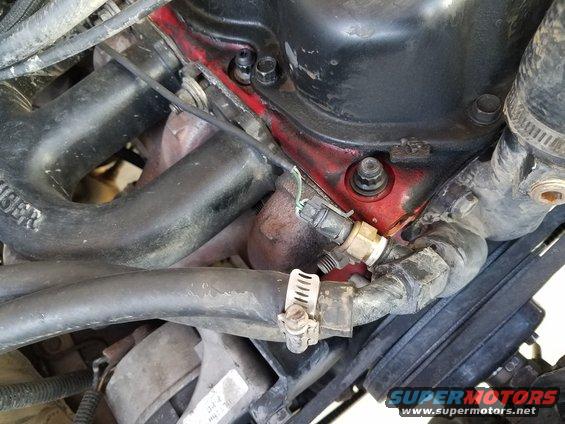
There's another threaded port in the thermostat housing that's higher up (you can see it on the far edge of the picture). I'm not sure what that one is for, but it generally can't be used for controlling temperature, since it fluctuates hot and cold depending on the thermostat opening.
The port on the left is consistent engine coolant temp.
You may need to put a T in it if you want to run both a sensor for a fan and for an aftermarket gauge.
Unscrew the straight piece of pipe that the hose is connected to and screw this into its place. This is the later part that was first used for a vacuum tree (used to activate the EGR) and later for the EFI coolant temp sensor.
Once you put that piece in, you should be able to put your sensor into the threaded hole on the side. It's what's on my housing.
That part can also probably be found in a junk yard pretty easily.
I can't say for sure, since I've never measured it at that spot, and all I see on the dash is the needle moving.
But, it would make sense to me that it would. It starts at 195° up at the thermostat, and then moves through the engine block, soaking up the heat from the cylinders as it does. By the time it gets to the very back of the engine at #6, I imagine it's quite a lot hotter than it was when it started.
I'm sure the dash needle is calibrated to reflect this, and is possibly why Ford put the gauge there as it's the hottest part of the engine. If that part of the engine is okay, the rest of it's okay.
That's all completely theory, but it makes sense to me.
Unscrew the straight piece of pipe that the hose is connected to and screw this into its place. This is the later part that was first used for a vacuum tree (used to activate the EGR) and later for the EFI coolant temp sensor.
Once you put that piece in, you should be able to put your sensor into the threaded hole on the side. It's what's on my housing.
That part can also probably be found in a junk yard pretty easily.
Just a heads up, the threads are too big on this part. I bought one from there over a year ago, still sitting on the shelf. Have not been able to locate the correct one. Mine has a hole on the inside of the bend, got the hose jammed to the bottom with a double clamp to keep it from leaking.
It starts at 195° up at the thermostat, and then moves through the engine block, soaking up the heat from the cylinders as it does. By the time it gets to the very back of the engine at #6, I imagine it's quite a lot hotter than it was when it started.
The water pump pulls cooled water from the radiator and pushes it rearward around the cylinder jackets. Most of the water then leaves the block through the two large (banana) holes at the rear of the block and then it travels across the combustion chambers - the hottest part of the engine - to the thermostat. If you look at the triangular shaped holes in the block and head surrounding each cylinder and look at a head gasket at the same time you will see that there are only very tiny metering holes in the head gasket that only allow a very small portion of coolant to go up through these holes for even cooling and a place for air bubbles to exit.
So to sum up:
cool H20 from pump rearward through the cylinder jackets
up into the head at the rear
forward to the thermostat outlet
into the radiator
rinse and repeat
Most of the heat absorption of the coolant is done after it passes the sending unit.
Just a heads up, the threads are too big on this part. I bought one from there over a year ago, still sitting on the shelf. Have not been able to locate the correct one. Mine has a hole on the inside of the bend, got the hose jammed to the bottom with a double clamp to keep it from leaking.
Interesting, I wonder why the threads wouldn't match. I have one that I got off an EFI truck in the junk yard and the coolant sensor screwed right in.
Maybe a thread adapter is available?
Originally Posted by The Frenchtown Flyer
The water pump pulls cooled water from the radiator and pushes it rearward around the cylinder jackets. Most of the water then leaves the block through the two large (banana) holes at the rear of the block and then it travels across the combustion chambers - the hottest part of the engine - to the thermostat. If you look at the triangular shaped holes in the block and head surrounding each cylinder and look at a head gasket at the same time you will see that there are only very tiny metering holes in the head gasket that only allow a very small portion of coolant to go up through these holes for even cooling and a place for air bubbles to exit.
So to sum up:
cool H20 from pump rearward through the cylinder jackets
up into the head at the rear
forward to the thermostat outlet
into the radiator
rinse and repeat
Most of the heat absorption of the coolant is done after it passes the sending unit.
It sounds like I have it backwards then. Right idea, wrong direction.
So, 195° at the thermostat is the hottest part of the engine?
If so, I guess that doesn't explain the 220 - 230 temps he's seeing form the old sensor port back on the back of the engine.
I'll have to dig it out and measure, but the threads are 5/8" or 3/4" taper, and I think the housing was 1/2" taper on both the stock and aftermarket housing I got.
Rezvani's Latest Post-Apocalyptic Monster Is a Ford F-150 Raptor Underneath
Slideshow: Called the Fortress, the 850-horsepower pickup combines Raptor underpinnings with military-inspired features, survival equipment, and a starting price of $285,000.