When you click on links to various merchants on this site and make a purchase, this can result in this site earning a commission. Affiliate programs and affiliations include, but are not limited to, the eBay Partner Network.
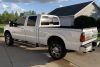
I purchased a 2015 F-250 SD 6.7L Platinum last week, and I've already encountered the dreaded P207F. Long story short, it is a beautiful truck, and I want to fix it, but prefer not to spend thousands at a dealer doing it. It has 95,000 miles, bone stock, but looks like it just drove off the assembly line. Seems to have been very well treated. Interior is spotless. Clean Carfax, etc. I've been trying to educate myself in the last few days, and I know enough to know that I don't know enough... At least I understand the acronyms, and how the system basically works. I'm a hot rod guy, but I’ve never owned a diesel before. I have an appointment next Tuesday to take the truck to an independent Diesel shop that seems to be knowledgeable from talking to them. When I went to pick up the truck last week, the Mom & Pop dealer had a mechanic run two regens to get it running. They claimed it needed to be done because it sat for a few months. After I drove it for about 200 miles or so, I got an error message, Engine Idled Soon, Exhaust Fluid Fault, See Manual. I was on the highway at the time, about 40 miles from home, so I turned around and went home (no issues getting home). I talked to the mechanic, and he suggested it could be a bad DEF pump, or plugged up with crystalized DEF. It sort of makes sense, as the truck was probably trying to do its first 'live' regen when I was driving, and if the DEF wasn't pumping, or not pumping enough, I'm guessing it might throw this message. Can you tell me if I'm on the right track, based on your experiences? If I get one of the iPhone apps, will that be enough to help diagnose it? If so, Is there one you would recommend? Sorry for the rambling post, but I wanted to help you understand where I'm at right now. The dealer hasn't abandoned me, but I doubt they would take the truck back without a fight (as-is, you know). Any help you can give me would be GREATLY appreciated!
I don't have a specific fix in mind but wanted to provide some info. A parked truck will not need an active regeneration unless it had been test driven for quite a few short trips, which is certainly a possibility. Additionally, if they had completed two stationary active regenerations, it would not have commanded one at 40 miles. The PCM is collecting data from various sensors to make specific calculations as a whole but SCR and the DPF are battling separate issues, such as SCR (DEF) doesn't have any impact on the DPF and regeneration frequency.
I had my DEF injector replaced but no DTCs, just dried DEF on the exhaust tips after parking and a lot of light purple (ish) color smoke when an active regeneration would begin between 600°F to 900°F, would clear up in the higher temps. I never did learn why a stuck open DEF injector would cause the harsh smelling smoke only during regeneration but the new DEF injector completely resolved it, was likely causing upstream calculation issues which lead to the smoke.
After others offer feedback, possibly worth it to run the KOEO SCR dosing test with IDS (powertrain > service functions) to a jar but based on this, now I'm not sure since "sensors OK" includes DEF injection system. This would inform if (A) the pump is working and (B) if the dosing rate is correct.
Hopefully you don't need an expensive DOC/SCR/DPF unit!
Last edited by kper05; Jun 7, 2020 at 01:52 PM.
Reason: Edit sentence
I don't have a specific fix in mind but wanted to provide some info. A parked truck will not need an active regeneration unless it had been test driven for quite a few short trips, which is certainly a possibility. Additionally, if they had completed two stationary active regenerations, it would not have commanded one at 40 miles. The PCM is collecting data from various sensors to make specific calculations as a whole but SCR and the DPF are battling separate issues, such as SCR (DEF) doesn't have any impact on the DPF and regeneration frequency.
I had my DEF injector replaced but no DTCs, just dried DEF on the exhaust tips after parking and a lot of light purple (ish) color smoke when an active regeneration would begin between 600°F to 900°F, would clear up in the higher temps. I never did learn why a stuck open DEF injector would cause the harsh smelling smoke only during regeneration but the new DEF injector completely resolved it, was likely causing upstream calculation issues which lead to the smoke.
After others offer feedback, possibly worth it to run the KOEO SCR dosing test with IDS (powertrain > service functions) to a jar but based on this, now I'm not sure since "sensors OK" includes DEF injection system. This would inform if (A) the pump is working and (B) if the dosing rate is correct.
Hopefully you don't need an expensive DOC/SCR/DPF unit!
Thanks for the info! The truck actually drove about 200 miles before the light came on, not 40 miles, if that makes a difference.
The quickest and easiest answer to how or why P207F sets is because the PCM is not "seeing" the expected NOx reduction based on inputs from your NOx11 and NOx12 (pre and post SCR catalyst) sensors. This CAN be caused by improper NOx sensor readings, a plugged DEF injector, poor DEF quality and/or coolant contamination into the exhaust. A good suggestion posted above is to run the dosing test to verify DEF injector output volume and function, as well as obtain a DEF sample to check the concentration (you need a refractometer for this). If those tests check out good, replacing the NOx sensors would be a start. Failing that, the SCR catalyst needs replaced.
The quickest and easiest answer to how or why P207F sets is because the PCM is not "seeing" the expected NOx reduction based on inputs from your NOx11 and NOx12 (pre and post SCR catalyst) sensors. This CAN be caused by improper NOx sensor readings, a plugged DEF injector, poor DEF quality and/or coolant contamination into the exhaust. A good suggestion posted above is to run the dosing test to verify DEF injector output volume and function, as well as obtain a DEF sample to check the concentration (you need a refractometer for this). If those tests check out good, replacing the NOx sensors would be a start. Failing that, the SCR catalyst needs replaced.
Thanks m-chan68,
is it possible to run the DEF dosing test without a high-end scanner? I’d like to try the easier, less expensive ideas first, before I start throwing parts at it... I think I should probably get a refractometer for future tasks. Can a plugged DEF injector be cleaned out, or does it have to be replaced? Sorry for all the questions, but I’m trying to accelerate my learning curve before the dealerships rob me...
Thanks m-chan68,
is it possible to run the DEF dosing test without a high-end scanner? I’d like to try the easier, less expensive ideas first, before I start throwing parts at it... I think I should probably get a refractometer for future tasks. Can a plugged DEF injector be cleaned out, or does it have to be replaced? Sorry for all the questions, but I’m trying to accelerate my learning curve before the dealerships rob me...
Regards,
John
Since I am a dealership technician, I have always used IDS for all my diagnosis needs. Therefore, I am not familiar with any aftermarket scan tools. I will go out on a limb to say it's unlikely you'll be able to run any of the tests mentioned above without the use of IDS or scan tool of equivalent calibre though. I'll be honest, I've never attempted to clean out a DEF injector though as I have yet to come across one that hasn't sprayed in all the tests I've ran yet. If you are interested in obtaining a refractometer, have a look at the video below. At about 4:15 is where the video uploader goes into detail about how it's used to check DEF concentration:
It's certainly a good excuse to get one if you can use it for other supported purposes. Fastenal or Grainger have them, of course I'm sure many other places too.
The quickest and easiest answer to how or why P207F sets is because the PCM is not "seeing" the expected NOx reduction based on inputs from your NOx11 and NOx12 (pre and post SCR catalyst) sensors. This CAN be caused by improper NOx sensor readings, a plugged DEF injector, poor DEF quality and/or coolant contamination into the exhaust. A good suggestion posted above is to run the dosing test to verify DEF injector output volume and function, as well as obtain a DEF sample to check the concentration (you need a refractometer for this). If those tests check out good, replacing the NOx sensors would be a start. Failing that, the SCR catalyst needs replaced.
Hi m-chan68,
I have an update on my P207F issue. I took the truck into a local diesel mechanic. Actually, I had to have it towed, because when I went to drive it there, it started up in idle mode... They checked out the DEF system for proper flow and DEF quality, and then performed a forced regeneration, using the IDS scanner. They also turned on the %DPF ghost screen for me. The forced regen turned off the code, but they kept the truck for another day and took it on a few drives to make sure it was ok. The %DPF was at 0%. No components were replaced. I picked it up yesterday at the close of business and had a nice discussion with the mechanic about various diesel topics. The truck was on LOW FUEL, so I drove a few miles to a station and filled it up. A couple of miles down the road, the check engine light came on! No screen warnings, though. I hooked up my scanner when I got home and it had all three P207F codes again, freeze frame, pending, and permanent. The shop was already closed, and I’m not sure if they are open Saturday.
In your opinion, since the DEF system seems to be working, and the DPF is apparently clean, does the quick P207F code point to a possible Nox sensor failure? I know you can’t diagnose it through the forum, but I’d like your thoughts, as you have experience in this area. Thanks in advance for your help.
Rezvani's Latest Post-Apocalytic Monster Is a Ford F-150 Raptor Underneath
Slideshow: Called the Fortress, the 850-horsepower pickup combines Raptor underpinnings with military-inspired features, survival equipment, and a starting price of $285,000.

















 Update!
