When you click on links to various merchants on this site and make a purchase, this can result in this site earning a commission. Affiliate programs and affiliations include, but are not limited to, the eBay Partner Network.
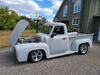
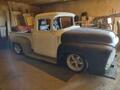
I have always thought that '56 trucks and their lines are truly amazing. Having built a few I came across a truck body at the 2019 Autofair in Charlotte NC. The body was complete, but only a roller. A price was negotiated and the truck was hauled home. But this time I wanted to do something completely different than the aftermarket mustang II or crown vic front suspension kits. Enter my friend Dennis Frings. Dennis was originally from Wisconsin and was a well know builder of circle track and NASCAR chassis. His work was always meticulous to say the least, as he always tig welded everything with stainless steel rod. Even today in his 80's he still can weld a stack of dimes.
Dennis received notoriety for building winning chassis and was in the company of many of the great race car drivers in the 1970s and 1980s. He is a Hall of Fame inductee and through the years he and I have become very good friends. Getting back to my story, Dennis had this front clip hanging on the wall of his shop for decades, and i asked him what it was about. He said that it was the last clip that he build for NASCAR in the 1980s. It was the last one he built due to the fact that NASCAR changed the rules on him again and outlawed his design, so he got pissed off and walked away. I asked him if he would be willing to let me build my truck chassis around this frame clip, and after some discussion he agreed. The adventure was about to start! Dennis is wearing the cowboy hat
My '56 had a Volare front clip welded to the frame at a slight angle. The result was a lots of weld beads and not much structural consideration. But it took quite a while to cut it all free and still maintain the main chassis at the firewall. Volare, Whoa whoa!
Generally i don't like to whack off the frame at the firewall and butt weld a clip to this, but with Dennis' guidance he assured me that with proper boxing and reinforcement the structural integrity would be there. The other challenge was the clip on the Busch Series cars goes up at the firewall, and the frame stubs on the chassis would not line up with the gravel pan on the truck body. A step down would have to be designed to allow the bumper to be in its stock position.
The boxing went well, so next was making all the NASCAR chassis parts line up correctly on to my new clip. Upper and lower control arms were selected and adjusted. I had the original catalog so I had an idea of what it was supposed to look like.
I was not going to use coil overs, but wanted jack screws so I could get height adjustment along with a real NASCAR feel to the suspension. No stock mustang ii upper control arms for me! Next was the step down for the bumper mounting. Not the sexiest execution but once the core support and the front clip is back on, no one can see the transition.
Nice work. I'm not trying to be negative with my post. It's definitely more than I am capable of doing. But I don't quite understand the need for stainless filler rod when welding steel. To the best of my knowledge it doesn't increase the weld strength and some chromium in the weld filler might migrate out into the steel during the weld process leaving the stainless vulnerable to oxidation. The stack of dimes weld beads look nice and it takes a lot of skill to create. From an engineering and structural standpoint the peaks and valleys in that type of weld creates stress risers and reduces the integrity of the weld connection. In structural applications there are maximum dimensional limits to the peaks and valleys in a weld bead.
Nice work. I'm not trying to be negative with my post. It's definitely more than I am capable of doing. But I don't quite understand the need for stainless filler rod when welding steel. To the best of my knowledge it doesn't increase the weld strength and some chromium in the weld filler might migrate out into the steel during the weld process leaving the stainless vulnerable to oxidation. The stack of dimes weld beads look nice and it takes a lot of skill to create. From an engineering and structural standpoint the peaks and valleys in that type of weld creates stress risers and reduces the integrity of the weld connection. In structural applications there are maximum dimensional limits to the peaks and valleys in a weld bead.
Theres only one reason why your reasoning doesn't hold a candle here: real world experience.(I'm not judging not yours, but rather the welders)
It sounds like the guy doing the welding has quite a few references and real-world applications of physical creations that actually existed and mechanically functioned in the real world--real time.(not hypothetical internet arguments)
It's tough to beat that kind of experience with anything on the internet.
Nice work. I'm not trying to be negative with my post. It's definitely more than I am capable of doing. But I don't quite understand the need for stainless filler rod when welding steel. To the best of my knowledge it doesn't increase the weld strength and some chromium in the weld filler might migrate out into the steel during the weld process leaving the stainless vulnerable to oxidation. The stack of dimes weld beads look nice and it takes a lot of skill to create. From an engineering and structural standpoint the peaks and valleys in that type of weld creates stress risers and reduces the integrity of the weld connection. In structural applications there are maximum dimensional limits to the peaks and valleys in a weld bead.
I agree with you entirely, and i have actually heard that comment before. I asked him about it, and he said he built winning championship cars that way, so that was that. He did mention that some of his customers complained about it as it was difficult to repair after it was wrecked. I think he is a perfectionist, and the welds were works of art for him. Everything I have seen that he built is like that.
Next challenge was to make a 1963 Ford FE 390 with a C6 transmission fit in the chassis. The issue is that the 390 has the troublesome front sump oil pan with the additional vexing oil filter sticking out 90 degrees from the crankshaft on the driver side. How to make that work?
Bill Elliott built a BBW 1956 F100 on the chassis of one of his NASCAR cars. Virtually everything under the sheetmetal was race car...full floating rearend, tunable suspension, driveline, even the master cylinder on the brakes was from the race car. A guy I know named Brad Romaine in San Diego owns the truck and has kept it just as it was when Bill Elliot built it. Brad has a number of magazines that featured the truck, it might be worth a little research to see how it was done as you move down the road on yours. Oh yeah, it is "NASCAR Orange" in color.