When you click on links to various merchants on this site and make a purchase, this can result in this site earning a commission. Affiliate programs and affiliations include, but are not limited to, the eBay Partner Network.
Just replaced the distributor drive on my '65 F100, 240 6 cylinder. It cranked right up and I was able to adjust timing easily to about 2 degrees BTDC at 600 RPM per the manual. When I hooked up the vacuum line and rev'd the throttle the timing advanced off the scale - the last mark is 15 degrees and I'm estimating I lost view of it as it advanced beyond 30 BTDC.
The distributor is a rebuild. Diaphragm is of a different design than the one that I removed and that's shown in the manual.
It also sounds like it may be detonating at idle (???) or it may be that I'm hearing things. It's got a diesel sound like shaking a spray paint can. It doesn't get any worse when I rev the engine.
Could I have the vacuum advance hooked to the wrong port on the carburetor? Do I need to adjust the travel or spring tension on the vacuum advance? Not sure exactly where to go.
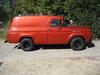
The truck was running - I just liked the way it looks at dusk with the lights on.
I didn't rebuild it myself - I bought it online. rockauto.com. Everything about the drive is identical except for the diaphragm. Total timing is 35 degrees, but according to the manual I only want about 15. Not sure how to limit the total timing. Been watching You Tube videos and searching online but no specific info for this distributor so far.
Total timing of low to mid 30 BTDC sounds right to me. I cannot remember ever seeing a spec of 15 for total advance, but I have not often walked outside of the V-8 world.
You're probably right Becky-is-a-66. The book says 14 1/2 at 2000 rpm, but everything I read online references 30+ degrees.... guess I should have checked what I had with the old distributor.
Initial timing is set by using a timing light and adjusting the timing by turning the distributor. This is done with the feed line to the vacuum advance disconnected and plugged. The vacuum advance, in most situations, is hooked to “ported vacuum” rather than manifold vacuum. Ported vacuum is essentially zero at idle and increases as the throttle plate is opened for acceleration or remains open for cruise, thus providing a vacuum increase to advance the timing a bit. As RPM increases the centrifugal weights in the base of the distributor provide additional advance of the timing. When everything is in play you get “total advance” somewhere in the 30s which is curved to match the camshaft profile. 2K is probably a bit too low to expect total advance.
Just replaced the distributor drive on my '65 F100, 240 6 cylinder. It cranked right up and I was able to adjust timing easily to about 2 degrees BTDC at 600 RPM per the manual. When I hooked up the vacuum line and rev'd the throttle the timing advanced off the scale - the last mark is 15 degrees and I'm estimating I lost view of it as it advanced beyond 30 BTDC.
The distributor is a rebuild. Diaphragm is of a different design than the one that I removed and that's shown in the manual.
It also sounds like it may be detonating at idle (???) or it may be that I'm hearing things. It's got a diesel sound like shaking a spray paint can. It doesn't get any worse when I rev the engine.
Could I have the vacuum advance hooked to the wrong port on the carburetor? Do I need to adjust the travel or spring tension on the vacuum advance? Not sure exactly where to go.
Originally Posted by cdherman
Pid --
Autolite and Carter both have some parts that will fall out if you open them up upside down. Marnus rebuilt a Carter, and was referring to loosing a ball from that carb. But same can happen with the Autolite (aka Fomoco, Motorcraft)
On the passenger side of the 1101 carb, above and to the left of the fuel inlet, there is probably a bullseye shaped valve. This is the spark control valve. Anyhow, you will get a new one with your 1101 rebuild kit. This valve regulates the vacuum that goes to the distributor. The distributor that works with autolite spark control valved carbs is called a loadomatic type.
Distributors "advance" the spark. The spark plug needs to fire a little before the piston gets to the top of the cylinder. The faster the engine is running, the more "in advance" the spark needs to be. When an engine runs faster, it USUALLY generates more vacuum, but not always. The vacuum to a distributor sucks on a vacuum advance canister, which in turn rotates a plate in the distributor. On this plate are the points. If the points move in relationship to the distributor shaft (which is of course, attached to the cam shaft via a gear, and the crank via more gears), the point in time when the "points" close and a spark is released to the spark plug can be varied.
Because the vacuum only advance method is unreliable in certain circumstances (Wide open throttle, with engine bogging down, is an example I have been given), a second method of advance was developed, based on the centrifual force moving some small weights and springs in the distributor. The combination of both vacuum and centrifuagal in one dizzy is better, for usual driving situations. Racing engines often have centrifuagal only advances.
OK, I have labored to explain this very carefully, for the following reason. The Ford loadomatic carb/distributor system is different than both of the above. It uses a combination of vacuum from the engine, but when that vacuum falls, it uses vacuum from the venturi. The flow of air through a carb, through the venturi, creates a vacuum inside the carb. This is what sucks and atomizes the fuel. Anyhow, the loadomatic dizzy has NO centrifgal advance. It saw its last years of use in the mid sixties. In fact, ONLY the 65 240 engine got it. The 300 had a conventional vacuum/centrifugal setup, and the 1101 carb for the 300 was made without the spark advance valve.
The loadomatic distributor and carb MUST be used together. Otherwise, you will screw up your advance and either have too much or too little. I would suggest you verify that you have both, or neither. The carb I have described to you. The distributor is also easily recognised. Twist on the rotor (with cap off dizzy). A meachanical advance dizzy will have a "springy: feel to it in one direction. You will be able to twist it about 20 degrees, and it will sping back when you let go. The Loadomatic dizzy will have no such springiness. It has a fixed shaft. The advance is varied only by the action of the vacuum canister on the plate/points.
OK, very long winded post. But it took me WEEKS to figure all that out, and I think I will be saving you some serious trail and error learning. If you choose to keep a carb with a spark control valve, you must keep a loadomatic dizzy as well. The only electronic upgrades for these type of dizzies are from Pertronix. Highly recomended, but I am tired of writing..
Agree with looking at the old distributor. My 65 shop manual only shows Load-O-Matics on the 240 engine. The 300's had dual advance distributors. It is possible someone already switched your engine to a dual advance and if you ordered a distributor for a 1965, 240 they would have sent you a Load-O-Matic.
OK - I'll look into that. The timing marks on the engine only go to 14 degrees which made me think that corresponded to the 14 1/2 called out in the manual... but certainly worth checking into more. Thanks
Keep in mind when reading "Total Timing" published numbers that doesn't include the vacuum advance. Sounds odd, the reason is because total timing is an old drag racing term, they don't use vacuum advance. The term stuck, causes mucho confusion.
When the vacuum advance is connected and then checking the ignition timing with a light, keep in mind there is no load on the engine in neutral, so there will be some eye-popping numbers. Highway cruising on flat ground the total advance + vacuum diaphragm is typically close to 50° BTDC (or more) depending on the engine. This is normal, helping to run smoother and cooler with the timing curve setup right. Estimates vary though there is somewhere around a 3 to 4 mpg efficiency loss without using or improperly setup vacuum advance.
Keep in mind when reading "Total Timing" published numbers that doesn't include the vacuum advance. Sounds odd, the reason is because total timing is an old drag racing term, they don't use vacuum advance. The term stuck, causes mucho confusion.
When the vacuum advance is connected and then checking the ignition timing with a light, keep in mind there is no load on the engine in neutral, so there will be some eye-popping numbers. Highway cruising on flat ground the total advance + vacuum diaphragm is typically close to 50° BTDC (or more) depending on the engine. This is normal, helping to run smoother and cooler with the timing curve setup right.
All true, but there is also a vacuum advance curve calculated with a separate mechanical advance curve. If you have an off-shore or improperly calibrated vacuum advance, there is no telling what the total advance rate is, unless set-up on a DIST MACHINE.
Same problem with using either manifold or ported vacuum signal. Manifold will advance immediately whereas ported not until the throttle plate opens (sometimes).
The mechanical advance would have to be set up differently for whatever method you choose to use. LOAD-O-MATIC is a completely different system where the actual advance signal is controlled by the CARB SPARK CONTROL VLV and the tension of the DIST SPRINGS. Even point set - rubbing block tension has some bearing on it.
If you have an off-shore or improperly calibrated vacuum advance, there is no telling what the total advance rate is, unless set-up on a distributor machine.
A distributor machine is a nice thing to have, but it is absolutely no problem (technically) to use the engine itself as a distributor machine. A whole lot less convenient with a side order of "pain in the azz", this is true.
Let's back up a second here though. At this point I don't believe we even know what he actually has installed, in terms of the factory LOM distributor & carburetor (or not) do we?
Rezvani's Latest Post-Apocalytic Monster Is a Ford F-150 Raptor Underneath
Slideshow: Called the Fortress, the 850-horsepower pickup combines Raptor underpinnings with military-inspired features, survival equipment, and a starting price of $285,000.