


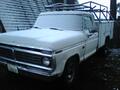
73 f250 ignition switch wiring

Thread Starter
|
Mountain Pass
Joined: Feb 2018
Posts: 108
Likes: 0
73 f250 ignition switch wiring
Hello, Maybe someone can tell me how to find a wiring diagram. Colors may help, and where the wires go to (starter, etc.) may help too. Since this has been severely messed with. Even before I messed with it myself. A couple years ago I wired in a new ignition switch and bypassed the neutral safety switch wire. This was a shortcut to just getting it to run. But now the truck starts and runs fine. And now I miss that NSS, especially when I start up and instantly take a kamikaze run at the car parked behind me. TIA
Thread Starter
|
Mountain Pass
Joined: Feb 2018
Posts: 108
Likes: 0
This is fixed now. A previous post on FTE had these golden words; "S post (inside ign switch) feeds red/blue to NSS, which then feeds S post @ solenoid." Knowing this I was able to snip and splice a couple wires and now my truck only starts when in Park. Thank you.

Moderator


Joined: Jan 2001
Posts: 56,946
Likes: 2,717
From: Virginia

I was working this up earlier and then had to leave. I came back and finished it up and then saw you got it fixed, good. But since I already did it I am going to post it up anyway.
Here is a diagram for a 1974. Should be very close to yours. If you look in the center of the diagram you will find the starter relay. Coming off that is circuit 32, which is a red/blue stripe wire. If you follow that backwards, it leads off the right side of the diagram to the next diagram. http://www.fordification.net/tech/im...aster_2of8.jpg
Here is the next diagram. Circuit 32 red/blue comes in on the top left. You follow it all the way across and it seems it just passes through. But on the right side of the diagram you will notice two circuit 32 circuits leaving on the right side. If you follow that new circuit 32 down the right side of the diagram, you will see where it originates at the ignition switch. So now we have two circuit 32's leaving on the right side. http://www.fordification.net/tech/im...aster_3of8.jpg
Here is the next diagram, you can see both just pass on through the top, nothing much to see here but you may need it some day. http://www.fordification.net/tech/im...aster_5of8.jpg
Same with this diagram, it passes right on through the top. http://www.fordification.net/tech/im...aster_6of8.jpg
Here we finally get to our destination. If you follow both circuit 32's down, you can see they hit a neutral safety switch. But only if you have a automatic transmission. Believe it or not, trucks with a manual trans did not have a neutral safety on the clutch pedal till the early 80's. That is what the paranthesis are for, if you have a automatic it ran through the neutral safety, if not they had a jumper they installed at the factory so they could use the same harness for either tranny. http://www.fordification.net/tech/im...aster_7of8.jpg
Here is a diagram for a 1974. Should be very close to yours. If you look in the center of the diagram you will find the starter relay. Coming off that is circuit 32, which is a red/blue stripe wire. If you follow that backwards, it leads off the right side of the diagram to the next diagram. http://www.fordification.net/tech/im...aster_2of8.jpg
Here is the next diagram. Circuit 32 red/blue comes in on the top left. You follow it all the way across and it seems it just passes through. But on the right side of the diagram you will notice two circuit 32 circuits leaving on the right side. If you follow that new circuit 32 down the right side of the diagram, you will see where it originates at the ignition switch. So now we have two circuit 32's leaving on the right side. http://www.fordification.net/tech/im...aster_3of8.jpg
Here is the next diagram, you can see both just pass on through the top, nothing much to see here but you may need it some day. http://www.fordification.net/tech/im...aster_5of8.jpg
Same with this diagram, it passes right on through the top. http://www.fordification.net/tech/im...aster_6of8.jpg
Here we finally get to our destination. If you follow both circuit 32's down, you can see they hit a neutral safety switch. But only if you have a automatic transmission. Believe it or not, trucks with a manual trans did not have a neutral safety on the clutch pedal till the early 80's. That is what the paranthesis are for, if you have a automatic it ran through the neutral safety, if not they had a jumper they installed at the factory so they could use the same harness for either tranny. http://www.fordification.net/tech/im...aster_7of8.jpg
Thread Starter
|
Mountain Pass
Joined: Feb 2018
Posts: 108
Likes: 0
Thanks for that Dave. Looks just like my NSS wiring. So I am visualizing it as; the ignition switch puts the electricity to the NSS (which in reality is a short wire although for diagramming I can see why it makes a very long line), and the NSS (if the gear selector is in Park) passes it along to the starter relay, causing the relay switch to close contacts, making the starter turn over and sending (briefly) a full 12volts to the coil. You are showing me how to read a wiring diagram. Seems like the first rule is, nothing is on the diagram in the place where it is on the truck. But I can see how that is fine as long as I follow along the wires.
Moderator
Joined: Jan 2001
Posts: 56,946
Likes: 2,717
From: Virginia
Thanks for that Dave. Looks just like my NSS wiring. So I am visualizing it as; the ignition switch puts the electricity to the NSS (which in reality is a short wire although for diagramming I can see why it makes a very long line), and the NSS (if the gear selector is in Park) passes it along to the starter relay, causing the relay switch to close contacts, making the starter turn over and sending (briefly) a full 12volts to the coil. You are showing me how to read a wiring diagram. Seems like the first rule is, nothing is on the diagram in the place where it is on the truck. But I can see how that is fine as long as I follow along the wires.
You are correct and that is one of the most difficult parts of wiring. Translating the diagram to the actual wiring on the truck and the locations of the components. The diagram is very good for troubleshooting though, and getting how the current logically flows through the electrical system.

Thread
Thread Starter
Forum
Replies
Last Post
scottlathrop
1961 - 1966 F-100 & Larger F-Series Trucks
2
Nov 24, 2013 07:54 AM
big-ugly
1973 - 1979 F-100 & Larger F-Series Trucks
16
Aug 25, 2012 05:46 PM
auntiemame
1961 - 1966 F-100 & Larger F-Series Trucks
3
Jun 29, 2003 12:04 PM



