When you click on links to various merchants on this site and make a purchase, this can result in this site earning a commission. Affiliate programs and affiliations include, but are not limited to, the eBay Partner Network.
The riser valve is in the exhaust manifold right above where the exhaust pipe connects to it. Those two pictures wouldn't show the valve. Here's an example. When the engine is cold the valve should be closed and if you rotate the external shaft it pivots on - counter-clockwise - it should pivot freely and swing back on its own to the closed position from the spring pressure.
In this case your truck would have likely originally had an oil bath air filter and someone changed it out. The heat riser was never connected to the air cleaner by a tube, but what it does is holds exhaust heat close to the bottom of the intake manifold so the air in the intake plenum is warmed quickly during a cold start.
If that valve is stuck closed it will be constantly directing heat to the bottom of the intake plenum even when the truck has warmed up. Plus it would block exhaust flow - restricting the pipe outlet. Not good for performance.
The spring heats up and opens the valve automatically. Likewise, if that spring is broken it will never open the valve.
The riser valve is in the exhaust manifold right above where the exhaust pipe connects to it. Those two pictures wouldn't show the valve. Here's an example. When the engine is cold the valve should be closed and if you rotate the external shaft it pivots on - counter-clockwise - it should pivot freely and swing back on its own to the closed position from the spring pressure.
In this case your truck would have likely originally had an oil bath air filter and someone changed it out. The heat riser was never connected to the air cleaner by a tube, but what it does is holds exhaust heat close to the bottom of the intake manifold so the air in the intake plenum is warmed quickly during a cold start.
If that valve is stuck closed it will be constantly directing heat to the bottom of the intake plenum even when the truck has warmed up. Plus it would block exhaust flow - restricting the pipe outlet. Not good for performance.
The spring heats up and opens the valve automatically. Likewise, if that spring is broken it will never open the valve.
I don't have anything like that on mine that I remember, but will give it a second look.
Modern gasoline is probably more prone to vapor lock in an old school open system. I like to use Marvel's in the gas tank for a few different reasons, and this is one of them, it seems to help. Also make sure the distributor mechanical and vacuum ignition advance is working correctly all up and down the RPM range and at cruise. Retarded timing can raise temperatures. Is it pinging or knocking? Of course check for more simple defects, like a loose, worn or glazed fan belt & pulley.
I got all of the timing issues taken care of and the ignition advance is working properly. There is no pinging or knocking and it purrs like a kitten. Do you put the Marvel's into every tank?
Pretty much, a couple glugs every 10 gallons, or 4 fl ozs. Seems to help keep the effects of ethanol from alloy castings & rubber bits in carb parts away. I try to avoid corn squeezins too. Tough to do that on a road trip, but if I'm not driving it much a fresh tank of pure gasoline seems to store better. This can be a problem with classic or collector rides, before you know it the fuel sits around for six months or longer and end up with degraded winter blend in the summer. Stale fuel is not good for engine innards. Anyway it's worth a try, can't hurt anything.
I don't have anything like that on mine that I remember, but will give it a second look.
It should be there if it is stock, but perhaps not if the manifold has been replaced or modified. If you look at this eBay ad as an example - it is an aftermarket reproduction - but you can maybe see this example has the same mechanism on the side and you can also maybe see the flapper valve if you look into the top of the manifold.
[QUOTE=TA455HO;18777520]It should be there if it is stock, but perhaps not if the manifold has been replaced or modified. If you look at this eBay ad as an example - it is an aftermarket reproduction - but you can maybe see this example has the same mechanism on the side and you can also maybe see the flapper valve if you look into the top of the manifold./QUOTE]
It is there and working. I laid eyes on it yesterday.
I put the heat shield I picked up on the fuel line and warmed it up, test drove it, let it idle for a while and problem solved. The heat shield got very hot, but the carb stays cool to the touch. It ain't pretty but, it'll work for now until I figure out a better fix.
I had not seen a pic of your fuel line routing before but that might be contributing to the problem. Originally both the distributor vacuum advance line and the fuel line were routed around the front of the valve cover. There was even a little metal support attached to the thermostat housing that looked like this.
The first bend on the upper left is where the vacuum line would run through and the second bend just before the opening would capture the fuel line. The tab bent toward the back keeps it from rotating as the bolt is tightened down.
By routing it like they did it is not over the top of the engine, and is much closer to the fan blade for that cooling effect. Even the metal support probably helps wick heat away from the tube.
Glad to hear you got it to run but the fact that there is that much heat there is strange. That design of inline motor with shared manifold is in millions of vehicles for decades if not a century by now and if they don't have heat shields that you don't have and don't have a heat problem then something else is up. Not to sound ominous but if its close to stock it should work like most. Have you put your hand in there when you start it cold and see if you can feel a blast of heat or something?
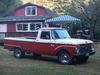
I don't have anything on the front like that, but this truck being so not factory and cobbled from so many different years it doesn't surprise me. I will be redoing the fuel line and getting rid of the rubber hose dad put on there and I would love to get it off of the top of the motor. I'll have to find/fashion a bracket like that.
@Cheddar
I was really surprised that shielding the line made that much difference and my gut says it is in the routing of the line. Hopefully the bracket fix above should allow me to get rid of that ugly silver stuff.
Well, it has done it to me a few more times. We are having some very hot weather right now, 105 with the heat index today. The carb is still staying cool so I don't think it is a problem with the heat. I thought it was the fuel tank being sealed, so last night I left the cap loose instead of tightening it down and it just stalled coming back to work this afternoon. I don't think it would be the sending unit as it is gravity fed from the bottom of the tank and not leaking. I did order another one to fix the fuel gauge and it arrived today so I will rule it out for sure. The fuel pump is really all that is left. Can a mechanical fuel pump intermittently fail? I know there is a set of rubber one way valves in there, but the only ones I have ever had fail did it all at once. I did pressure test it and it is right under 4 psi so I'm thinking it is a little low.
I don't see a fuel filter inline between your fuel pump and carb. chances are there is some junk floating around in your float bowl plugging up some small but important hole in the carburetor. I would pull the float bowl while full and pour the fuel through a cheesecloth or smth, see what u see.
This Hennessey Takes the Expedition Tremor's Off-Roading Capability to the Next Level
Slideshow: The VelociRaptor Expedition gains a lift, upgraded suspension, Brembo brakes, and trail-ready equipment while retaining the stock 440-horsepower EcoBoost V6.
Rezvani's Latest Post-Apocalyptic Monster Is a Ford F-150 Raptor Underneath
Slideshow: Called the Fortress, the 850-horsepower pickup combines Raptor underpinnings with military-inspired features, survival equipment, and a starting price of $285,000.