When you click on links to various merchants on this site and make a purchase, this can result in this site earning a commission. Affiliate programs and affiliations include, but are not limited to, the eBay Partner Network.
Hey everyone! It's been a while but I've got some exciting news and I want all of your input. However, I ask that anyone who replies do so with meaning and intelligence. I don't need to hear how stupid my ideas are or that I'm wasting my time. I appreciate this forum and it's members for the expanse of knowledge and ideology and I want to capitalize on those things. So please, please, PLEASE keep this professional and leave the negativity and trash talk out. This project is important to me and I'm very excited to get started and I can't wait to hear what everyone has to say! Thank you.
I just purchased a 1993 F150 extended cab 4x4 with a 5.8L. This truck is a BEATER!! Total work truck, interior needs redone and there's plenty of sheet metal work to do, it's decently straight, just the typical rust to deal with. It's got 250-260k on the clock, it runs and drives but she also smokes! So here's the direction I'd like to take. I've really taken a liking to the Overland style rig. Something about a truck that I can point whatever direction I want and go, and be self-sufficient as I go there is really appealing to me. When the family and I set out to get away, we like to really get away! I have a daily driver so I can take my time and do things right and the way I want to. I'm only asking for legitimate advice and ideas. I've spent a ton of time reading and learning within this forum and I know that most of the answers I'm looking for are out there, I just wanted to narrow the playing field and get some input on a specific application that I'm really excited about. Thank you everyone that takes time to read this and thank you for sharing your knowledge and input, it is ALL greatly appreciated!
So, the first step will be the engine. It needs a rebuild, its been a hard 260k and she's starting to leak her vitals all overt. So I ask do I just tear it down and give it a basic overhaul or should I spice it up a little? I've been rolling around in my 4.9L FOREVER now and I'm excited to have a V8 again. Any opinions on power upgrades? Is it worth putting some money in to performance? I know it's not the roller rocker engine so I'm just curious what you all think. Ill be running at least 35 inch tires, maybe 37s down the road. I'm not looking for burnout power but I want a little giddy up with the go. The other side of the coin is I'm also big on reliability. When we go out on an "adventure" we get OUT OF TOWN! I don't want to get 500 miles away from home and have some catastrophic engine failure! On a side note... with the engine out should I do anything in particular with the ol' E4OD tranny? Shift kit? Torque converter? Maybe just a flush and filter?
Ok, second step... the body. The fenders I'm not to worried about, I can fix them or replace them, plus i plan on doing a set of cut-out fender flares. The cab I plan on repairing, its easy to weld in a couple corners and some rocker pieces. As far as the bed is concerned, and here's where I may get a little loopy, its a long bed. Not a fan, especially with the extended cab. What I'd really like to do is shorten the frame, I can even relocate the rear axle if needed and possible, put a flat bed on with a pop up camper and fill the voids on the sides of the camper with tool boxes or storage compartments of some sort. Told you I was loopy. Let me ask this, would it be possible to mount the extended cab on a short bed frame? I'm not really concerned with the area behind the cab, I'll build whatever I need to back there to fit. I really want to build this truck as an Overland style rig. I've got a wife, a ten year old daughter and two dogs, a great big and a little tiny, and we love roaming the mountains of Colorado! I really like the little (and i mean little) extra room the ex-cab provides, its perfect for the kid and dogs, but some of the trails we like aren't that friendly to the longer wheel based rigs. My '94 single cab shorty does just fine so if there's a chance I can tighten up the wheelbase on the new truck I'm willing to do what it takes.
And now on to the third step. I will be doing a SAS on this truck. It's been a dream of mine to do this but I haven't wanted to shut down my daily driver, plus it'll be a learning experience and I want to be able to handle the curve ***** properly and do the swap correctly. This isn't going to be a mud bogging truck, except for the occasional river or pit crossing, but it will need to articulate over boulder fields and rock out croppings. Is a standard leaf spring suspension sufficient? Would coil springs and extended radius arms be better? Or a full on (expensive) four link setup? Like i said earlier, we sometimes travel 500+ to get where we're going so ride quality is definitely a consideration as well. Which front axle is preferred? I've always been a fan of the Dana 60 with the closed knuckle (like a big ball joint if I'm correct) but I see the open knuckle all the time too. Is there a preferred axle for my application? I suppose availability will play a factor in my choice as well, but like I said, I've got decent access to multiple generations of Fords. Should I use a 60 in the rear as well? What are my options? I'd really like to incorporate lockers in the equation, but would limited slip front and rear be better? I plan on having an on-board air system so throw out some ideas and opinions on lockers or limited slip please, it never hurts to ask right?
So I guess that pretty much sums it up. Engine, Transmission, Body (or Frame rather) and Suspension are the things I'd like input on. All the little stuff like interior and accessories I'll pick away at in between the big stuff. Again, thank you ALL for your input and ideas, this forum has a wealth of knowledge throughout and it means a lot to me that you all took the time to think about my questions and add your response. I'll get some preliminary photos up next week, I'm excited to show this rusty little turd off! Thank you again!
One think I'll mention first is that a potential downside to Big Ideas is that they can take a lot longer to implement than you expect, and you end up not getting to enjoy them as soon (or as much) as you had hoped. So especially with a 10 year old daughter I'd suggest keeping the project small enough that you can realistically complete it in a year or two (meaning for me at least, that you expect it to take 3 - 6 months!). Not saying Big Ideas are bad, just that if your daughter is 18 by the time this truck goes on its first trip you might be regretting your choices. So maybe try to keep it as simple as possible right out of the gate, and upgrade later as desired. That said, it's your truck and you know your priorities a lot better than I do so...
I don't have much info to give you on engine and trans. There's a guy on here with the screen name Goin' Boarding who's built a mild 351 in front of an E4OD. Hopefully he'll chime in. And there are a lot of others with tons of expertise there too.
On the body/frame, the frame kicks up just behind the cab, so putting a SuperCab on a regular cab frame would be problematic, involving either a pretty big body lift or else frenching the frame into the rear of the floor. I'd suggest staying with a SuperCab frame and shortening it as needed. Personally I'd stay with the wheelbase of a SuperCab short box, but if you want to build a custom box and want to go shorter, that's an option too.
On axles, in my experience closed knuckles seem to just be on really old axles and no one wants then unless they are going for a restoration. They tend to have a much bigger turning radius than open knuckles.
If you are going for 37s you probably do want to go with Dana 60s. But for overlanding I might aim smaller. 35s or even 33s will carry you pretty far, and most overlanders aren't looking for something to take them over that much crazy terrain. And what kind of accommodations are you thinking of? If it's a rooftop tent you might be better served with a lower roof (and therefore less lift and smaller tires). In that case a rear 8.8" (or 9") and a front Dana 44 might be good options. But if you also want this to be a really good rockcrawler then you need to make other compromises, and the 60s and 37s might be what you want. And again, starting simpler (like just a swap to a solid Dana 44 in front with some 33s) will get you on the trail sooner.
I'm not that big a fan of limited slips. The factory style (clutch-type) isn't going to be nearly positive enough if you are going places where you are worries about articulation. A Torsen or TrueTrac might be OK, but again, not so positive if you are lifting a tire. Personally I'd go with an automatic locker in the rear (like a Grizzly or a Detroit, or a lunchbox locker if simple and cheap are goals, at least short-term) and a selectable in the front (like an OX or an ARB). That combo has worked well for me off-road, and really doesn't have that bad of manners on-road either, as long as you are willing to not overdrive your "one-wheel drive" rear end going around corners (an automatic locker will tend to spin the inside rear tire in a turn, that's really its only quirk, but it can be a handful if you aren't careful). Others prefer the automatic in the front and selectable in the rear. This might be best on trails, but it gives dangerous handling issues when in 4WD at higher speeds, so I'd REALLY suggest staying away from a front automatic if snowy freeways are in the plans. Or two selectable lockers might be your best option if you are concerned about slippery sidehills (I've felt OK about the rear automatic in my experience, but it is more likely to side-slip than an open diff).
On suspension, given that it's an F-150 I'd go with rear leafs and front coils with radius arms, although I'd probably upgrade to longer radius arms. A well-designed link suspension will give better articulation and travel, but again, if this is an overlanding rig you probably aren't getting that extreme anyway. Not that there wouldn't be some benefit, but I think I'd stay closer to stock, just for simplicity.
One think I'll mention first is that a potential downside to Big Ideas is that they can take a lot longer to implement than you expect, and you end up not getting to enjoy them as soon (or as much) as you had hoped. So especially with a 10 year old daughter I'd suggest keeping the project small enough that you can realistically complete it in a year or two (meaning for me at least, that you expect it to take 3 - 6 months!). Not saying Big Ideas are bad, just that if your daughter is 18 by the time this truck goes on its first trip you might be regretting your choices. So maybe try to keep it as simple as possible right out of the gate, and upgrade later as desired. That said, it's your truck and you know your priorities a lot better than I do so...
I don't have much info to give you on engine and trans. There's a guy on here with the screen name Goin' Boarding who's built a mild 351 in front of an E4OD. Hopefully he'll chime in. And there are a lot of others with tons of expertise there too.
On the body/frame, the frame kicks up just behind the cab, so putting a SuperCab on a regular cab frame would be problematic, involving either a pretty big body lift or else frenching the frame into the rear of the floor. I'd suggest staying with a SuperCab frame and shortening it as needed. Personally I'd stay with the wheelbase of a SuperCab short box, but if you want to build a custom box and want to go shorter, that's an option too.
On axles, in my experience closed knuckles seem to just be on really old axles and no one wants then unless they are going for a restoration. They tend to have a much bigger turning radius than open knuckles.
If you are going for 37s you probably do want to go with Dana 60s. But for overlanding I might aim smaller. 35s or even 33s will carry you pretty far, and most overlanders aren't looking for something to take them over that much crazy terrain. And what kind of accommodations are you thinking of? If it's a rooftop tent you might be better served with a lower roof (and therefore less lift and smaller tires). In that case a rear 8.8" (or 9") and a front Dana 44 might be good options. But if you also want this to be a really good rockcrawler then you need to make other compromises, and the 60s and 37s might be what you want. And again, starting simpler (like just a swap to a solid Dana 44 in front with some 33s) will get you on the trail sooner.
I'm not that big a fan of limited slips. The factory style (clutch-type) isn't going to be nearly positive enough if you are going places where you are worries about articulation. A Torsen or TrueTrac might be OK, but again, not so positive if you are lifting a tire. Personally I'd go with an automatic locker in the rear (like a Grizzly or a Detroit, or a lunchbox locker if simple and cheap are goals, at least short-term) and a selectable in the front (like an OX or an ARB). That combo has worked well for me off-road, and really doesn't have that bad of manners on-road either, as long as you are willing to not overdrive your "one-wheel drive" rear end going around corners (an automatic locker will tend to spin the inside rear tire in a turn, that's really its only quirk, but it can be a handful if you aren't careful). Others prefer the automatic in the front and selectable in the rear. This might be best on trails, but it gives dangerous handling issues when in 4WD at higher speeds, so I'd REALLY suggest staying away from a front automatic if snowy freeways are in the plans. Or two selectable lockers might be your best option if you are concerned about slippery sidehills (I've felt OK about the rear automatic in my experience, but it is more likely to side-slip than an open diff).
On suspension, given that it's an F-150 I'd go with rear leafs and front coils with radius arms, although I'd probably upgrade to longer radius arms. A well-designed link suspension will give better articulation and travel, but again, if this is an overlanding rig you probably aren't getting that extreme anyway. Not that there wouldn't be some benefit, but I think I'd stay closer to stock, just for simplicity.
Thank you Nothing Special... that is exactly the kind of input I'm looking for! You are absolutely right about Big Ideas, they can totally turn in to Bad Ideas in a heart beat!
I understand what you're saying about the frame and the differences between the two. I jumped on the 'ol googler after I posted this and looked at the differences. I agree that a regular cab frame is out, I'm going to have to research a little more about shortening the SuperCab frame. I'm sure it would be fine as is, I'm just used to my shorty. As far as "living arrangements" go I was leaning towards a pop up camper although I do like the rooftop tent idea. If I go pop up I definitely want it mounted on a flat bed so I can build the sides up with storage and tool compartments. If the cut out fender flares eliminate the rust on the wheel wells I may just slap on a topper and a tent.
So for the axles you nailed it again. 35s are plenty big, my buddy has a set on his 96 Bronco and they look good. And with cutouts, the SAS and a mild lift I think I'll have all the clearance I need. I'm by no means going to be taking on King of the Hammers but I want to do some creepy crawling when I get the chance. I realize now that I'm going to have to do more homework on the whole locker/ limited slip thing. I can honestly say I've never needed either for the trails I've done, I guess it's just the idea that catches me up.
So for the suspension you suggested coils and extended radius arms in the front. That seems like a more affordable and attainable goal for me. A fancy four link would be cool but it'd also be expensive! Is it possible to mount a Dana 44 this way? If memory serves me, isn't that the setup that early (70-79ish) Broncos and F150s came with? Would I need to beef up anything in the 8.8? Obviously the running gears have to match but will I need larger axles? And what running gears would you suggest? My 4.9L shorty has 3.73 open diff and it's tough pulling 75 on the highway on 31s. But it's also seriously underpowered too!
Man, I can't thank you enough for your input. You had a lot of really good information and gave me a more realistic perspective to work with. I'll be searching for the engine build that Goin' Boarding is putting together as well, I'd really like to get the engine cleaned up and ready to go. Thanks again for taking the time to reply!
Here's a link to a thread I started on the various options in differentials. https://www.ford-trucks.com/forums/1...erentials.html. I have my opinions that some will disagree with, but I try to keep those separate from more factual descriptions of how they work. So hopefully it will be a good starting point for you. And even if you've always been able to get by with open diffs, I strongly encourage you to go with at least one locker. They let you crawl over stuff that otherwise you'd need to use momentum for, and momentum is what breaks things (of course that means you just move up to harder obstacles that you need momentum for...!).
For gears I've run 3.55s with 33" tires and a stock 351W with E4OD. I liked that setup for normal street driving. And I have 4.10s with 33" tires, a 302 and NV3550 5 speed manual (with OD) in my Bronco. I like that setup for street and trail (but with an Atlas 4.3:1 transfer case). Most people will tell you that those gears are too tall. And for your use I'd probably agree. With 33" tires I'd say you'd probably be happiest with 4.10 - 4.56 gears. With 35s maybe 4.56 - 4.88. Lower gearing (higher numbers) will help you pull hills better when hauling a load, and will be better on trails. The taller end of that range will be a little less "buzzy" on the freeway (which may or may not matter to you). Mileage probably won't be a lot different (but will almost certainly be lower with taller tires).
I'm not sure what it takes to put a solid axle under an F-150, but there are people asking about it here pretty frequently (search around a little) and it seems to be pretty straightforward. I think the easiest way is to stay with coils and radius arms. Assuming that's true, adding extended radius arms is pretty straightforward. By the way, you said you have your heart set on a solid axle swap, so I won't try to talk you out of it. But the F-150s TTB really isn't a bad choice either.
Sorry, I don't know what the limits of an 8.8" are, or what it takes to beef it up. I'd think you'd be fine stock with up to 33" tires, but that's just a guess. And I'd guess that higher strength axle shafts are available for a little more peace of mind. But I've never looked into that axle much.
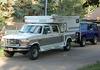
If by "pop up camper" you mean a slide-in pop-up truck camper, I ran one of those (8') on my F-150 SuperCab short-box (picture below). I wouldn't really recommend it. It's really a little to much weight. I added air bags which helped it handle it better, but they really limit wheel travel (not an issue for me). And the truck was still over its rating, so I always sweated when I went by weigh stations. Plus the weight is pretty high for trail riding, and the tie-down points take a pretty good beating if you are twisting the truck up much with the camper on.
I have a '96 F-150, 5.8L/E4OD/4x4/3.55 gears, supercab short box. I rebuilt the (actually a spare) engine after losing compression from a broken ring. Used GT40P heads, ported 5.0/5.8L hybrid intake, stock roller cam, 1.7:1 roller rockers, long tube headers. It woke the truck up, made it a lot nicer to drive. I ran 33x10.5 tires for a while, now on 235/85R16. Great setup empty, but would be better with 4.10 for hauling, or 4.56 if I went to 33"+ tire again. The truck has a flatbed. It got around OK in the mountains, but required momentum as NothingSpecial mentioned. Then I added an Aussie locker and air compressor, now I can air down the tires to 20 psi or so, and go very slow over technical terrain. I removed both sway bars, that helped a lot with articulation for the rocks. I haven't lifted a tire since doing that. The truck is "lifted" only about 1.5" to clear the tires and get heavier springs for hauling. Bilstein shocks help tame the ride on washboard. Not an all out build by any means but it gets around. The 32x9.5 tire is a compromise between road and dirt for me. I end up running a lot of highway. In the last 4 months the truck has been from Arizona to Minnesota and all over in between so highway manners are important to me.
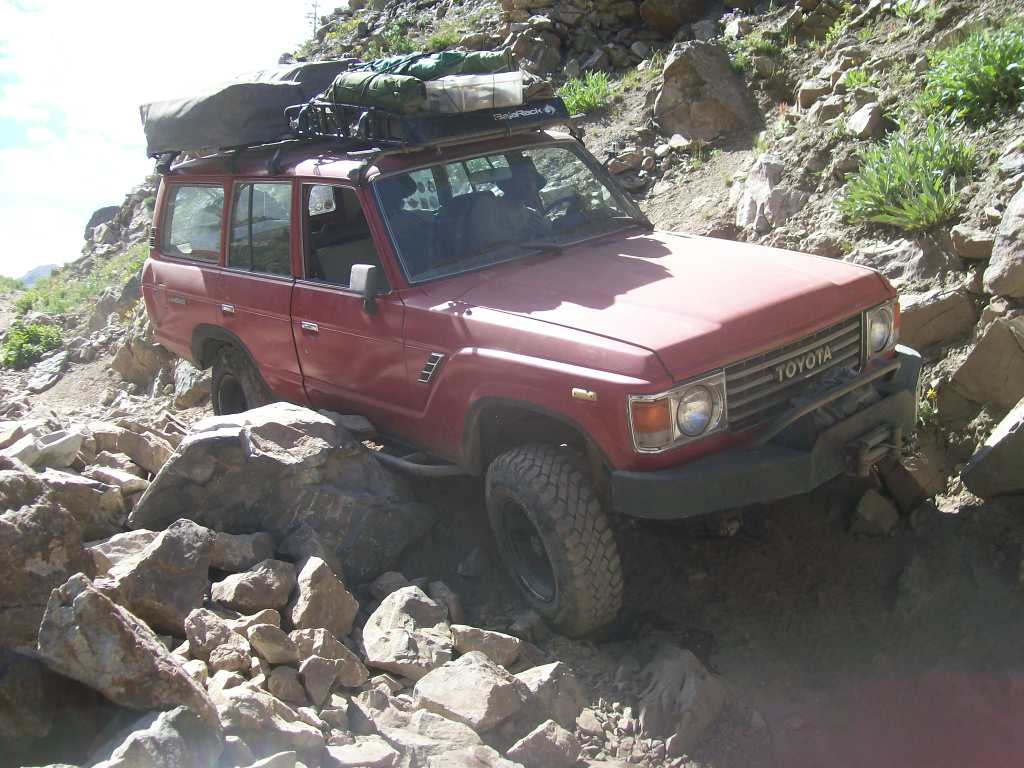
I bought a beat up old Four Wheel Camper a couple years ago, ripped it all apart, and rebuilt it for a flatbed. After some time of running the camper bolted straight to the flatbed, I removed my flatbed, and built an articulating subframe for the camper (search google for "three point flatbed mount"). The frames on these trucks are open C and extremely flexible. Having a camper bolted down to a surface that flexes several inches when the axles get crossed up is no good (worse with a flatbed camper than standard) as the camper gets continuously twisted and can sustain damage. For reference on what these old trucks can do when mildly setup, I drove up from Marble, CO to Crested Butte via Devil's Punchbowl route without so much as slipping a tire. The toughest obstacle was the point shown below (sorry no pictures of my truck doing it, I was solo, snagged this off the TrailsOffroad site). I had to go up over the top of this big rock, due to the camper making the truck top heavy. Stacked a few rocks and walked over top. Wouldn't have made it at full tire pressure and no locker. The only other notable place I've gone you may know is the top of Mosquito Pass. In general I can go down any forest service road, and only turn away from tough Jeep trails that are supposed to be extremely challenging. The biggest limitation, in general, is high center of gravity. I've been as close as you can get to flopping this rig, and it happens much earlier than when empty. Really ups the pucker factor on Colorado shelf roads.
Weight is serious consideration with a half ton truck. With my camper on the truck (no flatbed), minimal fuel, propane, water, food, it sits just under 6k lbs. With fuel, a friend and I, plus a couple bikes & recovery gear it's near 6500 lbs ready to go, GVWR is 6250. With a family & commercially built camper you will rapidly approach the 7k lb mark. My truck runs down the road fine even up to 7k lbs, but know it isn't exactly legal. It may be advisable to start with an HD truck. The frame is 1/4" thick instead of 3/16" and the full float axles are more than capable of handling the weight and the bigger tires you want. Not saying you're wrong to use a half ton but I would think on this carefully. A heavy truck on half ton axles in the rocks can be a delicate endeavor. Not so much for the 8.8" rear but the D44 up front. It won't matter much if it's a solid or TTB, the U-joints and shafts are the same (okay, extra joint & slip on the TTB, but marginally stronger in solid, not worth the effort in my opinion). I'd either use Spicer's best non greasable joints in the D44 TTB to stay cheaper, and then be mindful of the throttle, or go D60. I do like this wheelbase (137"). Longer would be tough on some switchbacks for sure. The supercab is nice. I removed the rear seat and built a platform. Dogs can lay on top, and all my tools & recovery gear fit underneath with room to spare. Might not be so good with a kid unless they can sit in the middle of the bench seat.
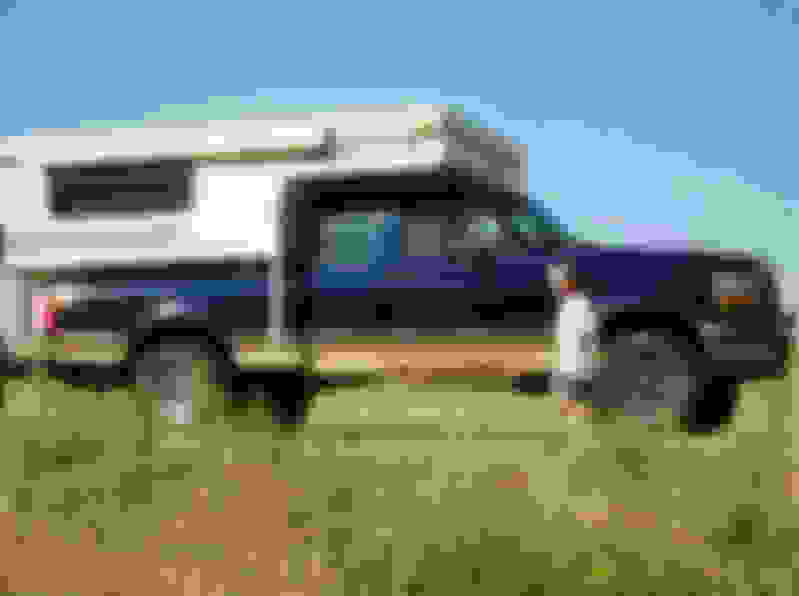
Here's my setup. I must say it feels extremely luxurious considering the places it will go. First trip. Trip where I realized hard mounted flatbed wasn't going to cut it. Articulating subframe. Testing new mount system, full flex. To do this again I would have the camper pivot in the rear, not the front to avoid cab contact.
I'm happy with the truck & camper so far. 35" tires on heavier, deeper geared axles with a little more track width would be beneficial at times. It was a lot of work to get to this point. I'm a single guy and so if I'm not at work I can do whatever I want, like work on the truck/camper whenever I'm home. Family life might draw out the project. Buying a camper that's ready to go would have saved me the most time. Anyway, the above is just some food for thought. My main advice is be realistic about your capabilities and goals, and what you value (building vs exploring). Another thought is don't try to bring your house into the backcountry or you'll end up in an arms race of weight & capacity. I've seen the following pan out on Expedition Portal forums: first try the F150 but with too much gear, have to step to an F250 for all the stuff, but the F250 needs heavier recovery gear and armor, so the F250 gets overloaded, so you get an F450 to haul the gear to recover the truck, but now you need heavier recovery gear, and might as well bring more stuff bc you can. Suddenly you're scaling 12k lbs and can't hardly go anywhere, but boy does your truck look like you get out there. Maybe a little exaggerated but keep it in mind. I think using a gas powered F250 or F350 and being mindful of weight would be a pragmatic approach. I know you just bought the F150 but it sounds like it needs a lot of work.
Here's a link to a thread I started on the various options in differentials. https://www.ford-trucks.com/forums/1...erentials.html. I have my opinions that some will disagree with, but I try to keep those separate from more factual descriptions of how they work. So hopefully it will be a good starting point for you. And even if you've always been able to get by with open diffs, I strongly encourage you to go with at least one locker. They let you crawl over stuff that otherwise you'd need to use momentum for, and momentum is what breaks things (of course that means you just move up to harder obstacles that you need momentum for...!).
For gears I've run 3.55s with 33" tires and a stock 351W with E4OD. I liked that setup for normal street driving. And I have 4.10s with 33" tires, a 302 and NV3550 5 speed manual (with OD) in my Bronco. I like that setup for street and trail (but with an Atlas 4.3:1 transfer case). Most people will tell you that those gears are too tall. And for your use I'd probably agree. With 33" tires I'd say you'd probably be happiest with 4.10 - 4.56 gears. With 35s maybe 4.56 - 4.88. Lower gearing (higher numbers) will help you pull hills better when hauling a load, and will be better on trails. The taller end of that range will be a little less "buzzy" on the freeway (which may or may not matter to you). Mileage probably won't be a lot different (but will almost certainly be lower with taller tires).
I'm not sure what it takes to put a solid axle under an F-150, but there are people asking about it here pretty frequently (search around a little) and it seems to be pretty straightforward. I think the easiest way is to stay with coils and radius arms. Assuming that's true, adding extended radius arms is pretty straightforward. By the way, you said you have your heart set on a solid axle swap, so I won't try to talk you out of it. But the F-150s TTB really isn't a bad choice either.
Sorry, I don't know what the limits of an 8.8" are, or what it takes to beef it up. I'd think you'd be fine stock with up to 33" tires, but that's just a guess. And I'd guess that higher strength axle shafts are available for a little more peace of mind. But I've never looked into that axle much.
If by "pop up camper" you mean a slide-in pop-up truck camper, I ran one of those (8') on my F-150 SuperCab short-box (picture below). I wouldn't really recommend it. It's really a little to much weight. I added air bags which helped it handle it better, but they really limit wheel travel (not an issue for me). And the truck was still over its rating, so I always sweated when I went by weigh stations. Plus the weight is pretty high for trail riding, and the tie-down points take a pretty good beating if you are twisting the truck up much with the camper on.
Buddy...I'll tell you what! That is a nice looking pickup sir! It ready gives perspective to how big those campers are though. I hadn't thought about all the cab contact and rattling about, the clearance issues and the added weight. Check out Goin' Boarding truck in the next comment, its a really cool setup with the way the camper can pivot. I've got a fiberglass topper on my shorty that I "furnished" with a couple memory foam pads and old comforters and the wife likes it alright. Most of the time I throw a tent up and we rack out in there unless the weather's not crazy. The thing that bugs me the most though is unloading/reloading all my gear but it's a small price to pay! That rooftop tent is looking better by the minute!
As far as the SAS goes, I've read probably every thread and write up there is on the subject and I'm very confident I have the skill set to do the conversion. However I agree that the TTB setup is a winner. I'm surprised after all these years some one hasn't developed a better lift kit to contend with all the issues that come with lifting them. My friends Bronco has a 4" lift and 35s and I like the look of it, I just wish there wasn't so much hardware hanging down all over the place. I know the 8.8s are really popular in the hot rod scene, they're great for building a narrowed rear end for a tubbed car so I'm thinking it'll probably stand up to what ill be dishing out for the time being. Oh, double thanks on throwing in a couple different ratios to work with. I need a little more learning when it comes to all that stuff!
This is great! I've been sharing all this info and ideas with my wife and she's really getting in to it! Thank you so much for the help and support, its a real confidence booster. Beautiful truck sir, thank you for sharing it with me.
I have a '96 F-150, 5.8L/E4OD/4x4/3.55 gears, supercab short box. I rebuilt the (actually a spare) engine after losing compression from a broken ring. Used GT40P heads, ported 5.0/5.8L hybrid intake, stock roller cam, 1.7:1 roller rockers, long tube headers. It woke the truck up, made it a lot nicer to drive. I ran 33x10.5 tires for a while, now on 235/85R16. Great setup empty, but would be better with 4.10 for hauling, or 4.56 if I went to 33"+ tire again. The truck has a flatbed. It got around OK in the mountains, but required momentum as NothingSpecial mentioned. Then I added an Aussie locker and air compressor, now I can air down the tires to 20 psi or so, and go very slow over technical terrain. I removed both sway bars, that helped a lot with articulation for the rocks. I haven't lifted a tire since doing that. The truck is "lifted" only about 1.5" to clear the tires and get heavier springs for hauling. Bilstein shocks help tame the ride on washboard. Not an all out build by any means but it gets around. The 32x9.5 tire is a compromise between road and dirt for me. I end up running a lot of highway. In the last 4 months the truck has been from Arizona to Minnesota and all over in between so highway manners are important to me.
I bought a beat up old Four Wheel Camper a couple years ago, ripped it all apart, and rebuilt it for a flatbed. After some time of running the camper bolted straight to the flatbed, I removed my flatbed, and built an articulating subframe for the camper (search google for "three point flatbed mount"). The frames on these trucks are open C and extremely flexible. Having a camper bolted down to a surface that flexes several inches when the axles get crossed up is no good (worse with a flatbed camper than standard) as the camper gets continuously twisted and can sustain damage. For reference on what these old trucks can do when mildly setup, I drove up from Marble, CO to Crested Butte via Devil's Punchbowl route without so much as slipping a tire. The toughest obstacle was the point shown below (sorry no pictures of my truck doing it, I was solo, snagged this off the TrailsOffroad site). I had to go up over the top of this big rock, due to the camper making the truck top heavy. Stacked a few rocks and walked over top. Wouldn't have made it at full tire pressure and no locker. The only other notable place I've gone you may know is the top of Mosquito Pass. In general I can go down any forest service road, and only turn away from tough Jeep trails that are supposed to be extremely challenging. The biggest limitation, in general, is high center of gravity. I've been as close as you can get to flopping this rig, and it happens much earlier than when empty. Really ups the pucker factor on Colorado shelf roads.
Weight is serious consideration with a half ton truck. With my camper on the truck (no flatbed), minimal fuel, propane, water, food, it sits just under 6k lbs. With fuel, a friend and I, plus a couple bikes & recovery gear it's near 6500 lbs ready to go, GVWR is 6250. With a family & commercially built camper you will rapidly approach the 7k lb mark. My truck runs down the road fine even up to 7k lbs, but know it isn't exactly legal. It may be advisable to start with an HD truck. The frame is 1/4" thick instead of 3/16" and the full float axles are more than capable of handling the weight and the bigger tires you want. Not saying you're wrong to use a half ton but I would think on this carefully. A heavy truck on half ton axles in the rocks can be a delicate endeavor. Not so much for the 8.8" rear but the D44 up front. It won't matter much if it's a solid or TTB, the U-joints and shafts are the same (okay, extra joint & slip on the TTB, but marginally stronger in solid, not worth the effort in my opinion). I'd either use Spicer's best non greasable joints in the D44 TTB to stay cheaper, and then be mindful of the throttle, or go D60. I do like this wheelbase (137"). Longer would be tough on some switchbacks for sure. The supercab is nice. I removed the rear seat and built a platform. Dogs can lay on top, and all my tools & recovery gear fit underneath with room to spare. Might not be so good with a kid unless they can sit in the middle of the bench seat.
Here's my setup. I must say it feels extremely luxurious considering the places it will go. First trip. Trip where I realized hard mounted flatbed wasn't going to cut it. Articulating subframe. Testing new mount system, full flex. To do this again I would have the camper pivot in the rear, not the front to avoid cab contact.
I'm happy with the truck & camper so far. 35" tires on heavier, deeper geared axles with a little more track width would be beneficial at times. It was a lot of work to get to this point. I'm a single guy and so if I'm not at work I can do whatever I want, like work on the truck/camper whenever I'm home. Family life might draw out the project. Buying a camper that's ready to go would have saved me the most time. Anyway, the above is just some food for thought. My main advice is be realistic about your capabilities and goals, and what you value (building vs exploring). Another thought is don't try to bring your house into the backcountry or you'll end up in an arms race of weight & capacity. I've seen the following pan out on Expedition Portal forums: first try the F150 but with too much gear, have to step to an F250 for all the stuff, but the F250 needs heavier recovery gear and armor, so the F250 gets overloaded, so you get an F450 to haul the gear to recover the truck, but now you need heavier recovery gear, and might as well bring more stuff bc you can. Suddenly you're scaling 12k lbs and can't hardly go anywhere, but boy does your truck look like you get out there. Maybe a little exaggerated but keep it in mind. I think using a gas powered F250 or F350 and being mindful of weight would be a pragmatic approach. I know you just bought the F150 but it sounds like it needs a lot of work.
Hey there! Thanks for joining in! That's quite the rig you've built! Even just seeing it from the outside it looks luxurious! You must have a TON of room in there. I'm looking forward to reading up on the flatbed conversion, it looks pretty interesting. Also I'm excited about the engine write up. I just read a thread about the GT40 heads and 5.0/5.8 hybrid intake, it sounds awesome but that's going to be new territory for me. I'm excited to learn about it though!
So I'm fairly certain my engine doesn't have the roller rockers, I believe that was 95-96 only. Will this affect or prevent me from doing these upgrades? Is it possible to convert my engine to this style? I'm sure it couldn't be that easy, probably have to change it to a mass air system and reprogram the ECU? Anyways I'm going to dig in to your links when I'm through here.
Is your air compressor the York style (belt driven) or a Viair/ARB style electric pump? I've tossed both ideas around and I'm up in the air (ha) over which to run. I like the York for the continuous pressure, but I'm not sure about another pulley on the belt. On the other hand I'm not impressed with the whole "run for five minutes, cool down for twenty" that comes with the electric either. I will have a storage tank, maybe two so that will help with the duty cycles but what are your thoughts?
After reading what you and NothingSpecial said about the pros and cons of running a camper I think I'm going to go with the fibreglass topper and possibly a rooftop tent. Like I said in my other reply most of the time we just throw up a tent but in case the weather isn't being friendly I put a couple memory foam pads and comforters in the bed of my shorty and they do alright. Any suggestions on making it more comfy in there? I've seen the air mattresses contoured to fit the bed but I've got a big ol clumsy Rottweiler and a tiny little Chihuahua thing with razors on her feet so I know that's not going to be an option! However I was thinking a single mattress would fit right nice between the wheel wells? What do you use to hold your gear from tossing all around? I've got most everything in totes, camping supplies and such, a couple coolers, all the bedding and the camping chairs. I fold/roll the blankets as small as I can and I'm pretty clever in the way I position the totes and coolers (I put some eyelets in the bed rails and use a small ratchet strap to hold them tight to the bed sides) so the dogs can get up to the slider AND have room to lay down but it never fails that the bedding or chairs dislodge and scatter everywhere! I know with the extended cab I'll gain some more storage, I'm just curious how you handle things.
How did you clear 33" tires with only 1.5" of lift? Am I missing something?! What springs did you use in the front? Is the rest of the front end stock? Did you do any type of body lift? I'd really like to run 35s, it may unnecessary but I'd still like to try. I am going to do cutout fender flares so I'll gain some clearance there but if I could run 35s with minimal lift and keep the articulation intact I might just leave the TTB in place.
One last thing I forgot to include in my original post... talk to me about a winch. Is it necessary? Would it be a valuable investment? Do you have one or have plans to incorporate one? If the answer to any of those is yes, would you do a solid bumper mount or utilize a receiver hitch so you could move it front to back?
Well I have to say, your truck is awesome, I would roll that beast anywhere! And the information you've shared with me is invaluable and I appreciate you taking the time to reply with actual thought. I'm going to go read up on your engine build and check out the other link, maybe get some more inspiration. I hope you won't mind if I pick your brain a little more should I have any questions. Thank you again!
For what it's worth, in that picture it has about a 2.5" lift with extended radius arms (otherwise stock TTB) and is sitting on 33/9.50-15 tires.
Gorgeous. May I ask what springs and radius arms you used? If you recall that is. Goin Boarding said he was able to fit 33s with only a 1.5" lift. If that's the case, and your truck is fair proof that it's possible, I may reconsider the SAS and retain the TTB. I really do like the articulation it's capable of I'd just like a little wider track and a little more ground clearance.
I'm happy to share and thanks for the compliments. I really like the camper but yes it can be troublesome off road, mostly those off camber situations. I primarily built it for mtb bike trips and for that it is excellent. Very roomy and can fit bikes inside (out of sight). I've always wondered how a raised ceiling topper on an 8' bed would be for camping, I bet I'd be content with that. My only experience with a truck topper was in a 6' box Tundra with two people and a big dog; it was pretty cramped. We built platform to sleep on with storage underneath, ditched that due to headroom, and ended up with a "kitchen" shelf on one side of the bed with a memory form mattress on the floor next to it. That pickup box was carpeted too. It wasn't a bad setup just no fun to hang out in, which was fine unless the weather was terrible. Even another 4" headroom would have made a big difference.
The back seat area holds most of my random gear, all the heavy stuff gets strapped down so it's not a projectile in a crash or roll over. In the camper everything has it's place or is strapped down. Once in a while something has gone flying but typically not. This was some trial and error. Basically if you think it could maybe come out of place, it will.
For the air compressor I'm just running a $60 unit off Amazon (Master Flow MF-1050). I air up four tires from ~20psi to 50 psi without a break. It takes approximately 20 minutes, maybe a touch faster. A larger compressor sounds great, I was just penny pinching at the time. Wasn't sure how much I'd use it either. I would say this compressor is the smallest to run, bigger will obviously be faster, especially with larger tires, and likely outlast mine that gets pushed on the duty cycle rating.
I have a 9500lb winch on a cradle strapped down under my rear seat platform. Permanent mount has merits but this keeps it out of the elements, and I don't go wheeling to use it, it's just there for the time I'm solo and stuck. I wired in an Anderson powerpole connecter up front, and had previously built a front receiver. I will wire in another plug in the rear at some point. With the locker and low tire pressure though I doubt I'll get much winch use. I wouldn't call it necessary but its good peace of mind, and before the rear locker I have had several situations where I barely got out of a bad spot alone, one little mistake and I'd have been SOL. I got the winch and locker at the same time due to those experiences. I have also used it to drag trees off of the trails when I forget the chainsaw at home.
Springs are Moog CC844 coils up front with a 1/4" shim under them, for about 1.5" lift. The caster/camber bushings were able to correct the camber. The bumper had to shimmed out ~0.5", but then cleared the 33x10.5R15 BFG's just fine (photo in signature line is with 33x10.5 tires), however there wasn't much more room if stuffing the tires off road. Rear leaves came from Jeff's Bronco Graveyard, stock capacity but with the overload arched for a continuous hauling application. They raised the rear 2" over stock, approximately. 35" tires would require more lift, I would guess a 4" kit would do it with the right wheels.
Both non-roller and roller 351W had non-roller rocker arms with a 1.6:1 ratio. The "roller" part of the newer 351W (1994 and up) was in the lifters & camshaft. You could install a F4TE (stock roller motor cam) roller camshaft in your non-roller block if you used link-bar roller lifters. The pre-roller cams were pretty restrictive, where the OEM roller cams are pretty good for a truck motor. Link bar lifters are pricey though, so you could alternatively install a better flat tappet cam that is speed density friendly. Add long tube headers, a little ignition timing bump, and you'll make good improvements for a reasonable investment without digging too deep. I've read the stock heads can support up to 275 hp. There are definitely many different ways to go about it. The main thing is to know these motors are restricted by the exhaust, cam, heads, then intake, in that order. This means that bolting on a good intake to your existing motor won't net you appreciable gains. Stay away from "cold air intakes" or throttle body spacers, both are wastes of money at best.
I went with a lift kit from Tuff Country. That was back in about 1999, I don't know if they are still around. It was a total bolt-on kit with TTB drop brackets,longer radius arms with brackets, rear lift blocks and 4 shocks. I did have alignment problems and bump-seer until I added a drop pitman arm, but after that I was very happy with the results. (edit: I guess they are around, here's a link https://www.tuffcountry.com/)
On the air compressor, there are electrics rated for 100% duty cycle, but they do get more expensive (or less air flow). I would strongly suggest making sure you do go with 100% duty cycle if you go with electric. They aren't real fast, and you will end up pushing it too far if you are airing up 4 tires.
Also adding air tank capacity is a mixed blessing. You can run the compressor and fill the tank(s) while driving and then air up tires faster... until the tank is empty. Then it's a lot slower since the compressor is filling the tires and the tank rather than just the tires. I have a 2.5 gallon tank on my Bronco with a Viair II (I think). It will really only bring one 33/10.50-15 tire from 15 to 35 psi before the tank is down to the same pressure as the tire and you are going slow. I usually fill 2 tires at the end of a trail, then drive a few miles before filling the other 2. And if you go with wider, bigger tires it will be even slower (I'm thinking about 35/12.50-15s on the Bronco and I'm wondering if I'll need to upgrade my air supply). A belt-driven compressor should be faster, or a CO2 tank would be a lot faster (but limited). There are also faster (but more expensive) electrics.
Like GoinBoarding, I have a receiver-mount winch for my Bronco, which is wired for both front and rear use. I suppose a receiver mount probably isn't quite as stout as a permanent mount, especially for angled pulls. But I really didn't want the winch on and in the weather all the time I drive it around town. And being able to move it to the back, or to my pickup (which I haven't wired yet...) was another plus. I've only had the winch for a few trips and I think I've only used it twice (and probably could have gotten by without it then). But like lockers, a winch (if used smart) lets you go slow instead of beating on the truck even harder. So especially if you'll be out on your own, it's a really nice tool to have available. (When I am 'wheeling I leave the winch in the front receiver rather than coming up with another place to stow it in a bobtail.)
Make sure you're front frame, especially in the suspension mounting areas, is well reinforced. The f150 frames were never designed to handle weight like a bed camper and a truck full of overlanding gear, which can easily exceed a ton. Almost all the weight up front is concentrated on about a foot length of frame at the coil spring, where the front leaf sprung 250/350 spread the load over 4+ft of frame rail. It'd be a good idea to consider an engine bay cage and a cross brace to tie the frame and spring /shock mounts together. I've seen where people have tore welded on coil buckets off the frame and where people have twisted the frame rails around the coil buckets by overloading a truck. The RA mounts under the cab can also twist.
My opinion, based on my personal experience of starting with a different generation f150 for a similar project and then bailing on it after rebuilding the frame and lifting the suspension. For a off road toy a 150 is fine but for hauling/towing /heavy work, start with a 250/350. You get better axles, HD suspension, better brakes, stronger steering, stronger frame and usually better cooling system, better charging system, a more HD tranny, aux coolers on tranny and steering, all things that will most likely need to be added /upgrade on a f150 for overlanding. For some states the most important thing a 250/350 has is a higher legal weight capacity. Around here you could get stopped by DOT if they see a 150 with a camper on it, they've been cracking down on overloaded trucks the last few years.
I would've saved, probably a couple thousand dollars and a few years of fooling around if I really thought about my end goals initially and started with more HD truck. I understand the want to build something from scratch, but upgrading existing systems is usually much easier, and cheaper, than adding them. Food for thought.
This Hennessey Takes the Expedition Tremor's Off-Roading Capability to the Next Level
Slideshow: The VelociRaptor Expedition gains a lift, upgraded suspension, Brembo brakes, and trail-ready equipment while retaining the stock 440-horsepower EcoBoost V6.
Rezvani's Latest Post-Apocalyptic Monster Is a Ford F-150 Raptor Underneath
Slideshow: Called the Fortress, the 850-horsepower pickup combines Raptor underpinnings with military-inspired features, survival equipment, and a starting price of $285,000.









 ).
).


