


Advice on the correct stall.....

Thread Starter
|
Mountain Pass
Joined: Feb 2019
Posts: 243
Likes: 1
Advice on the correct stall.....
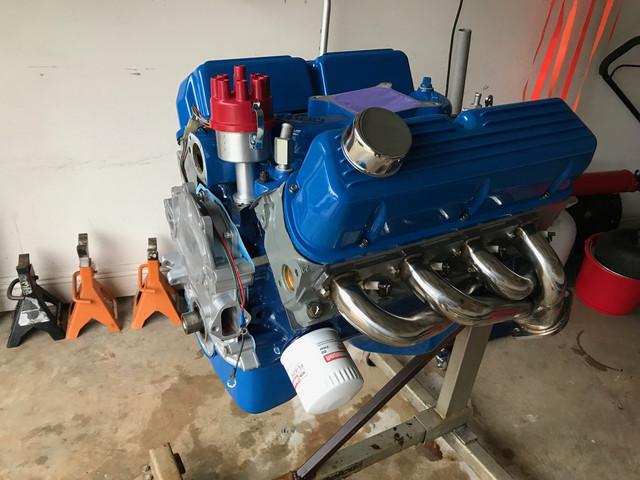
Ok, I have a newly rebuilt 1970 302, 351W, heads 270H cam, shorty headers, 600 Holley 4B and a newly rebuilt C4. This is not going to be a race truck, just a cruiser. What RPM stall is the best match up?
thanks everyone
unisex names that start with k
thanks everyone
unisex names that start with k

Lead Driver
Joined: Jan 2003
Posts: 9,893
Likes: 12
From: Ohio

I would not go too steep. You need to keep in in the lower end of the power band of the cam. Go just over stock. 1800-2000? What gears in the back? You don't want it to be slipping badly as you cruise slowly in town. That build up heat in the converter, so even so make sure you have a nice cooler added.
Thread Starter
|
Mountain Pass
Joined: Feb 2019
Posts: 243
Likes: 1
I replace the pistons with 20 over forged 10.1 compression
when I did the calculations it came to 10.1
I am new to this but I think I got it right
when I did the calculations it came to 10.1
I am new to this but I think I got it right

Tuned
Joined: Jan 2019
Posts: 308
Likes: 27
From: Fallout Shelter
NOTE: Larger cams typically decrease dynamic compression and smaller cams increase it. For instance generally don't put a 250 ADVERTISED duration cam in a 10 to 1 engine....it will probably detonate itself to death unless you make whacky compensations for it. Likewise you normally don't see 292 cam in a 8 to 1 engine.... as it will have very low useful compression and be a turd. This is why for optimal performance you need higher static compression ratios to support larger cams and you want to stick with smaller cams for stockish lower compression ratios. And... If you don't care about performance and just want the engine to sound like the intro to Van Halen's Hot For Teacher....well....I guess you'll have a cool sounding turd....
Trending Topics
Thread Starter
|
Mountain Pass
Joined: Feb 2019
Posts: 243
Likes: 1
Your at 10 to 1 STATIC compression which is what most think of as compression. So yes, you would simply say the engine is 10 to 1 compression when someone asks. Dynamic compression is calculated from static compression, cam timing events, etc. Rule of thumb is about 8.0 to 1 for good performance with iron heads with decent chamber design. Much over that and you get into detonation territory. Much under about 7.5 to 1 or so and you start getting anemic so to speak. Again just a rule of thumb as they're are a lot of variables that come into play with dynamic compression and resistance to detonation. seriously Read up on it sometime, it really gives some good insight on some of the whys?? of engine building and cam selection. There's a bunch of online calculators that you can play with and see how certain cams and static compressions affect dynamic compression.
NOTE: Larger cams typically decrease dynamic compression and smaller cams increase it. For instance generally don't put a 250 ADVERTISED duration cam in a 10 to 1 engine....it will probably detonate itself to death unless you make whacky compensations for it. Likewise you normally don't see 292 cam in a 8 to 1 engine.... as it will have very low useful compression and be a turd. This is why for optimal performance you need higher static compression ratios to support larger cams and you want to stick with smaller cams for stockish lower compression ratios. And... If you don't care about performance and just want the engine to sound like the intro to Van Halen's Hot For Teacher....well....I guess you'll have a cool sounding turd....
NOTE: Larger cams typically decrease dynamic compression and smaller cams increase it. For instance generally don't put a 250 ADVERTISED duration cam in a 10 to 1 engine....it will probably detonate itself to death unless you make whacky compensations for it. Likewise you normally don't see 292 cam in a 8 to 1 engine.... as it will have very low useful compression and be a turd. This is why for optimal performance you need higher static compression ratios to support larger cams and you want to stick with smaller cams for stockish lower compression ratios. And... If you don't care about performance and just want the engine to sound like the intro to Van Halen's Hot For Teacher....well....I guess you'll have a cool sounding turd....
FTE Stories
Ford Trucks for Ford Truck Enthusiasts

Rezvani's Latest Post-Apocalytic Monster Is a Ford F-150 Raptor Underneath
Verdad Gallardo
Top 10 Most Expensive Ford Trucks Ever Sold on Bring a Trailer
Joe Kucinski
2027 Ford Super Duty Buyer's Guide (Every Model, Engine, & Package)
Brett Foote
Top 10 Ford Truck Tragedies
Joe Kucinski
AEV FXL Super Duty - the Super Duty Raptor Ford Doesn't Make
Brett Foote
Lobo Vs Lobo: Proof the F-150 Lobo Should Be Even Lower!
Michael S. Palmer
Ford's 2001 Explorer Sportsman Concept Looks For a New Home
Verdad Gallardo
10 Best Ford Truck Engines We Miss the Most!
Joe Kucinski
2026 Shelby F-150 Off-Road: Better Than a Raptor R?
Brett Foote
Thread
Thread Starter
Forum
Replies
Last Post
78f-150Supercab
Small Block V8 (221, 260, 289, 5.0/302, 5.8/351W)
13
Apr 7, 2008 03:17 PM
jazzy66
FE & FT Big Block V8 (332, 352, 360, 390, 406, 410, 427, 428)
2
Oct 18, 2004 03:08 PM