



Alternator stator wire

Thread Starter
|
Senior User
Joined: May 2016
Posts: 139
Likes: 0
Alternator stator wire
1973 P-400 with a 300 six. My alternator's been working fine, but it appears to be wired differently from all diagrams I can find (mostly for F-series), and now that I'm cleaning up the wiring I have to decide whether to replicate the original circuit or follow diagrams. The question concerns the S terminal at the voltage regulator. It goes to a 4-way junction that's hot in RUN. Other members of the junction are the pink ignition resistor wire, the brake warning lamp, and the red/green ignition switch wire. This junction looks like factory wiring, not like the previous owner's awful and very obvious modifications. However, all diagrams - none of which are specifically for a P-series - say it should go to the STA (stator) terminal on the alternator, which on mine appears to be unused at all (Field, ground, and obviously the B+ posts are used like normal).
Do I have some old oddball alternator? What should I do here?
Do I have some old oddball alternator? What should I do here?

Lead Driver


Joined: Jul 2017
Posts: 9,600
Likes: 1,174
From: San Jose, CA
I'm not 100% sure because it's a P-series, but a question about the dash. Do you have full instrumentation, including an ammeter? Or just the usual indicator lamps for BAT or CHG or whatever they label it as?
Ford in their smaller trucks used two distinct wiring schemes for the regulator. With an ammeter only three wires are used at the regulator, while with indicator lamps all four are utilized.
This may have no bearing on yours unfortunately, but just in case I figured I'd ask.
For the smaller vehicles that used an ammeter, only three positions are used and the Stator wire from the back of the alternator is run straight to the carburetor's automatic choke. ON some trucks this practice only started in '73, but they probably used that on other vehicles earlier perhaps.
If we don't come up with an answer here, have you checked on the "big truck" forums here yet?
Good luck
Paul
Ford in their smaller trucks used two distinct wiring schemes for the regulator. With an ammeter only three wires are used at the regulator, while with indicator lamps all four are utilized.
This may have no bearing on yours unfortunately, but just in case I figured I'd ask.
For the smaller vehicles that used an ammeter, only three positions are used and the Stator wire from the back of the alternator is run straight to the carburetor's automatic choke. ON some trucks this practice only started in '73, but they probably used that on other vehicles earlier perhaps.
If we don't come up with an answer here, have you checked on the "big truck" forums here yet?
Good luck
Paul
Thread Starter
|
Senior User
Joined: May 2016
Posts: 139
Likes: 0
Thanks. I have an ammeter, and the only warning lamp is the big one for the brakes. It's my understanding that the I terminal on the voltage regulator is for the alternator idiot light. There is no wire on my I terminal. I have a manual choke, the cable for which appears (on the same basis as the wiring: clean install contrasted with PO's hackjobs) to be factory-installed.
Lead Driver
Joined: Jul 2017
Posts: 9,600
Likes: 1,174
From: San Jose, CA
Ok, we may be on to something then.
With an ammeter the other trucks do not utilize the "I" position of the regulator. Only the F, S and A connections are made.
The F is the Orange Field wire to the FLD terminal on the back of the alternator.
The S terminal would have a Green w/red Switched wire from the ignition switch directly. Along with the ignition coil, it's the only other wire that is hot with the key both in START and RUN, but not ACC.
The A terminal would have a Yellow Sensing wire that is connected directly to one of the main battery hot wires, so it stays hot all the time.
I think the original meanings of the letters were Field, Stator, Armature and Indicator.
But for our use, I've always changed the S to "switched" and the A to "always hot" just for my own memory game.
You say your alternator charges currently? If so, can you tell if this is how it's wired? Perhaps pull the connector and check the wires for readings. Should be full battery voltage on the Yellow A wire, but only with the key ON for the Green w/red S wire.
Hope that's it.
Oh, and does your ammeter work? If you don't mind, could you peek up under the dash and find out if the Black w/yellow wire runs through an inductive loop on the back, or if it's just ring terminals on studs with nuts as an "in" and "out" connection?
If it turns out to be too hard to see under there, don't break your neck twisting it around like a pretzel like we have to do on our smaller trucks! Hopefully yours is easier.
Thanks
Paul
With an ammeter the other trucks do not utilize the "I" position of the regulator. Only the F, S and A connections are made.
The F is the Orange Field wire to the FLD terminal on the back of the alternator.
The S terminal would have a Green w/red Switched wire from the ignition switch directly. Along with the ignition coil, it's the only other wire that is hot with the key both in START and RUN, but not ACC.
The A terminal would have a Yellow Sensing wire that is connected directly to one of the main battery hot wires, so it stays hot all the time.
I think the original meanings of the letters were Field, Stator, Armature and Indicator.
But for our use, I've always changed the S to "switched" and the A to "always hot" just for my own memory game.
You say your alternator charges currently? If so, can you tell if this is how it's wired? Perhaps pull the connector and check the wires for readings. Should be full battery voltage on the Yellow A wire, but only with the key ON for the Green w/red S wire.
Hope that's it.
Oh, and does your ammeter work? If you don't mind, could you peek up under the dash and find out if the Black w/yellow wire runs through an inductive loop on the back, or if it's just ring terminals on studs with nuts as an "in" and "out" connection?
If it turns out to be too hard to see under there, don't break your neck twisting it around like a pretzel like we have to do on our smaller trucks! Hopefully yours is easier.
Thanks
Paul
Thread Starter
|
Senior User
Joined: May 2016
Posts: 139
Likes: 0
That is indeed how it's wired, more or less - S wire is a red-green to the ignition switch. However, diagrams show it going to the alternator, hence my confusion.
Ammeter is inductive loop, not inline. It does work.
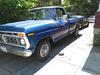
Little pretzeling required here. The dash is mildly awkward but the rest of the vehicle has fantastically easy access for maintenance, a good thing because it needs a lot of maintenance, and without factory schematics I had to document all the wiring by tracing it myself. There's a hood, a doghouse, an engine bay big enough for a 460, a cab big enough to stand up in, and the floor unbolts to access the transmission. You can - as I did before driving it home - replace the transmission output bearing in pouring rain, standing on the ground inside the cab.

Ammeter is inductive loop, not inline. It does work.
Little pretzeling required here. The dash is mildly awkward but the rest of the vehicle has fantastically easy access for maintenance, a good thing because it needs a lot of maintenance, and without factory schematics I had to document all the wiring by tracing it myself. There's a hood, a doghouse, an engine bay big enough for a 460, a cab big enough to stand up in, and the floor unbolts to access the transmission. You can - as I did before driving it home - replace the transmission output bearing in pouring rain, standing on the ground inside the cab.
Logistics Pro


Joined: Jul 2005
Posts: 4,217
Likes: 154
Cool truck! Construction work?
Lead Driver
Joined: Jul 2017
Posts: 9,600
Likes: 1,174
From: San Jose, CA
Mobile RR Electrical & Plumbing Supply & Service & Livestock Feed Provider!
You can be whatever you want to be with that thing.
So, back to the issue. It sounds like the typical "diagram does not match reality" issue with Fords.
It's not that the diagram you're showing is not correct. It's just that it's only correct for some Ford vehicles. The ones with your type of ammeter are always connected the alternate way, with only 3 positions of the regulator used, and the stator not utilized at all.
And those ammeters, unlike the later shunted-type, work a treat. I've heard of them getting old and failing, but never personally experienced one, or even seen one up close. They just keep working for the most part, and are perfectly safe too, unlike pass-through ammeters that can be overpowered and start fires.
The only limitation in current flow is the size and length of the charge wire itself. Unfortunately Ford usually used a heavy jacketed 10ga wire. Fine for up to about 70 amps in the smaller vehicles (with shorter wire runs) but a larger vehicle like yours may have more wire length and a more limited capacity.
Then again, your engine is right there under the dash practically, so yours might be even shorter!
Either way, remember that the large Black w/yellow wire you're going to be seeing at various parts of the system is one big "charge loop" where it exits the alternator, runs up through the cabin, feeds the fuse panel, accommodates various splices for feeding other branches, and then heads back out to the engine compartment and the starter relay's battery side.
All power runs from the battery to the rest of the vehicle, until the engine starts and then the alternator pushes back with it's 14.5v and feeds all accessories and charges the battery at the same time.
Sorry if you knew all that already, but it's worth mentioning anyway. And means that, like most vehicles, whenever you're working on the alternator that Black w/yellow wire is always hot.
Some Fords used Black w/red stripe at the battery and Black w/yellow at the alternator, while others used Black w/yellow the entire run. Still others were Black only at the battery side. Function is the same, just the wire colors varied.
The Green w/red wire is just the "exciter" wire that tells the regulator to turn on. The Yellow (or Yellow w/white sometimes) is the battery voltage sensing wire. The Orange Field wire still just sends a variable voltage to tell the alternator how much to charge.
Paul
You can be whatever you want to be with that thing.
So, back to the issue. It sounds like the typical "diagram does not match reality" issue with Fords.
It's not that the diagram you're showing is not correct. It's just that it's only correct for some Ford vehicles. The ones with your type of ammeter are always connected the alternate way, with only 3 positions of the regulator used, and the stator not utilized at all.
And those ammeters, unlike the later shunted-type, work a treat. I've heard of them getting old and failing, but never personally experienced one, or even seen one up close. They just keep working for the most part, and are perfectly safe too, unlike pass-through ammeters that can be overpowered and start fires.
The only limitation in current flow is the size and length of the charge wire itself. Unfortunately Ford usually used a heavy jacketed 10ga wire. Fine for up to about 70 amps in the smaller vehicles (with shorter wire runs) but a larger vehicle like yours may have more wire length and a more limited capacity.
Then again, your engine is right there under the dash practically, so yours might be even shorter!
Either way, remember that the large Black w/yellow wire you're going to be seeing at various parts of the system is one big "charge loop" where it exits the alternator, runs up through the cabin, feeds the fuse panel, accommodates various splices for feeding other branches, and then heads back out to the engine compartment and the starter relay's battery side.
All power runs from the battery to the rest of the vehicle, until the engine starts and then the alternator pushes back with it's 14.5v and feeds all accessories and charges the battery at the same time.
Sorry if you knew all that already, but it's worth mentioning anyway. And means that, like most vehicles, whenever you're working on the alternator that Black w/yellow wire is always hot.
Some Fords used Black w/red stripe at the battery and Black w/yellow at the alternator, while others used Black w/yellow the entire run. Still others were Black only at the battery side. Function is the same, just the wire colors varied.
The Green w/red wire is just the "exciter" wire that tells the regulator to turn on. The Yellow (or Yellow w/white sometimes) is the battery voltage sensing wire. The Orange Field wire still just sends a variable voltage to tell the alternator how much to charge.
Paul
Trending Topics
Lead Driver
Joined: Jul 2017
Posts: 9,600
Likes: 1,174
From: San Jose, CA
On diagrams, the pre-'72 schematics for Ford trucks (and some cars with ammeters) will typically tell this tale more accurately than the more common charge system diagrams. We see professional mechanics that are familiar with Fords still wire the regulators incorrectly when they get one to work on. Simply because they never ran across an ammeter-equipped car before.
If you do not have an old Chilton's Bronco or Pickup book, you can find some early diagrams at Seabiscuit68.tripod.com to get some reference points. Won't be for your vehicle unfortunately, but will show the early style wiring.
Paul
If you do not have an old Chilton's Bronco or Pickup book, you can find some early diagrams at Seabiscuit68.tripod.com to get some reference points. Won't be for your vehicle unfortunately, but will show the early style wiring.
Paul
FTE Stories
Ford Trucks for Ford Truck Enthusiasts

Rezvani's Latest Post-Apocalytic Monster Is a Ford F-150 Raptor Underneath
Verdad Gallardo
Top 10 Most Expensive Ford Trucks Ever Sold on Bring a Trailer
Joe Kucinski
2027 Ford Super Duty Buyer's Guide (Every Model, Engine, & Package)
Brett Foote
Top 10 Ford Truck Tragedies
Joe Kucinski
AEV FXL Super Duty - the Super Duty Raptor Ford Doesn't Make
Brett Foote
Lobo Vs Lobo: Proof the F-150 Lobo Should Be Even Lower!
Michael S. Palmer
Ford's 2001 Explorer Sportsman Concept Looks For a New Home
Verdad Gallardo
10 Best Ford Truck Engines We Miss the Most!
Joe Kucinski
2026 Shelby F-150 Off-Road: Better Than a Raptor R?
Brett Foote
Thread Starter
|
Senior User
Joined: May 2016
Posts: 139
Likes: 0
It's not that the diagram you're showing is not correct. It's just that it's only correct for some Ford vehicles. The ones with your type of ammeter are always connected the alternate way, with only 3 positions of the regulator used, and the stator not utilized at all.
...
...
On diagrams, the pre-'72 schematics for Ford trucks (and some cars with ammeters) will typically tell this tale more accurately than the more common charge system diagrams. We see professional mechanics that are familiar with Fords still wire the regulators incorrectly when they get one to work on. Simply because they never ran across an ammeter-equipped car before.
Alternators are a bit of a knowledge gap for me. Do I risk suboptimal function or damage if I wire it one way or the other (S on the VR to the alt, vs. to the ignition)?
FTE Legend

Joined: Nov 2015
Posts: 30,912
Likes: 4,123
From: Angier, NC

On the ALT side the stator stud in not used, left off or open.
As 1ton said in later years the stator side of the ALT is wired to the choke, my 81 F100 with a 330 six is this way.
I have not traced the REG side of the wires as my system is charging, if it's not broke don't fix it!
FYI My 81 has all gauges.
Dave ----
As 1ton said in later years the stator side of the ALT is wired to the choke, my 81 F100 with a 330 six is this way.
I have not traced the REG side of the wires as my system is charging, if it's not broke don't fix it!
FYI My 81 has all gauges.
Dave ----
Lead Driver
Joined: Jul 2017
Posts: 9,600
Likes: 1,174
From: San Jose, CA
I have no idea why the change, but they did it for some reason and it works either way.
Certainly the short fused run from the alternator is simpler and cleaner. And easier to service if something goes wrong.
But you can try without it to see if it still works. But likely it will not.
You can wire it through a light, or just directly to the key, but I bet it has to be turned on with the ignition switch or nothing happens.
Interestingly enough, even when it was wired for the lamp, the stator wire was still tapped into to heat up the choke. The other way, the choke was it's only duty, but this way it handled both the alternator function and choke.
On the newer generation of alternators like the 3g and 4g versions (not sure about 6g and above) the stator wire is back and does connect to the regulator.
It still comes down to why they felt it was necessary to change the wire orientation for an ammeter vs an indicator lamp. And I just don't know the answer.
Never seen it in print either, but maybe there's a Wikipedia entry somewhere waiting for us to find it!
But an alternator is an alternator, and should function just fine if it's connected as the factory intended.
Good luck.
Paul
Thread Starter
|
Senior User
Joined: May 2016
Posts: 139
Likes: 0
Voltmeter is sampling the alternator: negative wire goes straight to the alternator bracket which is shared with the main battery-to-block ground strap, as well as an extra ~8ga ground wire from the alternator ground post that's 3 inches away (seemed redundant but I suspected there was a reason they made a GND terminal, two even). Voltmeter positive wire goes straight to the alternator positive terminal. Both wires are ~14ga and neither spliced nor shared with anything else.
I relocated my starter relay to be closer to the battery and alternator. Now only one wire (starter power) has to go by the exhaust, wheras before it was a bunch of wires that went there and mostly came back; unnecessary looping and in a high-heat area. The always-hot starter relay post doubles as a power distribution post, as it did before. I set up my VR so that its A terminal reads off that post, ~2 feet of 4ga wire away from the battery positive. VR has an extra ground going from its case to one of the alternator GND posts. This way the VR is sampling the battery fairly directly.
There are a few areas of excessive wire looping on this rig. It was made as a 2-ton truck in Louisville in June '73, then shipped to Sherman TX to have Olson (Grumman?) put a body on it in August. Louisville probably wasn't exactly sure what would end up on the frame, so they made some wires much longer than needed, and only 45 years later is anyone bothering to clean it up
My VR plug has nothing but a plastic hole for the I terminal.
This all started when my distributor crapped the bed and I decided to convert to Duraspark. Just need to install plugs and beef up the drive gear pin, and it'll hopefully be ready to fire up.
It's a DIY motorhome, though mostly used for storage lately. Very incomplete except 4 inches of polyiso on every surface and extreme minimization of thermal bridging (I got clever about construction techniques).
I relocated my starter relay to be closer to the battery and alternator. Now only one wire (starter power) has to go by the exhaust, wheras before it was a bunch of wires that went there and mostly came back; unnecessary looping and in a high-heat area. The always-hot starter relay post doubles as a power distribution post, as it did before. I set up my VR so that its A terminal reads off that post, ~2 feet of 4ga wire away from the battery positive. VR has an extra ground going from its case to one of the alternator GND posts. This way the VR is sampling the battery fairly directly.
There are a few areas of excessive wire looping on this rig. It was made as a 2-ton truck in Louisville in June '73, then shipped to Sherman TX to have Olson (Grumman?) put a body on it in August. Louisville probably wasn't exactly sure what would end up on the frame, so they made some wires much longer than needed, and only 45 years later is anyone bothering to clean it up
It might still be necessary. All the Ford diagrams show it using a bypass resistor that is typically used when you need that circuit to be on any time the key is on. Whether the bulb burns out or not.
This all started when my distributor crapped the bed and I decided to convert to Duraspark. Just need to install plugs and beef up the drive gear pin, and it'll hopefully be ready to fire up.
It's a DIY motorhome, though mostly used for storage lately. Very incomplete except 4 inches of polyiso on every surface and extreme minimization of thermal bridging (I got clever about construction techniques).

New User
Joined: Jun 2019
Posts: 2
Likes: 0
Question about stator location
Ok i just changed my alternator and wiring because it burned up but i am not sure what to do with the stator wire i put one end on the alternator and the other on the bolt to the voltage regulator but I started my truck and the wire puffed up and melted is there a better place to put the wire? And what gauge should it be?
Thread Starter
|
Senior User
Joined: May 2016
Posts: 139
Likes: 0
Punctuation, please. It's the difference between "it's time to eat, grandma!" and "it's time to eat grandma!"
I learned since my original post... An alternator generates an AC voltage that is then converted (rectified) by diodes into DC. The STAtor terminal is connected to coil output before it gets to the diodes, so it puts out an AC voltage. Among its uses are as a tach signal, or to power electric components that can run on AC, such as the choke heater.
It sounds like you connected a high-current AC wire straight to ground; of course it melted. Leave that wire off unless you need it for something specific.
I learned since my original post... An alternator generates an AC voltage that is then converted (rectified) by diodes into DC. The STAtor terminal is connected to coil output before it gets to the diodes, so it puts out an AC voltage. Among its uses are as a tach signal, or to power electric components that can run on AC, such as the choke heater.
It sounds like you connected a high-current AC wire straight to ground; of course it melted. Leave that wire off unless you need it for something specific.
Lead Driver
Joined: Jul 2017
Posts: 9,600
Likes: 1,174
From: San Jose, CA
Where was it before? Do you have any diagrams, or old wires to compare?
It melted because it carries power when the alternator is running, so you simply shorted it out to ground by attaching it to the bolt. A stator is part of the inner workings, and is not a ground. The only wire that runs from an alternator to a regulator mounting bolt is a ground wire.
So a few important questions first:
1. What year is your truck?
2. Does it have full gauges in the dash, or warning lamps? That dictates where the wire goes, but there are only two places with stock alternators.
3. Is this a stock type alternator?
If you have gauges, which most of our trucks are optioned with, your stator wire would have been to power the carburetor choke.
If you have indicator lamps, the stator wire runs to the stator ("S") terminal on the voltage regulator.
Let us know what you have exactly and we can run down all the important wires for the alternator system.
Oh, and welcome to Ford-Trucks too! Sorry to hear about the melt-down.
Paul
It melted because it carries power when the alternator is running, so you simply shorted it out to ground by attaching it to the bolt. A stator is part of the inner workings, and is not a ground. The only wire that runs from an alternator to a regulator mounting bolt is a ground wire.
So a few important questions first:
1. What year is your truck?
2. Does it have full gauges in the dash, or warning lamps? That dictates where the wire goes, but there are only two places with stock alternators.
3. Is this a stock type alternator?
If you have gauges, which most of our trucks are optioned with, your stator wire would have been to power the carburetor choke.
If you have indicator lamps, the stator wire runs to the stator ("S") terminal on the voltage regulator.
Let us know what you have exactly and we can run down all the important wires for the alternator system.
Oh, and welcome to Ford-Trucks too! Sorry to hear about the melt-down.
Paul