





Autolite 2100 Float Spring Part #

Thread Starter
|
Post Fiend
Joined: Apr 2002
Posts: 19,311
Likes: 97
From: Waterloo, Iowa
Autolite 2100 Float Spring Part #

These float springs are not in the rebuild kits, they are available but I'd still like to find a part #; this has an extra letter so is not correct? Designed to "resist and absorb fuel pump pressure pulsations" and also keep fuel level steady on rough trails or uneven terrain.

Lead Gopher


Joined: Aug 2012
Posts: 10,049
Likes: 1,603
From: Seattle

Are you talking about the "F" in there. That's correct.
C3AZ-9F570-A - Float Dampener Spring.
There are a ton of parts with more than 4 digits in the base number.
Heck, check out these part numbers for the door trim panel as an example of some longer part numbers
RH Front Door Trim Panel - C5TZ-8123942-BAB - 1 each
LH Front Door Trim Panel - C5TZ-8123943-BAB - 1 each
Chad
C3AZ-9F570-A - Float Dampener Spring.
There are a ton of parts with more than 4 digits in the base number.
Heck, check out these part numbers for the door trim panel as an example of some longer part numbers
RH Front Door Trim Panel - C5TZ-8123942-BAB - 1 each
LH Front Door Trim Panel - C5TZ-8123943-BAB - 1 each
Chad
Thread Starter
|
Post Fiend
Joined: Apr 2002
Posts: 19,311
Likes: 97
From: Waterloo, Iowa
Well Ok, there it is! Looks to me there was actually a primary and secondary spring. They used the primary spring as far back as 1963 in the 2 bl 2100, a couple EBay sellers have them. $2.00 at Mikes. $37 for the one in the pic, and it's yours. The secondary spring used in the 4 barrels, is unobtanium, I think. May have been wound different/backwards.
Lead Gopher
Joined: Aug 2012
Posts: 10,049
Likes: 1,603
From: Seattle
I enjoy winding springs. I can't do every style of spring, like ones that change diameters in it's length (9636 in the drawing above is an example of this). But, I have done quite a number of springs over the years. Here's some of the parameters I use.
wire diameter - I use calipers to measure this
I.D. or O.D. of spring coils - either number is fine - the wire diameter x2 determines the other number - again measured with calipers
direction of wind - clockwise/counterclockwise - the one in your picture I'd call clockwise
compression or tension - the one in your picture is tension
number of winds - probably about 11 in that picture, but it's good to get an accurate count
style of "legs" - straight, hooked ends, where any bends occur.
Also, as a spring is wound it has to be done on a mandrel that is slightly smaller in diameter than the I.D. of the desired spring and an extra bit on the winds, because as the tension of winding the spring is relaxed it both unwinds some and gets larger in diameter some. The finer the wire diameter the less variation in "winding" versus "static" values.
Chad
wire diameter - I use calipers to measure this
I.D. or O.D. of spring coils - either number is fine - the wire diameter x2 determines the other number - again measured with calipers
direction of wind - clockwise/counterclockwise - the one in your picture I'd call clockwise
compression or tension - the one in your picture is tension
number of winds - probably about 11 in that picture, but it's good to get an accurate count
style of "legs" - straight, hooked ends, where any bends occur.
Also, as a spring is wound it has to be done on a mandrel that is slightly smaller in diameter than the I.D. of the desired spring and an extra bit on the winds, because as the tension of winding the spring is relaxed it both unwinds some and gets larger in diameter some. The finer the wire diameter the less variation in "winding" versus "static" values.
Chad
Thread Starter
|
Post Fiend
Joined: Apr 2002
Posts: 19,311
Likes: 97
From: Waterloo, Iowa
Thanks ND!
Yeah I thought about winding one up, tho for $2 it's hard to justify spending the time. The only thing though, doesn't the wire need to be annealed or un-annealed or hardened or whatever? Heat it up cherry red and quench it in oil or something?
Yeah I thought about winding one up, tho for $2 it's hard to justify spending the time. The only thing though, doesn't the wire need to be annealed or un-annealed or hardened or whatever? Heat it up cherry red and quench it in oil or something?
Lead Gopher
Joined: Aug 2012
Posts: 10,049
Likes: 1,603
From: Seattle
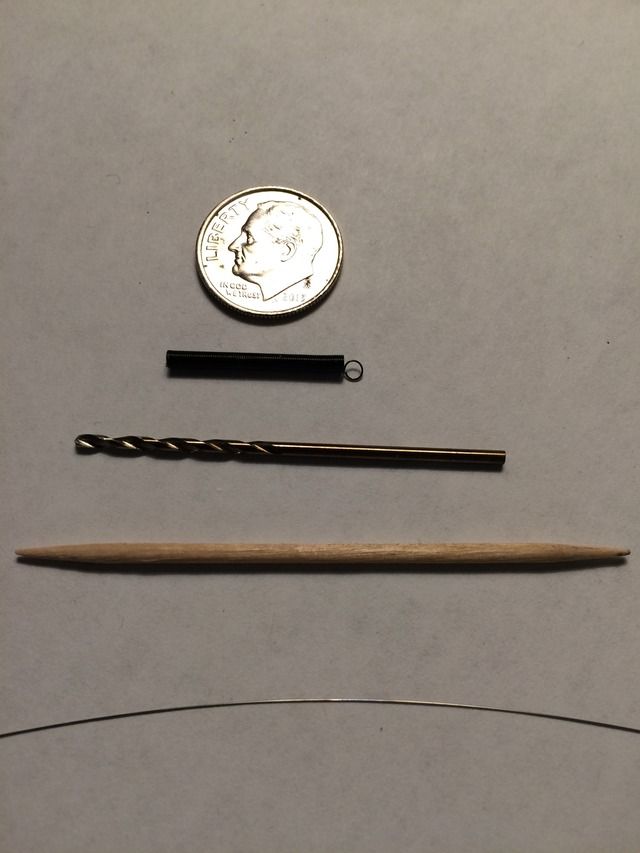
Here's a spring I've been trying to perfect. It's from the inside of the "Tic-Tac Clock" in my Trans Am. One end is missing the loop. It broke off at some point in its life and so the clock won't auto-rewind. The spring wire diameter is .006" or about as thick as the thickest human hair. Just about 100 windings in the spring. Compare to the dime just above it for scale. 1/16" drill bit fits inside. Toothpick is too large.
Chad

Chad
Trending Topics
Thread Starter
|
Post Fiend
Joined: Apr 2002
Posts: 19,311
Likes: 97
From: Waterloo, Iowa
B string on acoustic guitar is .015" or thereabouts. Hm. Could try winding my own float springs I guess. Just to see if it works.
FTE Stories
Ford Trucks for Ford Truck Enthusiasts

2027 Ford Super Duty Buyer's Guide (Every Model, Engine, & Package)
Brett Foote
Top 10 Ford Truck Tragedies
Joe Kucinski
AEV FXL Super Duty - the Super Duty Raptor Ford Doesn't Make
Brett Foote
Lobo Vs Lobo: Proof the F-150 Lobo Should Be Even Lower!
Michael S. Palmer
Ford's 2001 Explorer Sportsman Concept Looks For a New Home
Verdad Gallardo
10 Best Ford Truck Engines We Miss the Most!
Joe Kucinski
2026 Shelby F-150 Off-Road: Better Than a Raptor R?
Brett Foote
2027 Super Duty Carhartt Package First Look: 12 Things You NEED to Know!
Michael S. Palmer
10 Most Surprising 2026 Ford Truck Features!
Joe Kucinski
Lead Gopher
Joined: Aug 2012
Posts: 10,049
Likes: 1,603
From: Seattle
Exactly, you just use "Spring Wire" - Also referred to as "Music Wire". I buy the Precision Brand that Grainger sells. The whole endeavor is best reserved for springs that can't be sourced elsewhere. It takes a LOT of practice, too. But, a pound of spring wire can often make a good number of springs, too. It varies greatly. Anywhere from the 0.006" (4/0) diameter wire - 1 pound of it - is almost 2 miles long! And a minimum tensile strength of 419,000 PSI. It's really good stuff. That's a small box of it that fits in one hand. In the picture above it is the lowest in the picture, just below the toothpick.
0.029" (12 gauge) wire seems to be a common size that I use and it comes in a 1 pound box of 446 feet.
0.055" (24 gauge) wire is another common size I seem to use a lot. A 1 pound box is 124 feet.
0.085" (31 gauge) wire is down to just 52 feet in a one pound box.
Might still sound like a lot but once you start winding a spring it tends to use it quicker than one might imagine. A 1 inch diameter spring uses 3+ inches per turn or more than 1 foot for 4 turns.
This last size is getting large enough that if something goes wrong while winding it all heck can break loose, too. I use safety glasses and gloves when working with any of it and a leather shop coat when working with all but the tiny stuff.
You can get it in either a carbon steel alloy or stainless steel. Prices are not bad. The box of 0.055" in the alloy is $9.40.
https://www.grainger.com/product/PRE...sic-Wire-3L589
Chad
0.029" (12 gauge) wire seems to be a common size that I use and it comes in a 1 pound box of 446 feet.
0.055" (24 gauge) wire is another common size I seem to use a lot. A 1 pound box is 124 feet.
0.085" (31 gauge) wire is down to just 52 feet in a one pound box.
Might still sound like a lot but once you start winding a spring it tends to use it quicker than one might imagine. A 1 inch diameter spring uses 3+ inches per turn or more than 1 foot for 4 turns.
This last size is getting large enough that if something goes wrong while winding it all heck can break loose, too. I use safety glasses and gloves when working with any of it and a leather shop coat when working with all but the tiny stuff.
You can get it in either a carbon steel alloy or stainless steel. Prices are not bad. The box of 0.055" in the alloy is $9.40.
https://www.grainger.com/product/PRE...sic-Wire-3L589
Chad

Thread
Thread Starter
Forum
Replies
Last Post
Stinson1
2017 - 2022 Super Duty
2
Nov 14, 2018 12:06 PM
Stinky7-11
1973 - 1979 F-100 & Larger F-Series Trucks
1
Nov 4, 2011 11:08 PM