


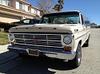

1968 F100 360 ONGOING PROBLEMS

Thread Starter
|
New User
Joined: Apr 2018
Posts: 15
Likes: 0
1968 F100 360 ONGOING PROBLEMS
Long drawn out mess!!! This is my second post.I received some great advice from the first, however, I am still having the same issue. 1968 F100, 58,000 original miles, 360, 3 on the tree, Autolite 2100 Carburetor, manual choke. Truck would start great when cold and run smooth for as long as I wanted. Shut it off, wait 10 minutes, would flood and be very hard to start. I rebuilt carb. flooded ALL the time real bad so I purchsed a professionally rebuilt 2100. Installed and truck would jerk and lunge while driving. Thought I got a bad carb so I returned it and got a second 2100. Same problem. Checked timing. Book says 6 DBTDC. was at 12 so I dialed it back to 6. Still jerking. Have tried every degree between 6 and 20. Some better than others but still not right. Replaced Fuel pump, lines and filters Still Same. Replaced Vacuum advance??? Original had two vacuum lines, one to the carb the other to the back of the intake manifold. LMC Truck, Dennis Carpenter Ford Parts and all of my local parts stores show the replacement advance that has only one line to the carb. So I installed that. Adjusted to 3 turns out like the manufacturer suggested and blocked off the intake manifold connection. Still jerks!!!! Adjusted vacuum advance everywhere from 2.5 to 5 turns out. Some better than others but still not right. SOOOO, I installed new Motorcraft Spark plugs, gaped .035. Same problem. Replaced Distributor cap with top of the line cap with copper contacts and new rotor button. Same problem. SOOO, installed new PERTRONIX electronic ignition module in distributor and did away with points and condenser. Also new coil. SAME PROBLEM!!!!!!! Went back and checked timing again and fiddled with the vacuum advance also. Same problem. I am about ready to drive it off a cliff. I THINK it has something to do with the timing and vacuum advance that I am missing. Should the vacuum advance have TWO lines instead of one? Thanks in advance for you HELP!!!

Fleet Owner
Joined: Dec 2009
Posts: 20,678
Likes: 82
From: NorCal
With a Pertronix, one of the vacuum ports on the dizzy gets capped off. The one that is inside-facing if I recall correctly... it's been a while and not something I readily notice since it was done by the PO.
Thread Starter
|
New User
Joined: Apr 2018
Posts: 15
Likes: 0
There is only one vacuum port available on the new replacement vacuum advance that I have and that is the one that goes to the carburetor. As I originally stated, my original vacuum advance had two vacuum ports; one to the carburetor and one to the intake manifold. All suppliers that I dealt with showed the new replacement advance as only having the one that goes to the carb. So that is what I am running now. I plugged off the other port on the intake manifold. I am wondering if the one port instead of the two port vacuum advance is the problem and if so why are all the expert suppliers (LMC, Dennis Carpenter, Autozone, Oreillys, Federated) suggesting the WRONG???? one. This is a true mistery to me! It all started with just replacing the faulty ORIGINAL carburetor.

Hotshot


Joined: Mar 2013
Posts: 14,255
Likes: 199
From: Phoenix, Az.
There is only one vacuum port available on the new replacement vacuum advance that I have and that is the one that goes to the carburetor. As I originally stated, my original vacuum advance had two vacuum ports; one to the carburetor and one to the intake manifold. All suppliers that I dealt with showed the new replacement advance as only having the one that goes to the carb. So that is what I am running now. I plugged off the other port on the intake manifold. I am wondering if the one port instead of the two port vacuum advance is the problem and if so why are all the expert suppliers (LMC, Dennis Carpenter, Autozone, Oreillys, Federated) suggesting the WRONG???? one. This is a true mistery to me! It all started with just replacing the faulty ORIGINAL carburetor.

Postmaster
Joined: Mar 2011
Posts: 2,698
Likes: 7
From: Taxachusetts
In all the rebuilt carbs you got I'm wondering if the "professionals" who rebuilt them took care to check/clean the check ball and little "weight" that holds the ball in place. They're small and resting below the venturi assembly.
What you could do if so inclined: Remove the cover plate - 4 screws(?) and then remove the venturi assembly - one screw. Carefully lift it out....take a gander at the emulsion tubes .... no cracks?
Beneath the one screw you took out from the venturi assembly should be the "weight" - a small, thin metal rod, and under that is the check ball. You might have to yank the carb in order to get the ball out...as you might have to turn it upside down to get it out. Be CAREFUL here!!! If you have 'em both, clean 'em and the passages, as well as the emulsion tubes. Carefully replace in carb after cleaning.... set the mixture screws to 1.5 turns out (ballpark number - you can fine tune it later) and give it a whirl.
Now, without the check ball and weight in place the fuel supply would go ka-fluey at times....flooding, lousy running....more times than not, but most noticeable on the accelerator pump use. I'll presuppose all that is good with the accelerator circuit.
Might be a good time to recheck the float and needle valve operation, too....
What you could do if so inclined: Remove the cover plate - 4 screws(?) and then remove the venturi assembly - one screw. Carefully lift it out....take a gander at the emulsion tubes .... no cracks?
Beneath the one screw you took out from the venturi assembly should be the "weight" - a small, thin metal rod, and under that is the check ball. You might have to yank the carb in order to get the ball out...as you might have to turn it upside down to get it out. Be CAREFUL here!!! If you have 'em both, clean 'em and the passages, as well as the emulsion tubes. Carefully replace in carb after cleaning.... set the mixture screws to 1.5 turns out (ballpark number - you can fine tune it later) and give it a whirl.
Now, without the check ball and weight in place the fuel supply would go ka-fluey at times....flooding, lousy running....more times than not, but most noticeable on the accelerator pump use. I'll presuppose all that is good with the accelerator circuit.
Might be a good time to recheck the float and needle valve operation, too....
Trending Topics

Post Fiend
Joined: Apr 2002
Posts: 19,311
Likes: 97
From: Waterloo, Iowa
As I recall from the first thread earlier, at one point you disconnected and plugged the vaccum advance - and the jerking/hesitation completely went away.
Is that correct, and is that still the case?
Is that correct, and is that still the case?
FTE Stories
Ford Trucks for Ford Truck Enthusiasts

2027 Ford Super Duty Buyer's Guide (Every Model, Engine, & Package)
Brett Foote
Top 10 Ford Truck Tragedies
Joe Kucinski
AEV FXL Super Duty - the Super Duty Raptor Ford Doesn't Make
Brett Foote
Lobo Vs Lobo: Proof the F-150 Lobo Should Be Even Lower!
Michael S. Palmer
Ford's 2001 Explorer Sportsman Concept Looks For a New Home
Verdad Gallardo
10 Best Ford Truck Engines We Miss the Most!
Joe Kucinski
2026 Shelby F-150 Off-Road: Better Than a Raptor R?
Brett Foote
2027 Super Duty Carhartt Package First Look: 12 Things You NEED to Know!
Michael S. Palmer
10 Most Surprising 2026 Ford Truck Features!
Joe Kucinski
Posting Guru
Joined: Apr 2006
Posts: 1,477
Likes: 7
From: NAMPA, ID.
From my 4 decades of experience I would say that ignition timing either initial or advance won't cause this jerking issue that you describe. If say the distributor wasn't advancing the timing at all for whatever reason it would just cause an across the board doggy engine Id say you've got a fuel issue only. I'd start by installing a phenolic carb base insulator or one of the very thick, 1\4 inch base gaskets. This cured my hot soak flooding issue. Next I would find out what size main jets you have in the carb and go 3or 4 sizes larger. This is due to the crappy low btu fuel we are forced to run now. This also cured the backing and hesitating that I experienced on my 69 f-250 that I completely restored. I spent a lot of time working these issues out.
One day I got fuel for my weed eater and didn't use the non ethanol fuel that I usually get. I had to crank the mixture screws out 2 turns in order to get the thing to run! You see todays vehicles have feedback fuel management systems and can compensate automatically for crappy fuel by fattening the mixture so that we wont have any annoying hesitation. This will use more fuel obviously but most people wont notice that. Good luck. Those replacement jets are available at Mikes carburetors out of Oregon I think. Good luck and don't give up.
One day I got fuel for my weed eater and didn't use the non ethanol fuel that I usually get. I had to crank the mixture screws out 2 turns in order to get the thing to run! You see todays vehicles have feedback fuel management systems and can compensate automatically for crappy fuel by fattening the mixture so that we wont have any annoying hesitation. This will use more fuel obviously but most people wont notice that. Good luck. Those replacement jets are available at Mikes carburetors out of Oregon I think. Good luck and don't give up.
Last edited by mrpotatohead; Apr 21, 2018 at 06:11 AM. Reason: Spelling
Thread Starter
|
New User
Joined: Apr 2018
Posts: 15
Likes: 0
Interesting, that you mentioned a fuel supply problem, because I was just discussing this with a friend after I noticed the following: tell me what you think. When I bought the truck I noticed that there is a clear inline fuel filter that is installed just BEFORE the fuel pump. Obviously put there by the previous owner. When I changed the fuel pump, which has the built in canister type filter, I also changed the inline filter with another clear type and the rubber fuel lines up to the steel fuel line. I have noticed that this in line filter barely has maybe a half a tablespoon of gas in it. I was wondering if maybe it should be nearly full or at least FULLER. Makes me wonder if the fuel line coming from the gas tank before the inline filter is clogged. The fella I bought the truck from says that he removed the tank, cleaned it out and lined it. I have removed the sending unit and looked down in it and it seems to be very clean. Although I do notice a scant amount of rust particles, like dust, in the in line filter. About the fuel: I have other old trucks and tractors as well as several small engines and I always us NON Ethanol gas in all. Don't have a problem like I used to with ethanol gas, it causes a lot of problems in older and small engines you are correct. So what do you think???? Thanks also to everyone else that has responded.
Thread Starter
|
New User
Joined: Apr 2018
Posts: 15
Likes: 0
Okay, I just got back on here. Since posting the above about the fuel issue, I removed the rubber fuel hose from between the inline filter and metal fuel line that goes to the tank. I noticed that only a small about of residual fuel flowed out then stopped. I then removed the fuel filler cap and pressurized the gas tank until gas ran freely from the metal line. Apparently there was no obstruction as I will discuss in a moment. I then installed NEW rubber fuel line from the metal line to the in line filter. The filter still didn't fill. I am crediting the free flow of fuel after the gas tank pressure dropped to a siphoning affect. I started the engine and the inline filter filled to about half. I drove the truck and it still exhibits the same problem. EVERY in line fuel filter I have ever seen is mounted between the carburetor and fuel pump. NOT before the fuel pump. I wonder if this is causing a fuel starvation issue? HAS ANYONE EVER DEALT WITH THIS? Next step is to remove the inline filter and run straight rubber fuel line. Although the fuel pump has a filter, I hate to remove the inline filter, UNLESS NECESSARY, because it is catching a little crud now and then. Your thoughts please!!
Postmaster
Joined: Mar 2011
Posts: 2,698
Likes: 7
From: Taxachusetts
A fuel filter in line before the pump and after the tank wouldn't cause a fuel starvation issue. It's fine.
I'm wondering about the "sock" on the pick-up tube....Could it be clogged? ..... Shoot, gas in my vehicles would run out by itself if I disconnected a line below the tank.
I'm wondering about the "sock" on the pick-up tube....Could it be clogged? ..... Shoot, gas in my vehicles would run out by itself if I disconnected a line below the tank.