When you click on links to various merchants on this site and make a purchase, this can result in this site earning a commission. Affiliate programs and affiliations include, but are not limited to, the eBay Partner Network.
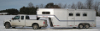
I picked up our first 5th wheel the other day and am noticing a lot of pushing and pulling when taking off, going over frost heaved roads, and when the truck shifts. I am a tad nose high, truck is level, and only used about 10psi in the bags. The only thing I could have changed was the setting on my Ranch shocks. I left the rears at 4. I have tried setting the brake controller and right now it is on 9. When I activate it it feels like it tries to grab initially then it backs off. I have the sensitivity to medium.
Sounds normal to me. Your truck hits the bumps (or shifts) and it has to push against the trailer, which provides resistance. Then, your trailer hits the same bumps, and will push against the truck as it moves.
Put a loaded backpack on and run down your driveway. Will you feel it bouncing against your back? Yup.
There are 5th wheel hitches out there with built-in airbags on them to help minimize the feeling you describe.
I can't help you with the brakes, as every truck/trailer combo is different....and I don't have a SD yet, but your setup looks great!
What kind of hitch and receiver do you have? That bucking sensation is known as "chucking". There are various things you can do to minimize it. A lot of it has to do with the hitch/receiver though.
I say to try stiffening up the shocks. And also, make sure you've got the correct brake type chosen. And do you have a slider hitch? If so, make sure it's properly locked in transport position.
It's hard to not let the roof line influence your eye when looking for level. Given the street is sloping a bit, I'd say your entire rig looks pretty good in that department. You've got plenty of clearance between the cab and cap as well as bumper and front of the camper.
Your truck has a brake hold feature, which means that when you let off the brake and hit the gas, the brakes don't actually release until you start to move forward. I've noticed this function seems to carry over to the campers I pull. Starting off with a lighter gas pedal helps reduce this feeling. It will also reduce the big clunk you can get in the hitch/pin area when starting out. Gentle braking will also reduce lunking when stopping. As mentioned, there are pin boxes with cushions, air bags, springs or levers sold to address these (perceived) problems. Installing a lube plate on your pin will eliminate the metal to metal contact at the pin/hitch point, which will help as well.
Setting the brake: on a straight, level street, get up to 25 mph then let off the gas and squeeze the manual lever on the brake controller. The camper brakes should activate and slow the truck (eventually stopping it). The wheels are not going to lock up, so don't try for that. I find that 7 or 8 is a good range for most campers and helps save the brakes on my truck. As an aside, I bet all you guys didn't realize I'm the guy breaking in your camper brakes and bearings, did you?
When you apply the (foot) brake, if you feel the camper is pushing the truck, increase the level by one. If you feel the camper is pulling back on the truck, decrease the level by one. The rig should stop as one unit, neither pushing or pulling on that pin/hitch.
Guess I should have mentioned I have the Andersen Ultimate 2. I have ~7" clearance from the bed rails. Also I didn't think about it until now but I do have a rubber bed mat. Andersen said less than 1/2" (or was it 3/4") is fine and mine is 1/2".
Guess I should have mentioned I have the Andersen Ultimate 2. I have ~7" clearance from the bed rails. Also I didn't think about it until now but I do have a rubber bed mat. Andersen said less than 1/2" (or was it 3/4") is fine and mine is 1/2".
Re-tighten your hitch under load to compensate for compression of the mat (if you haven't already).
All good tips above. But sounds normal-ish to me. Maybe raise the trailer to the next step by the axles (if possible) and use a little more air in the air bags.
The backpack analogy was a good one. The trailer is going to bump into the truck from time to time. As long as it's not rattling around constantly on the hwy, I wouldn't sweat in.
"Chucking maybe normal" .... but I have since lost this action entirely in/on my towing. When I was upgrading from my 34'er to my current 45'er, I figured it would be more evident. Not the case at all. So is it the new truck?, the new Coach?, or a combination of each?. hmmmm. Just hashing this out there, as there doesn't 'have to be chucking' when pulling. Seriously I've now got zero chuck or tug now, but I've had it on prior setups and like the OP; it sucks, but I do think you get (a bit) used to it after awhile.
Maybe I'd recommend a morride? for your 5er tongue, but you'd have to nix that Anderson.
"Chucking maybe normal" .... but I have since lost this action entirely in/on my towing. When I was upgrading from my 34'er to my current 45'er, I figured it would be more evident. Not the case at all. So is it the new truck?, the new Coach?, or a combination of each?. hmmmm. Just hashing this out there, as there doesn't 'have to be chucking' when pulling. Seriously I've now got zero chuck or tug now, but I've had it on prior setups and like the OP; it sucks, but I do think you get (a bit) used to it after awhile.
Maybe I'd recommend a morride? for your 5er tongue, but you'd have to nix that Anderson.
I thought the Andersen was compatible with the Morryde but not the trailair?
I just talked to Andersen and they said the Morryde is OK to use but they say in their testing it is a better ride with the standard pin box. They said due to their design there is less parts moving so the air pin boxes are not neccessary. He recommended I check my torque. They also said that using a rubber is OK and they recommend using one to prevent scratches in the bed and it adds a little cushion in the movement. Guess we will have to see once I hook up again in a couple weeks.
Rezvani's Latest Post-Apocalytic Monster Is a Ford F-150 Raptor Underneath
Slideshow: Called the Fortress, the 850-horsepower pickup combines Raptor underpinnings with military-inspired features, survival equipment, and a starting price of $285,000.