When you click on links to various merchants on this site and make a purchase, this can result in this site earning a commission. Affiliate programs and affiliations include, but are not limited to, the eBay Partner Network.
Thanks for the local link! The Innovate instructions recommend a 1” tall bung to keep the sensor at the edge of the exhaust pipe.
Also, it should be installed (not more than) 24” downstream from the header collector or exhaust manifold flange. If running open long-tube headers, the bung should be installed in the longest tube. Can’t use with open “shorty” headers
The sensor should be at least 10 degrees above horizontal to avoid condensation
I’m not confident that I can get a drill in any location like that, so I’ll let the muffler shop handle it!
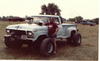
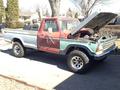
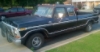
Thanks, guys, for all the support! I drive almost exclusively “around town”, and all three trucks get roughly 8-1/2 mpg.
What carburetor is installed? Some are easier to tune than others. Dial in the steady level-ground highway cruise jetting first, this may mean jetting down a couple sizes. Keep in mind that the manifold doesn't charge each cylinder with a uniform amount of fuel, whatever the leanest cylinder is sets the limit on how far you can go. And the O2 sensor is an average. So don't get carried away. Right around 16-1 is best economy for a carbureted engine. Fuel injection is a lot more accurate and they routinely lean things out to 18-1, but don't try this at home kids, with a carbureted engine.
Then measure the wide open throttle and acceleration AFR, want to see around 12.5 to 1, maybe slightly leaner than that. Leaning out the cruise may require drilling out the PVCRs a few thou to get the wide open throttle into the zone. Tuning with a wideband means you maximize economy while still being able to light the tires. Keep in mind you won't likely pass smog and if you have a catalyst on your exhaust it may well be nuked.
The bung didn’t come with a plug. You can’t hook up the sensor until it’s ready to install, and I couldn’t do the wiring at the exhaust shop, so I had to go to Pep Boys for a plug
The gauge didn’t come with a bracket. I had an old double bezel in the shed, so I used that until I got back to O’Reilly for a mounting bracket
I realize the various brains and gauges are mix-n-match, and a plug/socket would add a buck to the cost of the kit, but soldering up a bunch of stripped wires isn’t any fun
Granted, I bought this from an e-bay vendor, maybe paying the extra $60 to Summit buys a better install experience.
I had to have an exhaust shop weld the bung in. The kit didn't come with a plug, so I had to get one from Pep Boys.
In my situation, i was able to route the O2 sensor cable through the loops that guide the other wires/harness down the inner fender to the frame. The connector sits up with the connectors for the ignition control module.
The O2 sensor cable plugs into an extension cord. The other connector on the extension cord was small enough to fit through the cable hole in the firewall to access the passenger compartment.
The extension cord plugs into the control unit. The control unit has several stripped wires for:
12v
ground
data
another data
The gauge harness also has several stripped wires:
12v
ground
data
headlight dimmer
Soldered up the 12v leads to a wire for a switched hot. Soldered up the grounds to a black wire with a loop. Soldered the data in and out lines together. Soldered the headlight dimmer to the same on my LED tach
Ran the 12v to a switched hot. Disconnected the O2 sensor for he computer self-test. Reconnected the O2 sensor for the calibration. Disconnected the O2 sensor to install it in the bung. Reconnected the O2 sensor. Fired it up...
I figure I'll drive it for a month to get some average numbers off the gauge. Maybe after that I'll get back out with the tach and vacuum gauge to see if I can tweak the carb settings a bit.
ps...the kit comes with another cable to run to a laptop computer for logging, but it has a serial port. Also, my laptop has a dead battery.
I figure I'll drive it for a month to get some average numbers off the gauge. Maybe after that I'll get back out with the tach and vacuum gauge to see if I can tweak the carb settings a bit.
ps...the kit comes with another cable to run to a laptop computer for logging, but it has a serial port. Also, my laptop has a dead battery.
Is the port Kelloggs or General Mills?
On a more serious note, excellent conclusion to the install. Happy to see that the dimmer even works too!
FWIW I have used a wideband to tune a EFI setup. My warm camm'ed hot rod liked likes a bit less than 14.7 A/F at idle... say 14.3 - 14.5. The usual high 12's at WOT. At light cruise, low 15's works well... along with 50 or so degrees ignition advance (ie.vacuum advance). The lean A/F at cruise helps economy and also helps keep the engine clean. The trick is to tune the transition from cruise to acceleration for smoothness and no ping.
Turkey season is over so I finally got around to replacing clutch, camshaft, carburetor, and installing my AFR gauge. The AFR gauge has to be one of the best automotive tools I've ever purchased. Normally it takes me several days to get a carburetor tuned, and then I'm never totally sure it's safe. This afternoon I installed a 4150 Street Avenger and had it tuned within two hours. It's almost perfect. I just need a 8.5 power valve because the gauge goes through a little lean spot on transition from cruise to acceleration. I'm pretty dog gone happy.
Has anyone here wired a second gauge under the hood? Would it throw off the reading by wiring the second gauge on the same circuit? I'd really like the ability to read a gauge when I'm turning screws under the hood and when I'm driving. I guess you could always buy a second sensor, buuuut....
I doubt you could wire a second gauge to the same sensor and have them both read accurately. But of course you could add a whole new unit.
I must be missing something though. Why would you need AFR gauge when you're under the hood? The gauge is gonna be reading rich at idle anyway, and any "winging" of the throttle isn't going to tell you anything unless the vehicle is under load.
I doubt you could wire a second gauge to the same sensor and have them both read accurately. But of course you could add a whole new unit.
I must be missing something though. Why would you need AFR gauge when you're under the hood? The gauge is gonna be reading rich at idle anyway, and any "winging" of the throttle isn't going to tell you anything unless the vehicle is under load.
I'm wondering how a true dual set-up would benefit from a single O2 AFR set-up. Readings from only 1 of 2 headers may get you close, but not perfect on both sides, or equal on both sides of the motor. Any comments?
I'm wondering how a true dual set-up would benefit from a single O2 AFR set-up. Readings from only 1 of 2 headers may get you close, but not perfect on both sides, or equal on both sides of the motor. Any comments?
This Hennessey Takes the Expedition Tremor's Off-Roading Capability to the Next Level
Slideshow: The VelociRaptor Expedition gains a lift, upgraded suspension, Brembo brakes, and trail-ready equipment while retaining the stock 440-horsepower EcoBoost V6.
Rezvani's Latest Post-Apocalyptic Monster Is a Ford F-150 Raptor Underneath
Slideshow: Called the Fortress, the 850-horsepower pickup combines Raptor underpinnings with military-inspired features, survival equipment, and a starting price of $285,000.