


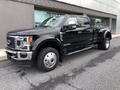


CDL for f350?
More Turbo
Joined: Oct 2009
Posts: 655
Likes: 18
From: Randolph County NC
In N.C. any trailer weighing 10k or more requires a CDL (Usually not enforced on camping trailers).The tags on my truck are for 21k, 11k truck and 10k trailer. In N.C. they do enforce weights on equipment trailers regardless of commercial or personnel use. I would check both states you plan on operating in to see how they deal with the license and if it is weight restricted. Also look into what weight you have for the tag on the truck. I read a few years back where a guy was hauling 5 bundles of railroad ties to do some landscaping and he was popped for weight in excess of his tag and over 10K on his trailer it was a big fine.

Cargo Master

Joined: Jul 2005
Posts: 3,495
Likes: 7
From: Not as far west as I want
One of things I encounter in an enforcement setting is businesses registering their vehicles for 26,000 pounds thinking that they’ll bypass the CDL requirements. They are weighed out and way over 13 tons. Then, I look at the ratings on the combination and see it requires a CDL to operate. Even looking at the ratings it’s easy to see who needs a class A and who doesn’t.
The question you you need to ask yourself is “am I making money or trying to make money doing this?”

Tuned

Joined: Jan 2013
Posts: 269
Likes: 6
I think 1979 Ford is the most correct on this matter....If I am not making $ using my class A there are many reasons to just give it up.
I do think there is some wrong information here. If you read my post clearly you will understand it seems like (they) are attempting to make it more & more difficult to just (hold on ) to a Class A if you are not activity using it. Issue #1 is simply the cost of it (something like $75 plus for extra endorsements). Then issue #2 is needing to present the medical certificate. (It costs money to get that every 2 years, And if you really are not using your class A it's money wasted). Not to mention the issue of being able to pass the medical. But there is something of a (loophole) that you can use so you do NOT have to supply the DMV with a current DOT medical certificate, But it has it's limitations. If you choose one of the "Excepted" classes (which I believe there are two of). It says you mainly transport bees, passengers (not for hire), agricultural equipment... But there are parts of those activities that limit you to 150 miles of the home base farm. BUT, I don't think either the DOT Cops at the scales OR the DMV would put together or have any issue if you had the Class A (with NO MEDICAL ON FILE) but were hauling PERSONAL RV or other such thing that in NO WAY seemed to be a commercial enterprise. Say a big F-450 hauling a goosneck (maybe you have air brakes)... As long as you are not trying to cheat the tax man and register the vehicle for a lower weight than you are hauling OR that the trailer exceeds the weight rating of the tow vehicle... I don't think any Dot Cop is going to screw with you. What I REALLY MEAN is I don't think (they) will pick up on the fact that your Class A is (related) to a "excepted" (Non Medical Card required) "occupation". Especially because you are not currently (when pulled over) using for that purpose. BUT at least you have it (A Class A rating) if there is any reason you need it (say for the possible air brakes mentioned, OR because of hauling a gooseneck on a 5th wheel pickup. I mention that because if you read the Florida laws carefully they make it sound like ANY 5th wheel operations require a commercial registration AND therefore a Class A license.
Yes it's all quite confusing, State laws vs. registration types vs. license types...
Again, I think it's got to be just another money making thing as there was NO REASON to change the way the laws USE TO BE. If you had a Class A and were not employed & using it there was no reason to "downgrade it". Neither was there a reason to keep your medical up to date.
After all, your not working right now so why should you keep paying a doctor to (inspect) YOU! If you get a job, many times the Employer sends you to HIS doctor at HIS expense. That's the time to get your physical and you already have the Class A. No Bullsh*# of having to get back to your home state where you have the class A & start with an IN PERSON visit just to pay more fees to have it (Class A) reinstated and physically hand them the DOT Medical from some doctor from another start... It's just a LOT of CRAP!
I might just attempt to pay the fee & keep it because I really don't trust these state DMV's when they say getting it reinstated is "easy". Maybe they just don't understand that everybody doesn't live in a house with a white picket fence with 2 and 1/2 kids and a dog and goes to work at 9 a.m. & returns home at 5 p.m Some of us are actually across the country for weeks or months at a time and it is not easy to just BE THERE when it's time to renew or reinstate your license!.
I'm not sure some of the above comments about having to start all over again are correct if you give it up BUT I do think these dip****s can change the laws at any time and it might just happen that in the future you WILL have to start all over again. Right now I think it's more about paying money and being there in person with some documents. Seems the thing they are focusing in on is the up to date DOT Medical Certificate AND now requiring that information be "on file" in THEIR computer system. Previously, all the DOT Cop was shown when he looked at your papers was your little wallet card that showed you had a current medical & the expiration date & some doctors name scribbled on it.
Lets face it....That is EASILY forged/copied & "doctored". (I KNOW). (They) the cops were not "verifying" any part of that information. NOW they WILL BE because it's going to be part of what shows up when they run your license! This is how "slippery slopes" start. Next you will have to PROVE & Supply the name of your CURRENT EMPLOYER. Then it will become the DRIVERS responsibility to prove he is part of a random drug testing program (most owner operators already have to do this). Can only imagin what's next!? DDT
I do think there is some wrong information here. If you read my post clearly you will understand it seems like (they) are attempting to make it more & more difficult to just (hold on ) to a Class A if you are not activity using it. Issue #1 is simply the cost of it (something like $75 plus for extra endorsements). Then issue #2 is needing to present the medical certificate. (It costs money to get that every 2 years, And if you really are not using your class A it's money wasted). Not to mention the issue of being able to pass the medical. But there is something of a (loophole) that you can use so you do NOT have to supply the DMV with a current DOT medical certificate, But it has it's limitations. If you choose one of the "Excepted" classes (which I believe there are two of). It says you mainly transport bees, passengers (not for hire), agricultural equipment... But there are parts of those activities that limit you to 150 miles of the home base farm. BUT, I don't think either the DOT Cops at the scales OR the DMV would put together or have any issue if you had the Class A (with NO MEDICAL ON FILE) but were hauling PERSONAL RV or other such thing that in NO WAY seemed to be a commercial enterprise. Say a big F-450 hauling a goosneck (maybe you have air brakes)... As long as you are not trying to cheat the tax man and register the vehicle for a lower weight than you are hauling OR that the trailer exceeds the weight rating of the tow vehicle... I don't think any Dot Cop is going to screw with you. What I REALLY MEAN is I don't think (they) will pick up on the fact that your Class A is (related) to a "excepted" (Non Medical Card required) "occupation". Especially because you are not currently (when pulled over) using for that purpose. BUT at least you have it (A Class A rating) if there is any reason you need it (say for the possible air brakes mentioned, OR because of hauling a gooseneck on a 5th wheel pickup. I mention that because if you read the Florida laws carefully they make it sound like ANY 5th wheel operations require a commercial registration AND therefore a Class A license.
Yes it's all quite confusing, State laws vs. registration types vs. license types...
Again, I think it's got to be just another money making thing as there was NO REASON to change the way the laws USE TO BE. If you had a Class A and were not employed & using it there was no reason to "downgrade it". Neither was there a reason to keep your medical up to date.
After all, your not working right now so why should you keep paying a doctor to (inspect) YOU! If you get a job, many times the Employer sends you to HIS doctor at HIS expense. That's the time to get your physical and you already have the Class A. No Bullsh*# of having to get back to your home state where you have the class A & start with an IN PERSON visit just to pay more fees to have it (Class A) reinstated and physically hand them the DOT Medical from some doctor from another start... It's just a LOT of CRAP!
I might just attempt to pay the fee & keep it because I really don't trust these state DMV's when they say getting it reinstated is "easy". Maybe they just don't understand that everybody doesn't live in a house with a white picket fence with 2 and 1/2 kids and a dog and goes to work at 9 a.m. & returns home at 5 p.m Some of us are actually across the country for weeks or months at a time and it is not easy to just BE THERE when it's time to renew or reinstate your license!.
I'm not sure some of the above comments about having to start all over again are correct if you give it up BUT I do think these dip****s can change the laws at any time and it might just happen that in the future you WILL have to start all over again. Right now I think it's more about paying money and being there in person with some documents. Seems the thing they are focusing in on is the up to date DOT Medical Certificate AND now requiring that information be "on file" in THEIR computer system. Previously, all the DOT Cop was shown when he looked at your papers was your little wallet card that showed you had a current medical & the expiration date & some doctors name scribbled on it.
Lets face it....That is EASILY forged/copied & "doctored". (I KNOW). (They) the cops were not "verifying" any part of that information. NOW they WILL BE because it's going to be part of what shows up when they run your license! This is how "slippery slopes" start. Next you will have to PROVE & Supply the name of your CURRENT EMPLOYER. Then it will become the DRIVERS responsibility to prove he is part of a random drug testing program (most owner operators already have to do this). Can only imagin what's next!? DDT

Fleet Mechanic


Joined: Dec 2007
Posts: 1,511
Likes: 340
From: Wildwood Pa
I will say that the WV police that run their weigh stations are the strictest, & do the most in depth inspections. But, they have treated me fairly. I was going to get a $500 gift from them, & had the paperwork in my hand ready to sign. This was after a 45 minute inspection. The officer said "wait, I forgot to check the horn & wipers on your truck, give me the paperwork back". I smiled & said no problem!, horn & wipers worked. Then he said "I forgot to check for flares & first aid kit". i requested permission to get out of the truck as those items were stowed behind the seat. He gave his OK on everything, then told me to accompany him inside the office. Uh Oh I thought. He had me sit at an empty desk while he tapped away on a computer for 5 minutes. He asked me to come over to his desk, & told me he had changed my fine to a warning! Made me happy! Original fine was for the company name being too small on the truck, needs to be legible from 20 feet, & it wasn't.
If you do get stopped, be exceedingly polite, do not lie about anything, don't get out of the truck unless you OK it with the officer.
Cargo Master
Joined: Jul 2005
Posts: 3,495
Likes: 7
From: Not as far west as I want
I had to laugh when I read this. I've been stopped more than a few times at weigh stations on the interstates in Pennsylvania & West Virginia, driving an F250 for commercial use. It has the company name & a DOT # on it, so I have to go thru the stations. While I've sat in the station having my paperwork, license, medical card, & truck & trailer inspected from end to end, I watch the highway & marvel at all the commercial trucks that blow by the weigh station, never go thru. I'm talking tractor trailers, tri axles, garbage trucks, small trucks with DOT #'s, all vehicles that should stop. I always wondered why those guys aren't busted for "bypassing a scale".
I will say that the WV police that run their weigh stations are the strictest, & do the most in depth inspections. But, they have treated me fairly. I was going to get a $500 gift from them, & had the paperwork in my hand ready to sign. This was after a 45 minute inspection. The officer said "wait, I forgot to check the horn & wipers on your truck, give me the paperwork back". I smiled & said no problem!, horn & wipers worked. Then he said "I forgot to check for flares & first aid kit". i requested permission to get out of the truck as those items were stowed behind the seat. He gave his OK on everything, then told me to accompany him inside the office. Uh Oh I thought. He had me sit at an empty desk while he tapped away on a computer for 5 minutes. He asked me to come over to his desk, & told me he had changed my fine to a warning! Made me happy! Original fine was for the company name being too small on the truck, needs to be legible from 20 feet, & it wasn't.
If you do get stopped, be exceedingly polite, do not lie about anything, don't get out of the truck unless you OK it with the officer.
I will say that the WV police that run their weigh stations are the strictest, & do the most in depth inspections. But, they have treated me fairly. I was going to get a $500 gift from them, & had the paperwork in my hand ready to sign. This was after a 45 minute inspection. The officer said "wait, I forgot to check the horn & wipers on your truck, give me the paperwork back". I smiled & said no problem!, horn & wipers worked. Then he said "I forgot to check for flares & first aid kit". i requested permission to get out of the truck as those items were stowed behind the seat. He gave his OK on everything, then told me to accompany him inside the office. Uh Oh I thought. He had me sit at an empty desk while he tapped away on a computer for 5 minutes. He asked me to come over to his desk, & told me he had changed my fine to a warning! Made me happy! Original fine was for the company name being too small on the truck, needs to be legible from 20 feet, & it wasn't.
If you do get stopped, be exceedingly polite, do not lie about anything, don't get out of the truck unless you OK it with the officer.
Some states have installed weigh in motion scales and use transponders to allow carriers with adequate credentials to bypass scales. There is an incab or roadside sign that gives instructions and it shows up in the scale house. If all is good, fine, head on down the road. Otherwise if an officer is available and there is a true bypass, then it stopped, the driver may be cited and it usually warrants closer inspection.
Fleet Mechanic
Joined: Dec 2007
Posts: 1,511
Likes: 340
From: Wildwood Pa
1979 Ford, I've seen the signs before the weigh stations in WV that say something about a transponder & always wondered what that was about. PA, where I spend most of my time, doesn't seem to use them. If the PA state police had enough manpower they could make a fortune busting the guys I see bypassing the scales.

Cross-Country

Joined: Feb 2018
Posts: 68
Likes: 0
I do want to point out that most of what has been stated in this thread is subjective to specific state laws, BUT most states require a class A CDL for any truck and trailer GCWR greater than 26,000 pounds regardless of whether it is commercial or private. The only general exception is a truck hauling an RV trailer for personal use. So, to clarify, in most states, a truck and trailer with a GCWR of greater than 26,000 pounds requires a class A CDL, unless it is an RV trailer. Additionally, a class A CDL is usually required to tow any trailer with a gross weight of over 10,000 pounds.
FTE Stories
Ford Trucks for Ford Truck Enthusiasts

10 Ugly Ford Trucks That We Still Kinda Love
Joe Kucinski
10 Things Every Truck Owner NEEDS (2026 Edition)
Michael S. Palmer
Rezvani's Latest Post-Apocalyptic Monster Is a Ford F-150 Raptor Underneath
Verdad Gallardo
Top 10 Most Expensive Ford Trucks Ever Sold on Bring a Trailer
Joe Kucinski
2027 Ford Super Duty Buyer's Guide (Every Model, Engine, & Package)
Brett Foote
Top 10 Ford Truck Tragedies
Joe Kucinski
AEV FXL Super Duty - the Super Duty Raptor Ford Doesn't Make
Brett Foote
Lobo Vs Lobo: Proof the F-150 Lobo Should Be Even Lower!
Michael S. Palmer
Ford's 2001 Explorer Sportsman Concept Looks For a New Home
Verdad Gallardo
Logistics Pro
Joined: Jul 2002
Posts: 4,821
Likes: 19
From: South Dakota
I do want to point out that most of what has been stated in this thread is subjective to specific state laws, BUT most states require a class A CDL for any truck and trailer GCWR greater than 26,000 pounds regardless of whether it is commercial or private. The only general exception is a truck hauling an RV trailer for personal use. So, to clarify, in most states, a truck and trailer with a GCWR of greater than 26,000 pounds requires a class A CDL, unless it is an RV trailer. Additionally, a class A CDL is usually required to tow any trailer with a gross weight of over 10,000 pounds.
One of many examples explaining this
Checking your local DMV is your best bet.

More Turbo
Joined: Dec 2003
Posts: 585
Likes: 11
From: Upper penninsula
That article is talking about state CDL requirements for operation of an rv motor home or trailer specifically, and not about what is required to pull a gooseneck or bumper pull flatbed or enclosed cargo trailer.
Most states have special rules to exempt rv operators from CDL requirements, but offer no such exemptions for non commercial operation of cargo haulers. The rv specific regulations are what the article is referring to.
F350 dually + 14000 lb gooseneck= CDL license.
Also, be careful with the information from your local DMV office re CDL requirements.
in Illinois I had to go to the regional CDL only office to get my license. The neighborhood office wasn’t allowed to issue them, and the clerks had no information on the requirements.
Michigan was similar, in that I had to explain to the clerk what a Class A Exempt license was. He had never issued or even seen one.
When you get stopped by the DOT for driving a commercially classified, albeit privately owned and operated vehicle, without a proper CDL, bad information of what license is required (from a clueless clerk) won’t fly.
Most states have special rules to exempt rv operators from CDL requirements, but offer no such exemptions for non commercial operation of cargo haulers. The rv specific regulations are what the article is referring to.
F350 dually + 14000 lb gooseneck= CDL license.
Also, be careful with the information from your local DMV office re CDL requirements.
in Illinois I had to go to the regional CDL only office to get my license. The neighborhood office wasn’t allowed to issue them, and the clerks had no information on the requirements.
Michigan was similar, in that I had to explain to the clerk what a Class A Exempt license was. He had never issued or even seen one.
When you get stopped by the DOT for driving a commercially classified, albeit privately owned and operated vehicle, without a proper CDL, bad information of what license is required (from a clueless clerk) won’t fly.
Cross-Country
Joined: Feb 2018
Posts: 68
Likes: 0
That article is talking about state CDL requirements for operation of an rv motor home or trailer specifically, and not about what is required to pull a gooseneck or bumper pull flatbed or enclosed cargo trailer.
Most states have special rules to exempt rv operators from CDL requirements, but offer no such exemptions for non commercial operation of cargo haulers. The rv specific regulations are what the article is referring to.
F350 dually + 14000 lb gooseneck= CDL license.
Also, be careful with the information from your local DMV office re CDL requirements.
in Illinois I had to go to the regional CDL only office to get my license. The neighborhood office wasn’t allowed to issue them, and the clerks had no information on the requirements.
Michigan was similar, in that I had to explain to the clerk what a Class A Exempt license was. He had never issued or even seen one.
When you get stopper by the DOT for driving a commercially classified, albeit privately owned and operated vehicle, without a proper CDL, bad information of what license is required (from a clueless clerk) won’t fly.
Most states have special rules to exempt rv operators from CDL requirements, but offer no such exemptions for non commercial operation of cargo haulers. The rv specific regulations are what the article is referring to.
F350 dually + 14000 lb gooseneck= CDL license.
Also, be careful with the information from your local DMV office re CDL requirements.
in Illinois I had to go to the regional CDL only office to get my license. The neighborhood office wasn’t allowed to issue them, and the clerks had no information on the requirements.
Michigan was similar, in that I had to explain to the clerk what a Class A Exempt license was. He had never issued or even seen one.
When you get stopper by the DOT for driving a commercially classified, albeit privately owned and operated vehicle, without a proper CDL, bad information of what license is required (from a clueless clerk) won’t fly.

Mountain Pass
Joined: Jul 2018
Posts: 137
Likes: 29
From: Northern MN
The plates depend on the state as well. Wisconsin is one of the states that always requires a CDL, but you can tow a 12K trailer behind an F150 without one because the GCWR is under 26K pounds.
I gave myself a headache on this one. In Wisconsin, you are only required to register at GCWR if you are pulling 5th wheels, including if you somehow modify a convertor dolly (usually used by semis pulling doubles with airbrakes) to be pulled by a pintle hook. If you will never pull a 5th wheel, then you register at GVWR (or at the GVW of the load you propose to carry, they do not care what the actuall GVWR is).
There is NOT an RV exemption for this. The law says "except mobile homes" but they reference a definition for mobile homes that specifically refers to house trailers built before 1976, which are pretty much never of the semi-trailer design (where part of the load rests over the towing vehicle) anyway.
Regular trailers simply get registered at their own GVWR and get attached to a truck also registered at its own GVWR.
I gave myself a headache on this one. In Wisconsin, you are only required to register at GCWR if you are pulling 5th wheels, including if you somehow modify a convertor dolly (usually used by semis pulling doubles with airbrakes) to be pulled by a pintle hook. If you will never pull a 5th wheel, then you register at GVWR (or at the GVW of the load you propose to carry, they do not care what the actuall GVWR is).
There is NOT an RV exemption for this. The law says "except mobile homes" but they reference a definition for mobile homes that specifically refers to house trailers built before 1976, which are pretty much never of the semi-trailer design (where part of the load rests over the towing vehicle) anyway.
Regular trailers simply get registered at their own GVWR and get attached to a truck also registered at its own GVWR.

Thread
Thread Starter
Forum
Replies
Last Post
CaptainSJD
2017 - 2022 Super Duty
16
Oct 28, 2017 11:57 PM