When you click on links to various merchants on this site and make a purchase, this can result in this site earning a commission. Affiliate programs and affiliations include, but are not limited to, the eBay Partner Network.
Please help me. I am new to towing and want to make sure that I have this right. I have a 2005 Ford F-250, crew cab short bed, 6.0 4WD. I bought this truck a year ago so that I can haul a rock crawler (Jeep YJ) and recently purchased a Kearney 18’ car hauler: two 3,500 lb axles and it weighs just under 2,000 lbs. The Jeep is under 5,000 lbs so the trailer is good. Trailer 2,000 lbs + 4,800 lb Jeep = 6,800 lbs. Good here.
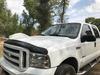
I looked at the sticker on tbe receiver and it says (see attached picture) for “weight carrying hitch”: max gross trailer weight 5,000 lbs and max tongue weight 500 lbs
The owners manual says the same. I had not planned on installing a weight distribution hitch on the car hauler trailer because I didn’t think it was necessary. With the weight distribution hitch the max gross trailer weight is 12,500 lbs and the max tongue weight is 1,250 lbs.
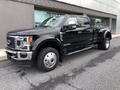
I just walked over to a brand new F250 and attached a picture of that sticker as well (black sticker).
Do I need to install a weight distribution hitch on the car hauler? Or do I need to upgrade the hitch? I am heading out to pick up my Jeep next weekend in New Mexico and I want to make sure I am doing everything right. Thank you!
You'll be fine so long as the plug and ball you use are rated for 7000#, and you load the Jeep on the trailer in a manner that hits the correct weight balance. I don't know why Ford's rating do not align with Class III or Class IV numbers, but based on the higher end WD number the hitch should be a Class IV and can handle what you're doing.
Originally Posted by Y2KW57
V-5 is a testing standard, not a Class.
A Class III hitch is rated at Class III by way of the V-5 testing standard.
The V-5 testing standard is now obsoleted, but those interested in comparing hitches should be aware that V-5 is only a testing standard, not a class rating. Most OEM hitches (up until the recent adoption of a new SAE standard) had "V-5" on the label, regardless of weight Class rating. The V-5 simply signifies that the V-5 standard of testing was used to determine the Class rating.
Incidentally, there is no such thing as a Class V in the V-5 testing standard. The highest class rating in the standard is Class IV. The use of the term Class V was a marketing ploy initiated by Reese, that later became a colloquialism for any hitch rated higher than the ratings defined as Class IV.
Specifically, "V-5" is simply a short hand acronym for the Vehicle Equipment Safety Commission Regulation 5, or VESC-5, or V-5. This federal commission was convened by the US Govt in the 1960's to address the lack of standards on the ratings of automotive towing equipment. In 1968, a final regulation was adopted, which was later revised in 1973 and 1977, and was later supplemented in 1980 by VESC-19, or "V-19", pertaining to fifth wheels and gooseneck trailers. Similar standards were commissioned by the Society of Automotive Engineers entitled the SAE J684, first issued in 1938, and more recently revised in 1998 and 2004. Some hitch receivers will say SAE J684 on the label instead of, or in addition to, V-5. Again, these symbols do NOT indicate a "Class V" weight or capacity rating, as no such rating exists in either of those standards.
The SAE standard was further supplemented with SAE J2638 pertaining to gooseneck and 5th wheel trailers, and was more recently revised with the towing testing standard that has been in the news during the last five years as the big three play chicken with each other as to who will adopt the new standard first or last, as the newer standard is more stringent, often yielding much lower tow ratings on the same equipment.
Anyway, I would lean towards going with the specs on the hitch, but if it tows well (no sway, porpoising, pushing, etc), then you might be OK. But you also might also enjoy the drive with WD more.
The trailer uses a 2.0” ball. I found a Class 5 bolt on receiver from Curt for $180 that I might try out.
With a 2" ball you aren't going to go over a 1-1/4" shank rated for 10000#, the ball won't max out a Class IV receiver. Unless you get something fancy like a B&W Tow and Stow. A 2.5" Class V receiver is massive overkill for a 7000# trailer.
With a 2" ball you aren't going to go over a 1-1/4" shank rated for 10000#, the ball won't max out a Class IV receiver. Unless you get something fancy like a B&W Tow and Stow. A 2.5" Class V receiver is massive overkill for a 7000# trailer.
Thanks. You’re sure this receiver is Class IV? So I need to pick up a 7,500 lb rated ball and I’m good to go.
I've pulled 10k with no WD on the same receiver with basically the identical truck that you have.
But load it correctly. If you stack 1500# on the tongue you'll break something, and if you have 200# on the tongue you'll flip the trailer.
Since it sounds like you're going to be hauling the same vehicle all the time, once you load it up head to a scale and get real weight numbers. Then mark the trailer with where the hubs should line up.
I've pulled 10k with no WD on the same receiver with basically the identical truck that you have.
But load it correctly. If you stack 1500# on the tongue you'll break something, and if you have 200# on the tongue you'll flip the trailer.
Since it sounds like you're going to be hauling the same vehicle all the time, once you load it up head to a scale and get real weight numbers. Then mark the trailer with where the hubs should line up.
Thank you guys! I’m going to pick up a 7,500 lb rated ball and also get a tongue weight scale to make sure the Jeep is positioned correctly on the trailer. Then just mark the trailer where it needs to go.
I did some digging and the difference between the 12,500 lb WD hitch rating and the 5,000 lb weight carrying rating is too large of a number.
Class III Gross Trailer Weights
6,000 lb weight carrying
10,000 lb WD hitch carrying
= 4,000 lb difference
Class IV Gross Trailer Weights
10,000 lb weight carrying
14,000 lb WD hitch carrying
= 4,000 lb difference
Ford’s numbers seem jacked. I can believe the 12,500 lb WD hitch carrying, but 5,000 lb weight carrying seems stupid. I should have bought a Prius then. Even if I subtract 5,000 lbs from the 12,500 lbs, that puts the weight distribution at 7,500 lbs.
the 5K number is what they felt comfortable with simply because they didn't think that anything over 500 lbs without putting something towards the steer wheels was safe enough.
That does not mean the sticker is in error, just conservative numbers.
Just remember how the WD works..
It uses the receiver as a lever to try to transfer weight to the front axle by "pulling up" on the tension bars of the WD hitch.
So that "some" of the 1250 lbs (max) gets transfered to the front axle..
Check your front and rear ride height before hitching up, to see how the trailer effects it, then go to the scale and see how the weights shift off front axle and on to rear axle.
Rezvani's Latest Post-Apocalytic Monster Is a Ford F-150 Raptor Underneath
Slideshow: Called the Fortress, the 850-horsepower pickup combines Raptor underpinnings with military-inspired features, survival equipment, and a starting price of $285,000.