When you click on links to various merchants on this site and make a purchase, this can result in this site earning a commission. Affiliate programs and affiliations include, but are not limited to, the eBay Partner Network.
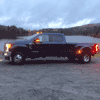
Really Ford?? I love this truck, bought it used with 14,000 miles on it and this week driving in the Wyoming slush, I noticed this in the back bed corners. How could this have made it off the line with those gaps? And why the heck didn't the previous owner do anything about it?? I plan on putting a tonneau cover on it and often times we travel with our luggage in the back, if we get into bad roads our stuff will be soaked with those holes there. My question for you all is will Ford do anything about this???
That's not a flaw; it's by design. I have the factory spray-in liner and have similar gaps in the bed. They allow the rain to drain. These trucks aren't designed to carry sesame seeds in bulk.
What's kinda scary with salt intrusion, is the dripping from the Bed light switch. I would think this would be a good reason to run wheel well liners and mud flaps.
The gaps that are shown in the photos are just the result of the manufacturing process. Their placement would not make them very functional as drains. The designed drains are across the front of the bed, where the floor meets the front bulkhead. There's no need for designed drains in the rear, providing the gap between the bed and tailgate has not been closed up/sealed.
Right or wrong, I sealed those gaps and the ones around my wheelwells with caulk before I installed my bed mat.
The gaps that are shown in the photos are just the result of the manufacturing process. Their placement would not make them very functional as drains. The designed drains are across the front of the bed, where the floor meets the front bulkhead. There's no need for designed drains in the rear, providing the gap between the bed and tailgate has not been closed up/sealed.
Right or wrong, I sealed those gaps and the ones around my wheelwells with caulk before I installed my bed mat.
The gaps aren't there by happenstance. They are there by design.
If they are "part of the manufacturing process", they why don't ALL the joints on the truck look like this? Please ...
The gaps are definitely there by design. The floor is separate from the bed walls, probably to allow for flexing. It may assist with water drain-out as well. Even a spray-in liner still has gaps. For those concerned about dust, dirt, and water...I'd suggest the caulking route which allows flex.
This topic was discussed in detail during late 2016 when early adopters noticed the large gaps, which were either smaller or didn't exist on 2016 models.
The gaps aren't there by happenstance. They are there by design.
If they are "part of the manufacturing process", they why don't ALL the joints on the truck look like this? Please ...
I'll try to clarify my comment. IMHO, yes they are there by design, as a result of the stamping process by which the bed panel was made. I seriously doubt that they could stamp an inside radius on that corner that was small enough to perfectly match the outside radius on the upright. And would they want to, and then run the risk of having a "tight" corner hold panels apart along another seam? Or cause a stress generator as a result of the tighter radius?
What I don't get is why they aren't sealed at the factory.
If you look at the drains that are located in the front of the bed, they're large enough to allow small sized debris to pass thru them. And they're located where road salt and debris doesn't get blasted up thru them. These other gaps are so small that they plug with debris rather than allow it to pass.
During Ford's extensive environmental testing, how couldn't they see these gaps as being an issue?
I'll try to clarify my comment. IMHO, yes they are there by design, as a result of the stamping process by which the bed panel was made. I seriously doubt that they could stamp an inside radius on that corner that was small enough to perfectly match the outside radius on the upright. And would they want to, and then run the risk of having a "tight" corner hold panels apart along another seam? Or cause a stress generator as a result of the tighter radius?
What I don't get is why they aren't sealed at the factory.
If you look at the drains that are located in the front of the bed, they're large enough to allow small sized debris to pass thru them. And they're located where road salt and debris doesn't get blasted up thru them. These other gaps are so small that they plug with debris rather than allow it to pass.
During Ford's extensive environmental testing, how couldn't they see these gaps as being an issue?
As well, I don't think they are there "by design" if so, Ford was planning on water and debris coming from the bottom?? Doesn't make sense, of all the trucks I've owned I have never had that much mud and water spewed into the bed of the truck. As well, why should i have to go and caulk, a $60,000 truck??? Again, doesn't make sense, like has been mentioned, water already drains in the gap at the tailgate and the front of the bed. This truck does have wheel well liners for what it's worth.
Really Ford?? I love this truck, bought it used with 14,000 miles on it and this week driving in the Wyoming slush, I noticed this in the back bed corners. How could this have made it off the line with those gaps? And why the heck didn't the previous owner do anything about it?? I plan on putting a tonneau cover on it and often times we travel with our luggage in the back, if we get into bad roads our stuff will be soaked with those holes there. My question for you all is will Ford do anything about this???
I have the factory rear wheel well liners and weathertech splash guards on my 17', I drove several hundred miles in snowy and slushy roads this weekend and didn't see the same intrusion that you have. I also have the factory spray in bed liner that looks like it minimizes those holes.
This Hennessey Takes the Expedition Tremor's Off-Roading Capability to the Next Level
Slideshow: The VelociRaptor Expedition gains a lift, upgraded suspension, Brembo brakes, and trail-ready equipment while retaining the stock 440-horsepower EcoBoost V6.
Rezvani's Latest Post-Apocalyptic Monster Is a Ford F-150 Raptor Underneath
Slideshow: Called the Fortress, the 850-horsepower pickup combines Raptor underpinnings with military-inspired features, survival equipment, and a starting price of $285,000.