


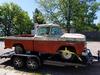

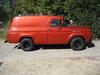

Calling all electrical geniuses!

Thread Starter
|
Senior User
Joined: Oct 2009
Posts: 149
Likes: 3
From: Upland, California
Calling all electrical geniuses!
Hi everybody! Happy new year! I started this post over on the large truck forum but I haven't gotten many replies so I thought I would post it here as well since the systems in question should by nearly identical:
So, I took my 1957 F600 out for a drive the other day and everything went just fine until I tried to start the truck after it had been sitting for about 15 minutes. The first two start attempts resulted in the illumination of the GEN and OIL warning lights but no crank of the engine. Subsequent attempts produced no results whatsoever; the truck seems to be electrically "dead". Here are the things I have been able to test or verify so far: The battery is new and charged. The positive and negative cables are clean and tight. I can measure 12 volts at the input side of the starter relay. The lights and horn do not work with the key in the off or on position like they used to. When I turn the key there is no clicking from the relay. I do NOT get 12 volts at the IGN terminal of the ignition switch regardless of switch position. None of the "jumper" test/troubleshooting procedures in the shop manual result in any cranking or warning light illumination. I can measure continuity between the positive wire attached to the resistor and the terminal of the wire attached to the IGN terminal of the ignition switch. The resistance across the resistor, terminal to terminal, is 3.5 ohms. I do NOT get 12 volts at the BAT terminal of the headlight switch regardless of ignition switch position. The electrical system is mostly original and complete but there are definitely some things that do NOT correspond to the outstanding wiring diagram I got from Classic Car Wiring. I am currently suspicious of the wire that goes from the small "S" (forward) terminal of the starter relay to the positive side of the resistor because it seems as though I should be able to read continuity there and I cannot. I'm sure I am missing some critical pieces to this puzzle but I look forward to hearing what you folks will ask and any assistance you may be able to provide!!
So, I took my 1957 F600 out for a drive the other day and everything went just fine until I tried to start the truck after it had been sitting for about 15 minutes. The first two start attempts resulted in the illumination of the GEN and OIL warning lights but no crank of the engine. Subsequent attempts produced no results whatsoever; the truck seems to be electrically "dead". Here are the things I have been able to test or verify so far: The battery is new and charged. The positive and negative cables are clean and tight. I can measure 12 volts at the input side of the starter relay. The lights and horn do not work with the key in the off or on position like they used to. When I turn the key there is no clicking from the relay. I do NOT get 12 volts at the IGN terminal of the ignition switch regardless of switch position. None of the "jumper" test/troubleshooting procedures in the shop manual result in any cranking or warning light illumination. I can measure continuity between the positive wire attached to the resistor and the terminal of the wire attached to the IGN terminal of the ignition switch. The resistance across the resistor, terminal to terminal, is 3.5 ohms. I do NOT get 12 volts at the BAT terminal of the headlight switch regardless of ignition switch position. The electrical system is mostly original and complete but there are definitely some things that do NOT correspond to the outstanding wiring diagram I got from Classic Car Wiring. I am currently suspicious of the wire that goes from the small "S" (forward) terminal of the starter relay to the positive side of the resistor because it seems as though I should be able to read continuity there and I cannot. I'm sure I am missing some critical pieces to this puzzle but I look forward to hearing what you folks will ask and any assistance you may be able to provide!!
Thread Starter
|
Senior User
Joined: Oct 2009
Posts: 149
Likes: 3
From: Upland, California
Here is the update on my latest "progress":
So, here's what I did today: I made a jumper so that I could measure the resistance from the battery input side of the solenoid to the battery terminal on the lights switch:0.5 ohms ( that includes the resistance in the jumper which was about 6 feet long). I then hooked up the battery and I was able to measure 12 volts at the same light switch terminal. (This is a change from yesterday). The wiring then goes to the "BAT" terminal of the ignition switch. I could also measure 12 volts there but the wire had been damaged and the turn signals had been spliced in that run so I made a new wire and removed the splice. Now, here is the goofy part that I can't figure out: I am getting this 12 volts at the "BAT" terminal with the key in the "OFF" position, which makes sense. This is how you are able to turn on your lights and honk your horn when the key is "OFF". When I turn the key to either the "ACC" or the "ON" position my 12 volts goes away. Also, if I turn the key to the "START" position I do not get voltage at the STARTER terminal of the ignition switch. I can get the same result if I connect up to the "BAT" terminal on the light switch as in my earlier testing. The ignition switch itself (out of the truck) gives me about 1/2 of an ohm between terminals as it should depending on switch position. Basically, at this point I cannot get a load put on the system because nothing will come on regardless of which position the ignition switch is in. I even tried using my jumper wire and running straight from the battery side of the solenoid to the "BAT" terminal of the headlight switch, bypassing all the trucks wiring and still, nothing! I am dazed and confused and I have decided to call it a night and have a beer...!
So, here's what I did today: I made a jumper so that I could measure the resistance from the battery input side of the solenoid to the battery terminal on the lights switch:0.5 ohms ( that includes the resistance in the jumper which was about 6 feet long). I then hooked up the battery and I was able to measure 12 volts at the same light switch terminal. (This is a change from yesterday). The wiring then goes to the "BAT" terminal of the ignition switch. I could also measure 12 volts there but the wire had been damaged and the turn signals had been spliced in that run so I made a new wire and removed the splice. Now, here is the goofy part that I can't figure out: I am getting this 12 volts at the "BAT" terminal with the key in the "OFF" position, which makes sense. This is how you are able to turn on your lights and honk your horn when the key is "OFF". When I turn the key to either the "ACC" or the "ON" position my 12 volts goes away. Also, if I turn the key to the "START" position I do not get voltage at the STARTER terminal of the ignition switch. I can get the same result if I connect up to the "BAT" terminal on the light switch as in my earlier testing. The ignition switch itself (out of the truck) gives me about 1/2 of an ohm between terminals as it should depending on switch position. Basically, at this point I cannot get a load put on the system because nothing will come on regardless of which position the ignition switch is in. I even tried using my jumper wire and running straight from the battery side of the solenoid to the "BAT" terminal of the headlight switch, bypassing all the trucks wiring and still, nothing! I am dazed and confused and I have decided to call it a night and have a beer...!
Thread Starter
|
Senior User
Joined: Oct 2009
Posts: 149
Likes: 3
From: Upland, California
One last bit of information to add:
Oh, I almost forgot! In all of that testing the lights switch and the ignition switch were hanging below the dashboard but I made sure to run a jumper from the shell or frame of each switch to chassis ground to simulate them being installed...
Oh, I almost forgot! In all of that testing the lights switch and the ignition switch were hanging below the dashboard but I made sure to run a jumper from the shell or frame of each switch to chassis ground to simulate them being installed...
FTE Legend


Joined: Jun 2004
Posts: 32,078
Likes: 2,434
From: Upstate NY

You first description sounded to me like a bad ground. Did you check both ends of the ground cable or just at the battery? If jumping directly to the starter fails to turn it over I would check there.

More Turbo
Joined: Aug 2008
Posts: 693
Likes: 18
From: Atascadero, CA

The two suggestions posted above are good advice. Typically when electrical issues come up out of what seems to be nowhere, a bad ground is the culprit. It is difficult to troubleshoot electrical gremlins if the ground path back to battery is faulty. Rust, corrosion, heat, broken wires and other issues all contribute to the deterioration of a solid ground on your 60 year old truck.
With that in mind, I suggest a process of elimination approach, starting with your ground connections. Using heavy duty ground straps or wire, make sure the engine is grounded to both the frame and the cab. The battery ground should be connected directly to the engine block or cylinder head. I also ground the bed in the same manner to the chassis. Parking light, tail light and headlight fixtures should have a separate ground as well. Use quality fasteners and make use of "star" washers to ensure a good connection. Jumper wires connecting various body and frame parts should be relatively large in diameter to handle the current. If you make your own ground straps (jumpers), crimp and solder all connections. You should be doing this with all of your other wire connections anyway. Remember, the cab, engine, bed and fenders are all isolated from the chassis with rubber insulators. This needs to be overcome by creating a good, solid ground circuit.
With the ground issue resolved, you can move on to the solenoid and ignition switch. Keep in mind that the original, factory wires in your truck are going to be brittle which means some of them may be broken in places where the break cannot be seen. Moving the wire harnesses around while checking the continuity may help locate a broken wire. If you plan on keeping your truck, performing a complete wiring overhaul is the way to go. It is relatively easy to do and will help you understand what is going on under the dashboard. I would recommend GXL or SXL grade wire with a minimum of 16 gauge for most of your low current connections. Avoid the cheap stuff as it will only get brittle when exposed to heat, especially in the engine compartment.
Both the ignition and headlight switches play an very important part in the overall wiring scheme used in these vehicles. Once you resolve the ground challenge, I would focus on those two switches. They can be removed from the truck and then checked using a simple, hand-held volt/ohm meter (VOM).
After doing all of the above, I would be very surprised if you were not able to pin point where your electrical problem comes from. You also should have a much more reliable truck in the process. Hopefully, these suggestions will be of some value.
With that in mind, I suggest a process of elimination approach, starting with your ground connections. Using heavy duty ground straps or wire, make sure the engine is grounded to both the frame and the cab. The battery ground should be connected directly to the engine block or cylinder head. I also ground the bed in the same manner to the chassis. Parking light, tail light and headlight fixtures should have a separate ground as well. Use quality fasteners and make use of "star" washers to ensure a good connection. Jumper wires connecting various body and frame parts should be relatively large in diameter to handle the current. If you make your own ground straps (jumpers), crimp and solder all connections. You should be doing this with all of your other wire connections anyway. Remember, the cab, engine, bed and fenders are all isolated from the chassis with rubber insulators. This needs to be overcome by creating a good, solid ground circuit.
With the ground issue resolved, you can move on to the solenoid and ignition switch. Keep in mind that the original, factory wires in your truck are going to be brittle which means some of them may be broken in places where the break cannot be seen. Moving the wire harnesses around while checking the continuity may help locate a broken wire. If you plan on keeping your truck, performing a complete wiring overhaul is the way to go. It is relatively easy to do and will help you understand what is going on under the dashboard. I would recommend GXL or SXL grade wire with a minimum of 16 gauge for most of your low current connections. Avoid the cheap stuff as it will only get brittle when exposed to heat, especially in the engine compartment.
Both the ignition and headlight switches play an very important part in the overall wiring scheme used in these vehicles. Once you resolve the ground challenge, I would focus on those two switches. They can be removed from the truck and then checked using a simple, hand-held volt/ohm meter (VOM).
After doing all of the above, I would be very surprised if you were not able to pin point where your electrical problem comes from. You also should have a much more reliable truck in the process. Hopefully, these suggestions will be of some value.
Trending Topics
Thread Starter
|
Senior User
Joined: Oct 2009
Posts: 149
Likes: 3
From: Upland, California
Hello everybody! Thank you to all who replied with suggestions and advice! I am VERY happy to report that the problem has been solved! It turned out to be a bad ground where the negative cable from the battery was connected to one of the bolts that are used to attach the battery tray! A good friend of mine was listening to me recount all the messing around I had been doing and suggested that before going any further that I check and verify that the ground path for the battery was sound. Literally 5 minutes with a test light proved out his theory and now my truck is running again! I was hesitant to believe that this was where the problem would be found because I had JUST had all of that stuff apart to put a new battery tray into the truck. I thought "how could that be the problem when I was just working there and everything was operating normally when I got finished"?!? But yet, that is exactly where the problem was and now it kinda all makes sense that I was getting the testing results that I was seeing. I can't tell you what a relief it is to be back up and running and ready to go drive around some more!
FTE Stories
Ford Trucks for Ford Truck Enthusiasts

Top 6 Best Deals Available on New Fords & Lincolns Right Now
Brett Foote
This Hennessey Takes the Expedition Tremor's Off-Roading Capability to the Next Level
Verdad Gallardo
Top 10 Fords at 2026 Carlisle Ford Nationals
Joe Kucinski
3 Best / 3 Worst Parts of Modern Ford Ownership
Brett Foote
10 Amazing Upgrades That Solve Common Ford Truck Owner Headaches
Pouria Savadkouei
Every 2026 Ford Engine Explained
Brett Foote
10 Ugly Ford Trucks That We Still Kinda Love
Joe Kucinski
10 Things Every Truck Owner NEEDS (2026 Edition)
Michael S. Palmer
Rezvani's Latest Post-Apocalyptic Monster Is a Ford F-150 Raptor Underneath
Verdad Gallardo
Thread Starter
|
Senior User
Joined: Oct 2009
Posts: 149
Likes: 3
From: Upland, California
Spurredon and Oldbleu, you guys win the prize! I WILL NVER TAKE GROUNDING FOR GRANTED AGAIN!! Oldbleu, thank you for that reply! It makes me think that the way my truck is wired may not be right in that the battery is grounded to the body by one of the bolts that attach the battery tray. This might have been a "field expedient" repair at one point in the trucks history and no one ever took the time or effort to make it right. It just makes sense that you would establish a constant "common" between the engine, frame and body to keep everything operating as it should. Do you know exactly where the ground lead from the negative side of the battery was SUPPOSED to go? The engine block would seem entirely logical. Also, I WILL be replacing the short strap between the cab and the back of the block and cleaning up its attachment points as soon as possible as well as coming up with a connection from the engine to the frame...!
More Turbo
Joined: Aug 2008
Posts: 693
Likes: 18
From: Atascadero, CA
On a Y-block V-8, a common place to connect the battery ground is to use one of the bolts on the right, rear side of the intake manifold. It is close, relatively easy to access and does the job. Never use a valve cover bolt regardless of your engine. Just remember to connect the other major ground components to the engine. Ideally, your first first ground connection should be to the component which will draw the most amperage. Obviously that is the engine by way of the starter motor. That particular ground connection should use a wire just as heavy as the positive side to the solenoid and starter. A six cylinder engine would probably be best connected to the back of the cylinder head as would most other newer Ford V-8 engines. Connecting to one of the bolts holding the bell housing and engine block together is another option.
Thread Starter
|
Senior User
Joined: Oct 2009
Posts: 149
Likes: 3
From: Upland, California
Awesome! Thanks Oldbleu! That makes perfect sense and will be an easy fix to make. The "hokey" way that the ground cable was set up just didn't seem like it would be correct even though it got me going. I will be making changes very soon!


Thread
Thread Starter
Forum
Replies
Last Post
MacFastStang
Electrical Systems/Wiring
11
Feb 15, 2007 06:16 PM
Gunsmoke460
1973 - 1979 F-100 & Larger F-Series Trucks
6
Oct 9, 2004 04:22 AM