






Fuel gauge

Thread Starter
|
Junior User
Joined: Jul 2017
Posts: 55
Likes: 0
Fuel gauge
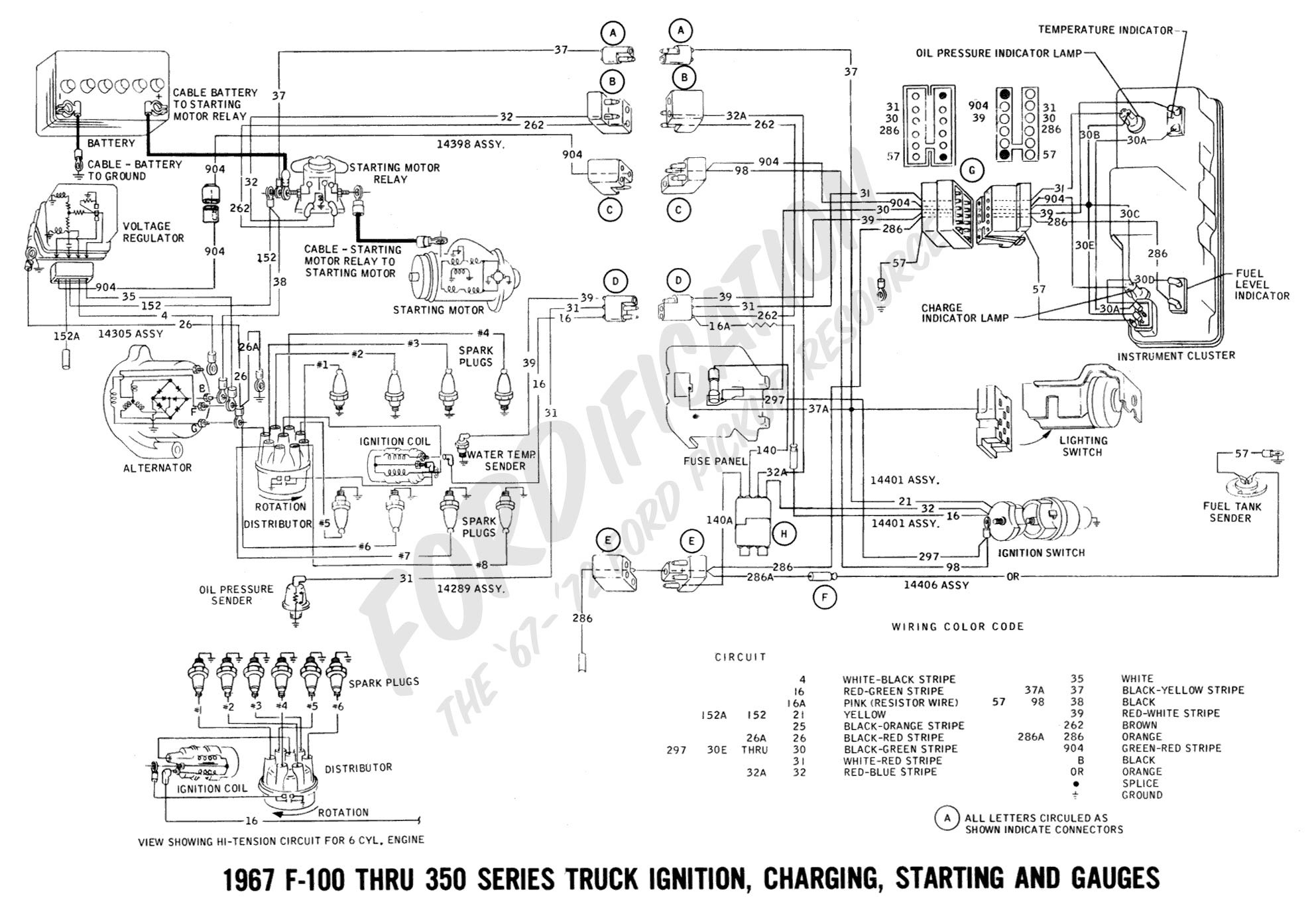
Wiring issue. Again. '67 F100. Just put in a new wiring harness. Noticed the fuel gauge wasn't working. Also the light bulb in that section of the cluster isn't working. Thought it may have been a bad voltage regulator or sending until. Replaced the sending unit. Nothing. Replaced the regulator. Nothing. I read on here to try grounding the fuel sending wire to check it. Not sure how to do that? Any other ideas of where to look?
Thread Starter
|
Junior User
Joined: Jul 2017
Posts: 55
Likes: 0

Lead Driver


Joined: Apr 2011
Posts: 6,399
Likes: 40
From: El Dorado, Arkansas
Did you put a volt meter on the wire, after you pulled the wire off the sender terminal, to see if you had voltage on that wire (with the key on).
If there isn't any voltage on the wire, then obviously the fuel gauge isn't going to read if it doesn't have a source voltage to begin with. If there is voltage on the wire, something is amiss with the fuel gauge itself.
Also note: The signal to the fuel sending unit is not a constant voltage signal. It's pulsed (on-off-on-off) from the small instrument cluster voltage regulator on the back of the instrument cluster. You may have difficulty trying to read the voltage on the fuel sender wire with a digital volt/ohm meter --digital multi-meters are averaging devices. The meter display will likely blink erratically with a DVOM.
If you have an analog voltmeter, you will see the needle swing back and forth as voltage is cycled on and off through the wire. If you don't have an analog meter, an automotive test light will work. You'll see the test light bulb blink on and off, if the wire is seeing a voltage pulse on it.
If there isn't any voltage on the wire, then obviously the fuel gauge isn't going to read if it doesn't have a source voltage to begin with. If there is voltage on the wire, something is amiss with the fuel gauge itself.
Also note: The signal to the fuel sending unit is not a constant voltage signal. It's pulsed (on-off-on-off) from the small instrument cluster voltage regulator on the back of the instrument cluster. You may have difficulty trying to read the voltage on the fuel sender wire with a digital volt/ohm meter --digital multi-meters are averaging devices. The meter display will likely blink erratically with a DVOM.
If you have an analog voltmeter, you will see the needle swing back and forth as voltage is cycled on and off through the wire. If you don't have an analog meter, an automotive test light will work. You'll see the test light bulb blink on and off, if the wire is seeing a voltage pulse on it.
Thread Starter
|
Junior User
Joined: Jul 2017
Posts: 55
Likes: 0
Did you put a volt meter on the wire, after you pulled the wire off the sender terminal, to see if you had voltage on that wire (with the key on).
If there isn't any voltage on the wire, then obviously the fuel gauge isn't going to read if it doesn't have a source voltage to begin with. If there is voltage on the wire, something is amiss with the fuel gauge itself.
Also note: The signal to the fuel sending unit is not a constant voltage signal. It's pulsed (on-off-on-off) from the small instrument cluster voltage regulator on the back of the instrument cluster. You may have difficulty trying to read the voltage on the fuel sender wire with a digital volt/ohm meter --digital multi-meters are averaging devices. The meter display will likely blink erratically with a DVOM.
If you have an analog voltmeter, you will see the needle swing back and forth as voltage is cycled on and off through the wire. If you don't have an analog meter, an automotive test light will work. You'll see the test light bulb blink on and off, if the wire is seeing a voltage pulse on it.
If there isn't any voltage on the wire, then obviously the fuel gauge isn't going to read if it doesn't have a source voltage to begin with. If there is voltage on the wire, something is amiss with the fuel gauge itself.
Also note: The signal to the fuel sending unit is not a constant voltage signal. It's pulsed (on-off-on-off) from the small instrument cluster voltage regulator on the back of the instrument cluster. You may have difficulty trying to read the voltage on the fuel sender wire with a digital volt/ohm meter --digital multi-meters are averaging devices. The meter display will likely blink erratically with a DVOM.
If you have an analog voltmeter, you will see the needle swing back and forth as voltage is cycled on and off through the wire. If you don't have an analog meter, an automotive test light will work. You'll see the test light bulb blink on and off, if the wire is seeing a voltage pulse on it.
Lead Driver
Joined: Apr 2011
Posts: 6,399
Likes: 40
From: El Dorado, Arkansas

ICVR on the back of the instrument cluster.

Trending Topics
Thread Starter
|
Junior User
Joined: Jul 2017
Posts: 55
Likes: 0
I put in a brand new one. So I hope it's not that.
FTE Stories
Ford Trucks for Ford Truck Enthusiasts

Rezvani's Latest Post-Apocalytic Monster Is a Ford F-150 Raptor Underneath
Verdad Gallardo
Top 10 Most Expensive Ford Trucks Ever Sold on Bring a Trailer
Joe Kucinski
2027 Ford Super Duty Buyer's Guide (Every Model, Engine, & Package)
Brett Foote
Top 10 Ford Truck Tragedies
Joe Kucinski
AEV FXL Super Duty - the Super Duty Raptor Ford Doesn't Make
Brett Foote
Lobo Vs Lobo: Proof the F-150 Lobo Should Be Even Lower!
Michael S. Palmer
Ford's 2001 Explorer Sportsman Concept Looks For a New Home
Verdad Gallardo
10 Best Ford Truck Engines We Miss the Most!
Joe Kucinski
2026 Shelby F-150 Off-Road: Better Than a Raptor R?
Brett Foote
Thread Starter
|
Junior User
Joined: Jul 2017
Posts: 55
Likes: 0
Old one of what? The fuel sending unit or the voltage regulator? When I replaced them I did it individually just in case it was one or the other.

Hotshot


Joined: Mar 2013
Posts: 14,255
Likes: 199
From: Phoenix, Az.
Thread Starter
|
Junior User
Joined: Jul 2017
Posts: 55
Likes: 0
If so, how do I check that? The wire goes from the sending unit to a harness, then the instrument cluster harness, then directly to the gauge.
Thread Starter
|
Junior User
Joined: Jul 2017
Posts: 55
Likes: 0
So I checked the voltage at the sending unit. Nothing. I put in the old regulator. Nothing. Checked the input wire on the regulator and had 12 volts. Output wire was around 2-3. Put the new regulator on. 12 volts going in and 5 coming out. I checked where the output wire connects to the gauge on the cluster and it registered 5 volts. Checked where the fuel sending unit wire connects to the gauge and it was pulsing; ranging from 1-3 volts. So I'm guessing it is the wiring somewhere between the gauge and the unit?
If so, how do I check that? The wire goes from the sending unit to a harness, then the instrument cluster harness, then directly to the gauge.
If so, how do I check that? The wire goes from the sending unit to a harness, then the instrument cluster harness, then directly to the gauge.
Hotshot
Joined: Mar 2013
Posts: 14,255
Likes: 199
From: Phoenix, Az.
I guess it pays to read the directions all the way, even when it addresses parts I don't have. My new wiring harness allows for two tanks. Since I don't have two, I skipped the directions. If I hadn't I would have seen that I was supposed to connect two wires if I only have the one tank.
Thread Starter
|
Junior User
Joined: Jul 2017
Posts: 55
Likes: 0
I was. Thank you. Next problem to fix is the reverse lights. But I'm still researching that one and have some ideas to try before I may need help.

Thread
Thread Starter
Forum
Replies
Last Post
scottlathrop
1961 - 1966 F-100 & Larger F-Series Trucks
4
Dec 30, 2012 04:21 PM