When you click on links to various merchants on this site and make a purchase, this can result in this site earning a commission. Affiliate programs and affiliations include, but are not limited to, the eBay Partner Network.
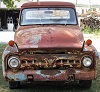
I am restoring a 53 F100 that has a rough cab. it needs floors, rockers, inner and outer rear cab corners and lower cowl patches. Is there an order that must be followed to do this correctly?
I have never done any sheet metal work on a F100 but feel I have the skills to do it. I am actually looking forward to digging into this build!
My advice would be to make sure that you do not cut out all the metal at the same time or weld in some cross bracing so the structural dimensions remain the same. The most important is the door openings. Before welding things solid make sure that the doors open and close properly and that your door gaps are as good as the original build permits. Just don't cut out the rocker panels and floor pan at the same time.
Depending upon the amount of rust that you have you may only have to use parts of the patch panels. Cut out the bad metal and then use cardboard to make yourself a template. Save the remaining pieces of the patch panel as you will probably need to fill in a few gaps where the patch panel doesn't quite cover the opening where you cut out the bad metal. Usually in the area where the A pillar meets the floor.
On my second cab I found the use of air punch/flanger from Harbor Freight and the use of clecos helpful. But you can use sheet metal screws in place of clicos.
Finally you can buy the front floor in two pieces or in one solid piece. I found the one piece to be easier. It also should include the front seat riser. You can leave the old riser in place and the new panel will fit right over it. Just make sure that you use weld-through primer (Eastwood has it) on the bottom side of the new panel before laying it on top of the old riser.
Yes, I was going to tack in some bracing in the doorways to prevent movement. I am thinking floors first, then rockers then the corners. I am going to attempt to leave as much of the rocker in place as possible to keep a little of the original structural integrity while I am doing the floors. I will then cut out the rest of the rockers to replace those.
Yes, do not cut the floor and the rockers. Do one side at a time unless you get the full floor, then install it and then do one rocker then the other. If something collapses on you just remount your doors in closed position and add bracing as necessary.
I wasn't going to tackle the work on my cab, but people on here convinced me that I could do it. I took it a piece at a time and it turned out pretty good. Not bad for someone who had barely welded before. Take a look at my albums. I took a lot of pics as I was doing it. Might help you plan it out.
I started with the rocker panels first to tie in the door posts when I did mine..
Yes, that would work well too. This is another reason to buy the full front floor including the seat riser. They do sell a full front floor without the riser and the section behind the doghouse is so thin that it was damaged in shipping. Better structure strength during reconstruction.
Jf you are looking for a good bracing for the cab try the double X design it keeps the cab from racking. When mine was being sand blasted he flipped and turned my cab every which way and when i got it back it was still in good shape. I also did floor, rockers, cab corners and door posts.
Welded with door on and checked before removing doors.
I am getting ready to start cutting out the old "swiss cheese" floor boards and cab corners so I can replace them. I am waiting on the rest of the sheet metal to get her as Mid Fifty did not have everything I needed at Supernationals. I did get the drivers side front floor board. I test fit it in the cab and see that it extends back to the seat mounting raised section (red arrow in the picture below). I was thinking I would just leave that raised section in the cab and run the rear floor pans up to the back of it also.
There is also a 2" x 2" square piece that sits on top of the floor board in the very back of the cab. I dont remember seeing a replacement piece for this piece for sale anywhere. Is this a piece that just gets removed and not replaced? Mine is pretty solid but the floor boards extend under it so I believe the best way to replace the rear floor boards is to remove this piece with the rest of the floor board. Do people remove it and then re-weld it back in after the rear floorboards have been welded in?
See black arrow in the below picture.
Also, I have a section I need to replace where the bubble was below the dimmer switch. I was just going to use flat metal there. What gauge metal should I use? 18 gauge? See problem area below
That square piece is sandwiched between the floor panel and the back of the cab. The square piece is not reproduced as far as I know so I had to make my own. I have pics in my build thread..
Hi guys. I too had the rear section of floor rotten as all hell. In the picture below you can see I cut it out and will make flat steel from scratch. I ground everything up until I was sure the metal was good. I went to my local economy steel place and I asked them what they recommended, to which the answer was 14 gauge steel, so I bought an off cut of 14g big enough to go edge to edge, and also some 2" box section to replace the supporting bar that goes from the two triangular pieces.
GJPilcher,
Nice, please share the pics of the progress!!
How are you going to attach the square stock to the back seam and the body mount brackets? I am assuming you are going to put the piece of 14 gauge sheet in first? Then weld in the square stock.
GJPilcher,
Nice, please share the pics of the progress!!
How are you going to attach the square stock to the back seam and the body mount brackets? I am assuming you are going to put the piece of 14 gauge sheet in first? Then weld in the square stock.
Thanks!
Jeff
Hi Jeff.
I think you are right, the sheet metal should go in first, with an overlap and plug welds. Then the square stock stitch welded to the new sheet metal, and the triangular end pieces. Then flip the cab on its back and stitch weld the body mount brackets to the underside of the sheet metal.
In theory this should be fairly simple but you know how it goes...
Rezvani's Latest Post-Apocalyptic Monster Is a Ford F-150 Raptor Underneath
Slideshow: Called the Fortress, the 850-horsepower pickup combines Raptor underpinnings with military-inspired features, survival equipment, and a starting price of $285,000.