


Cooling Issue
Thread Starter
|
Senior User
Joined: Oct 2016
Posts: 228
Likes: 5
From: Decatur, MI
Cooling Issue
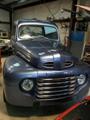
Been fighting a heating issue with my Flathead since I got the truck. Runs normal as long as I stay below about 2400. (or ambient temps below 70 deg) If I push it above that it starts to warm up considerably. Don't know if it will go full hot as I have not continued to push it. As soon as I slow down it will slowly cool off.
Radiator was cleaned recently, new water pumps, new belts, 160 thermostats, running straight water at this point (doesn't seem to change with antifreeze in it)
Have not pressure checked the system but don't appear to be losing water any where. Also, running gauges on both sides at this point and they seem to run close to the same temp...
I could just drive around at 47 mph or change the rear end ratio I guess but I would rather find the issue, if there is one..
Is continued operation above 2500 rpm more than I should expect???
Radiator was cleaned recently, new water pumps, new belts, 160 thermostats, running straight water at this point (doesn't seem to change with antifreeze in it)
Have not pressure checked the system but don't appear to be losing water any where. Also, running gauges on both sides at this point and they seem to run close to the same temp...
I could just drive around at 47 mph or change the rear end ratio I guess but I would rather find the issue, if there is one..
Is continued operation above 2500 rpm more than I should expect???

Fleet Owner


Joined: Jul 2004
Posts: 27,297
Likes: 1,059
From: NM
I've run my flattie at 2300 - 2500 in 100 deg weather for entire days, runs the same as in the winter, except on really long, steep hills, then it will go up a needle's width and drop back after the hill. I have a 4-row brass radiator, a shroud, but only a 3-blade fan (car-style).
My first guess would be your WP belt isn't tight enough, and is slipping at higher RPM. Have you lubed the fan lately?
The engine itself could be full of mud. Have you ever had it open? It would be worth pulling a thermostat to see what the water jacket looks like. What does the water look like?
My first guess would be your WP belt isn't tight enough, and is slipping at higher RPM. Have you lubed the fan lately?
The engine itself could be full of mud. Have you ever had it open? It would be worth pulling a thermostat to see what the water jacket looks like. What does the water look like?
Thread Starter
|
Senior User
Joined: Oct 2016
Posts: 228
Likes: 5
From: Decatur, MI
Thanks for the input guys.
When I got the truck, it had been sitting for a few years in a barn. I drained and refilled all the fluids, including the coolant before I got it running. I noticed the cooling issue right away but as the outside temps dropped last fall it became a none issue. Before i drove it last spring I pulled the radiator and had it boiled and cleaned, removed old water pumps and thermostats and used a hose to flush the block from top to bottom, installed new water pumps and thermostats (160s) and new belts filled with a 50/50 mix. Took it for a drive and had exactly the same issue, no change at all. I installed two gauges, one for each side and both sides warm up and run very near the same.
The timing was my next guess too but I'm having trouble finding a timing mark on my pulley. Might get a chance to diagnose more today...
When I got the truck, it had been sitting for a few years in a barn. I drained and refilled all the fluids, including the coolant before I got it running. I noticed the cooling issue right away but as the outside temps dropped last fall it became a none issue. Before i drove it last spring I pulled the radiator and had it boiled and cleaned, removed old water pumps and thermostats and used a hose to flush the block from top to bottom, installed new water pumps and thermostats (160s) and new belts filled with a 50/50 mix. Took it for a drive and had exactly the same issue, no change at all. I installed two gauges, one for each side and both sides warm up and run very near the same.
The timing was my next guess too but I'm having trouble finding a timing mark on my pulley. Might get a chance to diagnose more today...
Fleet Mechanic


Joined: Sep 2010
Posts: 1,834
Likes: 467
From: Mason City, Iowa
I have chased the same thing. It sounds like a coolant flow issue to me. Just enough flow at low speeds but once you get into a higher RPM not quite enough coolant flowing through the radiator to maintain or regulate the engine temp. I would check what everyone else has mentioned such as for sludge in the water jacket and making sure your vac advance timing is working and correctly advancing. I know you mentioned having your radiator boiled and cleaned but sometimes it just doesn't get all the crud out. If all else fails maybe looking at rodding it out or (gulp) replacing it.
Fleet Owner
Joined: Jul 2004
Posts: 27,297
Likes: 1,059
From: NM
What temperatures are you seeing on each bank? at what outside air temperature? I would expect temps somewhere near 185-190 in the summer. That is perfectly fine.
Trending Topics

Senior User
Joined: Oct 2004
Posts: 289
Likes: 0
I would first suspect retarded ignition timing. If you rule that out I would look at water flow, possibly too much. I remember reading about people having to install washers or restrictors in the radiator hoses because the flathead water pumps move the water through the radiator too quickly at higher engine speeds to allow enough time in the radiator for the water to cool down. Anyone else recall this?
FTE Stories
Ford Trucks for Ford Truck Enthusiasts

3 Best / 3 Worst Parts of Modern Ford Ownership
Brett Foote
10 Amazing Upgrades That Solve Common Ford Truck Owner Headaches
Pouria Savadkouei
Every 2026 Ford Engine Explained
Brett Foote
10 Ugly Ford Trucks That We Still Kinda Love
Joe Kucinski
10 Things Every Truck Owner NEEDS (2026 Edition)
Michael S. Palmer
Rezvani's Latest Post-Apocalyptic Monster Is a Ford F-150 Raptor Underneath
Verdad Gallardo
Top 10 Most Expensive Ford Trucks Ever Sold on Bring a Trailer
Joe Kucinski
2027 Ford Super Duty Buyer's Guide (Every Model, Engine, & Package)
Brett Foote
Top 10 Ford Truck Tragedies
Joe Kucinski
Fleet Owner
Joined: Jul 2004
Posts: 27,297
Likes: 1,059
From: NM
... I remember reading about people having to install washers or restrictors in the radiator hoses because the flathead water pumps move the water through the radiator too quickly at higher engine speeds to allow enough time in the radiator for the water to cool down. Anyone else recall this?
It is possible that OP simply has two bad thermostats. I had one that wouldn't open fully. On a trip in hot weather, climbing a lot of hills, the gauge would go up noticeably, then cool down on the back side of the hill. When I got home, I put it in a pan of boiling water with a new one. The old one would open about 75%, and stop. The chances of getting two bad ones may be slim, but.... it happens. They are cheaply made.
People on the Ford Barn have made a study of thermostats, some are rated for higher flows. These are the ones they recommend:
NAPA THM 530060 (160 deg)
Robertshaw #330-160
The Robertshaw is a high-flow model.


Logistics Pro
Joined: May 2010
Posts: 3,793
Likes: 19
From: Austin
Hey Hanger,
First.... It's good to have a running truck! You are 90% there. You talk about it
acting up when it's above a certain RPM... Could the problem be happening at
highway speed? We went round & round looking for an over heating issue on our '50.
We were missing a lot of the stock airflow pieces up at the front of the
truck. There are pieces that belong next to the radiator, under it, & over it to
force the air back through the radiator at speed. If you don't have these pieces your
truck won't cool properly.
Good luck over there. (We eventually just went for the biggest electric fan we could find
in the local salvage yard plus we addressed our air flow around the radiator....problem solved.).
Ben in Austin
1950 F1 (351W/AOD)
First.... It's good to have a running truck! You are 90% there. You talk about it
acting up when it's above a certain RPM... Could the problem be happening at
highway speed? We went round & round looking for an over heating issue on our '50.
We were missing a lot of the stock airflow pieces up at the front of the
truck. There are pieces that belong next to the radiator, under it, & over it to
force the air back through the radiator at speed. If you don't have these pieces your
truck won't cool properly.
Good luck over there. (We eventually just went for the biggest electric fan we could find
in the local salvage yard plus we addressed our air flow around the radiator....problem solved.).
Ben in Austin
1950 F1 (351W/AOD)

Thread
Thread Starter
Forum
Replies
Last Post
Pushachevy
1987 - 1996 F150 & Larger F-Series Trucks
3
Jul 27, 2016 09:24 AM
dutchlincoln79
335 Series- 5.8/351M, 6.6/400, 351 Cleveland
16
Jul 11, 2010 10:58 PM
lbrauer
1948 - 1956 F1, F100 & Larger F-Series Trucks
32
Jun 7, 2010 12:22 AM