When you click on links to various merchants on this site and make a purchase, this can result in this site earning a commission. Affiliate programs and affiliations include, but are not limited to, the eBay Partner Network.
Hello all, sometime within the next few months I am looking at doing a bit of towing, about 4,100 miles worth. I am wanting to get a 7'x16' enclosed trailer to haul the stuff with.
I have a 2003 F150, 5.4L Supercrew 4x4 with 3.73 gears, truck specs are:
Seems like the capacity of these enclosed trailers is 7,000lbs with the twin axles, 3,500 each. I don't anticipate being that heavy when loaded as it's mostly bulky items like furniture, tool chests, etc.
From what I've read, you want to load the trailer with about 60% of the weight in front and the other 40% in the rear with about 10% of the total weight on the tongue. And the tongue weight counts against your overall RGAWR & payload capacity.
What type of hitch would you guys recommend? A regular one, or WDH or one with sway control? I've also read that you want to make sure the trailer sits level when it's hooked to the truck, is that before or after it's loaded?
I'm currently running Cooper discoverer AT3 tires, 285/70R17 with 2833lb capacity each. That puts me at 5666 total, I'd be well within the limit of what they are rated for, however, do you think it might be worth it to throw a set of higher load tires on there for the journey?
The most I've towed before was with my father's 98 f150, 4.2L & tow package, it was a 16' car trailer with an 82 shortbed F150, probably just under 6,000 total. I found that filling the truck with premium made a noticeable difference in how the motor performed. Any one else also have that same experience when towing with their gas trucks?
Thanks for taking the time to read this, it's a bit of a far journey and I just wanna make sure I'll be set up well and be safe during that time.
For someone hint like that I'd probably just get a HD. All mount and a 10k rated ball and let 'er buck.
Measure the top of the receiver and the height of the ball on the trailer. Figure for about 2" of sag on the Truck and get the right amount of drop. Most ball mounts measure drop from the top of the mount to the ball mounting surface. Figure 3" for the height of the ball.
Thanks guys, I'll be sure to inflate the tires before hand. Truck got all new tires, shocks, front control arms upper and lower, tie rods and steering knuckles about 1,000 miles ago. The truck has the factory tow package with both 7 and 4 pin connectors out back and the extra transmission cooler. A friend is going to give me an extra brake controller he has. I also ordered and installed the Powerstop z36 truck & tow brake kit for the truck, pads, drilled & slotted rotors and calipers, I've been very happy with them so far. And with the $30 rebate they usually have it wasn't really more to upgrade than it was to order stock stuff. I think I'll be in good shape! Hardest thing is going to be finding a trailer now.
Hello all, sometime within the next few months I am looking at doing a bit of towing, about 4,100 miles worth. I am wanting to get a 7'x14' enclosed trailer to haul the stuff with.
I have a 2003 F150, 5.4L Supercrew 4x4 with 3.73 gears, truck specs are:
(1) Is your truck fitted with Class III trailer Tow Package (option code 535)? (I see from your post above that the answer is "yes".)
(2) The 2003 Trailer Tow Guide (page 21) specs the F150 5.4 3.73 SuperCrew 4x4 max GCWR at 12,500 lbs. Do you have different specs available?
(3) The max trailer weight spec for conventional towing (not fifth-wheel) with a SuperCrew 4x4 5.4 3.73 and 17" tires is 7,100 lbs. Note that this is with an essentially empty truck operated at sea-level.
My take is that the 13,500 lb GCWR required the 7,700 lb. Payload Pkg "A". which was not available on the SuperCrew configuration. (reference)
If you are lucky you will make 500-800 miles a day, so I will assume your trip will include 5-9 overnight stops. Make yourself a checklist to complete each morning. Things like check electrical connections, check hitch connection, lights, tire pressures, oil and coolant levels, check load, general walkaround, etc. At fuel/food stops during the day you may want to use a temp gun and check the rubber and bearing housing temps so you know if something is trending hotter. Find the problems before they bite you in an inconvenient part of your anatomy.
(1) Is your truck fitted with Class III trailer Tow Package (option code 535)? (I see from your post above that the answer is "yes".)
(2) The 2003 Trailer Tow Guide (page 21) specs the F150 5.4 3.73 SuperCrew 4x4 max GCWR at 12,500 lbs. Do you have different specs available?
(3) The max trailer weight spec for conventional towing (not fifth-wheel) with a SuperCrew 4x4 5.4 3.73 and 17" tires is 7,100 lbs. Note that this is with an essentially empty truck operated at sea-level.
My take is that the 13,500 lb GCWR required the 7,700 lb. Payload Pkg "A". which was not available on the SuperCrew configuration. (reference)
You may need to double check some of the specs...
Regards,
Jim / crewzer
Wow, thanks! After looking at that, you're right! This is how my owner's manual states it:
Starts off with supercab/crew then continues to the next page. Looks like the spec I read was for the 7700 payload package, where the 5.4L and 3.73 is listed, you see 16" wheels there but not 17. Turns out they don't even have the listing for supercrew with 5.4L and 3.73 17" wheels in the owner's manual!
I appreciate that, I'm also glad to know that I'll still be within the limits of the truck with the setup
If you are lucky you will make 500-800 miles a day, so I will assume your trip will include 5-9 overnight stops. Make yourself a checklist to complete each morning. Things like check electrical connections, check hitch connection, lights, tire pressures, oil and coolant levels, check load, general walkaround, etc. At fuel/food stops during the day you may want to use a temp gun and check the rubber and bearing housing temps so you know if something is trending hotter. Find the problems before they bite you in an inconvenient part of your anatomy.
Thanks, I hadn't thought of checking with a temp gun before! It would not be fun to have a bearing seize in the middle of the highway!
Wow, thanks! After looking at that, you're right! ...I'm also glad to know that I'll still be within the limits of the truck with the setup
Let's double-check that:
1) The maximum trailer weight assumes a base model truck with a 150# driver, no non-towing essential options, no other options, no passengers, no cargo, no tools, no cooler, etc. Anything you add to the truck must be correspondingly subtracted from the maximum trailer weight.
2) The trailer tongue weight must be be included as part of the truck's payload.
3) Let's assume your trailer will weigh 5,000# and have a tongue weight of 500#. 6,750# GVWR - 5,145# truck weight - 500# tongue weight leaves just 1,105# for the driver, passengers, tools, cooler(s), and cargo.
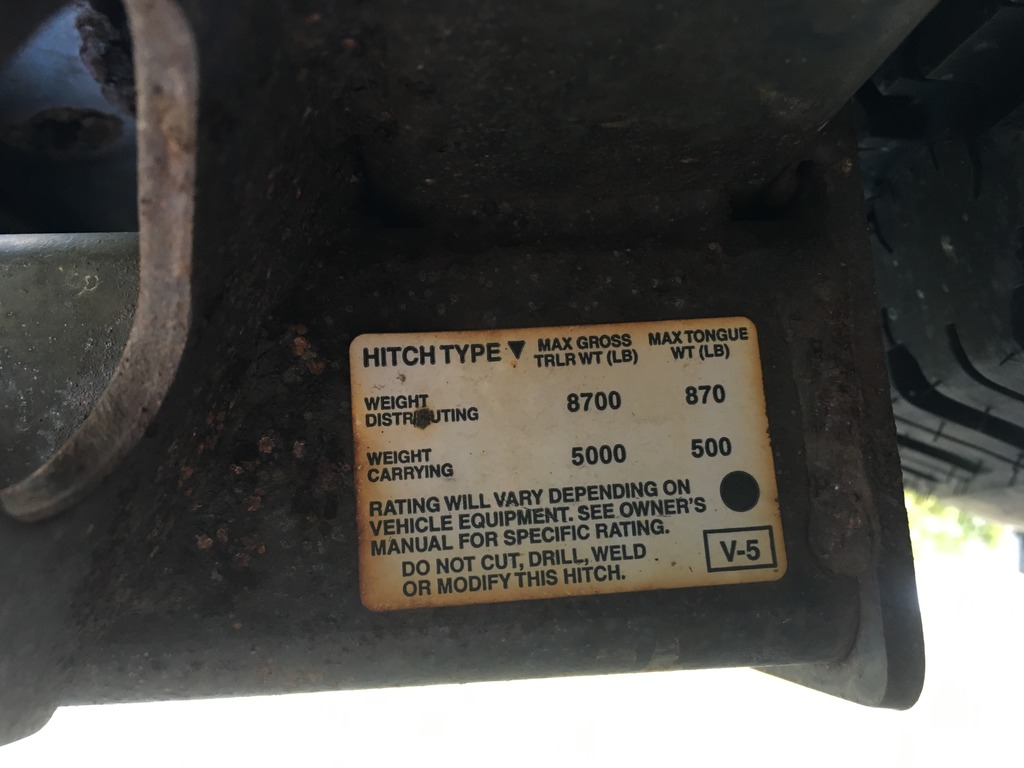
4) The factory trailer hitch weight carrying ratings are 5,000# max trailer weight and 500# max tongue weight. If you think you'll exceed that, you'll need to look into a weight distributing hitch. The WD hitch's weight must be accounted for.
5) Box trailers have large side areas and can get pushed around by the wind and/or passing trucks. You may need to consider a sway control device; some WD hitches have SC built-in.
6) The max weight specs are based on sea-level operation. If your route will take you up into some hills and/or mountains, then Ford recommends you derate the GCWR by 2% per 1,000 ft in elevation.
7) The trailer may not weight 7,000 lbs, but it'll likely present a significant aerodynamic load (drag), especially at highway speeds.
8) For a 4,100 mile trip towing a large trailer, I'd suggest changing the engine oil and filter immediately before and after the trip.
9) My ol' 2000 F250 has the 5.4 V8 and the 4-speed 4R100 auto trans. I've found it tows much better (i.e., less transmission hunting) when operated on 89 AKI (sea-level mid-grade) instead of 87.
1) The maximum trailer weight assumes a base model truck with a 150# driver, no non-towing essential options, no other options, no passengers, no cargo, no tools, no cooler, etc. Anything you add to the truck must be correspondingly subtracted from the maximum trailer weight.
2) The trailer tongue weight must be be included as part of the truck's payload.
3) Let's assume your trailer will weigh 5,000# and have a tongue weight of 500#. 6,750# GVWR - 5,145# truck weight - 500# tongue weight leaves just 1,105# for the driver, passengers, tools, cooler(s), and cargo.
4) The factory trailer hitch weight carrying ratings are 5,000# max trailer weight and 500# max tongue weight. If you think you'll exceed that, you'll need to look into a weight distributing hitch. The WD hitch's weight must be accounted for.
5) Box trailers have large side areas and can get pushed around by the wind and/or passing trucks. You may need to consider a sway control device; some WD hitches have SC built-in.
6) The max weight specs are based on sea-level operation. If your route will take you up into some hills and/or mountains, then Ford recommends you derate the GCWR by 2% per 1,000 ft in elevation.
7) The trailer may not weight 7,000 lbs, but it'll likely present a significant aerodynamic load (drag), especially at highway speeds.
8) For a 4,100 mile trip towing a large trailer, I'd suggest changing the engine oil and filter immediately before and after the trip.
9) My ol' 2000 F250 has the 5.4 V8 and the 4-speed 4R100 auto trans. I've found it tows much better (i.e., less transmission hunting) when operated on 89 AKI (sea-level mid-grade) instead of 87.
HTH, and best of luck!
Jim / crewzer
I don't anticipate being over 5,000lbs when loaded but it would be nice to have a setup that matches what the trucks capabilities are should I ever need it. Getting a class IV might be worth it, can't go wrong for the price either: https://www.etrailer.com/Trailer-Hit...eid=2003302025
What's your opinion on getting the upgraded hitch, if I do that would it still be advised to get a WDH with it as well? Getting both would probably make for a very smooth and safe drive.
And thank you for the input on the premium fuel. We used to have to 98 F150s, one had the 4.2L and the other had the 4.6L. I did one tow of about 450 miles with the 4.6L and two tows of about 750 miles with the 4.2L and each time I found that the premium fuel made the engine much happier.
Regarding fuel when towing, I'd try mid-grade (89 AKI) first before paying the full up-charge for premium (typically 93 AKI).
Originally Posted by meborder
If you get a WDH there is no need to upgrade the receiver. Your WDH capacity on the hitch is going to be a great plenty.
I agree. The label on the hitch should contain all of the specs, and they also be stamped onto the receiver itself. A picture of my 2000 F250's OEM hitch label is shown below.
The Class IV hirch is certainly an option. However, dropping 500-600 lbs of tongue onto the ball will surely drop your truck's back end and raise the front end. This will affect headlight aim, steering, and front tire wear. A properly set-up WD hitch will distribute the trailer's tongue weight across the truck- and trailer axles, and will help keep everything "on the level".
Thanks again for the info, checked out under my truck like you suggested and I'm happy to see the ratings on the hitch will be okay should I ever need to get a WDH to handle more weight.
Rezvani's Latest Post-Apocalytic Monster Is a Ford F-150 Raptor Underneath
Slideshow: Called the Fortress, the 850-horsepower pickup combines Raptor underpinnings with military-inspired features, survival equipment, and a starting price of $285,000.