When you click on links to various merchants on this site and make a purchase, this can result in this site earning a commission. Affiliate programs and affiliations include, but are not limited to, the eBay Partner Network.
If you think pulling the heads off was difficult, wait till you try to carefully set them back on. An engine hoist or someone with large biceps will be helpful.
Here's how we put the right head on. Dave crawled into the engine bay (he is short) and I handed it to him. Now the left side of the block is missing one alignment dowel, so that one could be more of a challenge until we get some bolts in.
I've seen and heard of these push rods come disengaged several times over the years. My theory is, it happens when a valve sticks open because of rust or valve stem deposits. Again, my thoughts only but when these old engines are awakened from storage, a valve sticks open and there is the disconnect. Lubrication to the rockers on these old engines is poor at best. IMO, we do not do these old engines any favors by starting and not warming them up fully during periods of storage. All this procedure does is promote moisture inside the engine and resultant rust. Frequent oil changes with good detergent oil and frequent use is, IMO, the answer to maintaining a healthy engine.
I would think an engine that had the valves so loose they would disconnect is highly unlikely. It would make as much noise as a compound threshing machine. Surely anyone would investigate.
As usual, Ray, your thoughts make a lot of sense! Thanks.
Make yourself a couple of pilot studs for the side that is missing a dowel. Just long enough to be able to grab the head to remove it after you get more of the bolts in. Slot it to be able to use a screwdriver.
Make yourself a couple of pilot studs for the side that is missing a dowel. Just long enough to be able to grab the head to remove it after you get more of the bolts in. Slot it to be able to use a screwdriver.
Good idea.. I think I'll work on that this week as I wait for my BIL to come again.
Glad you figured something out setting them back on. I got lucky setting the first one right on. But the second one, I think it was the passenger side, I almost messed up the head gasket trying to lean out over the fender and line it up while setting it down.
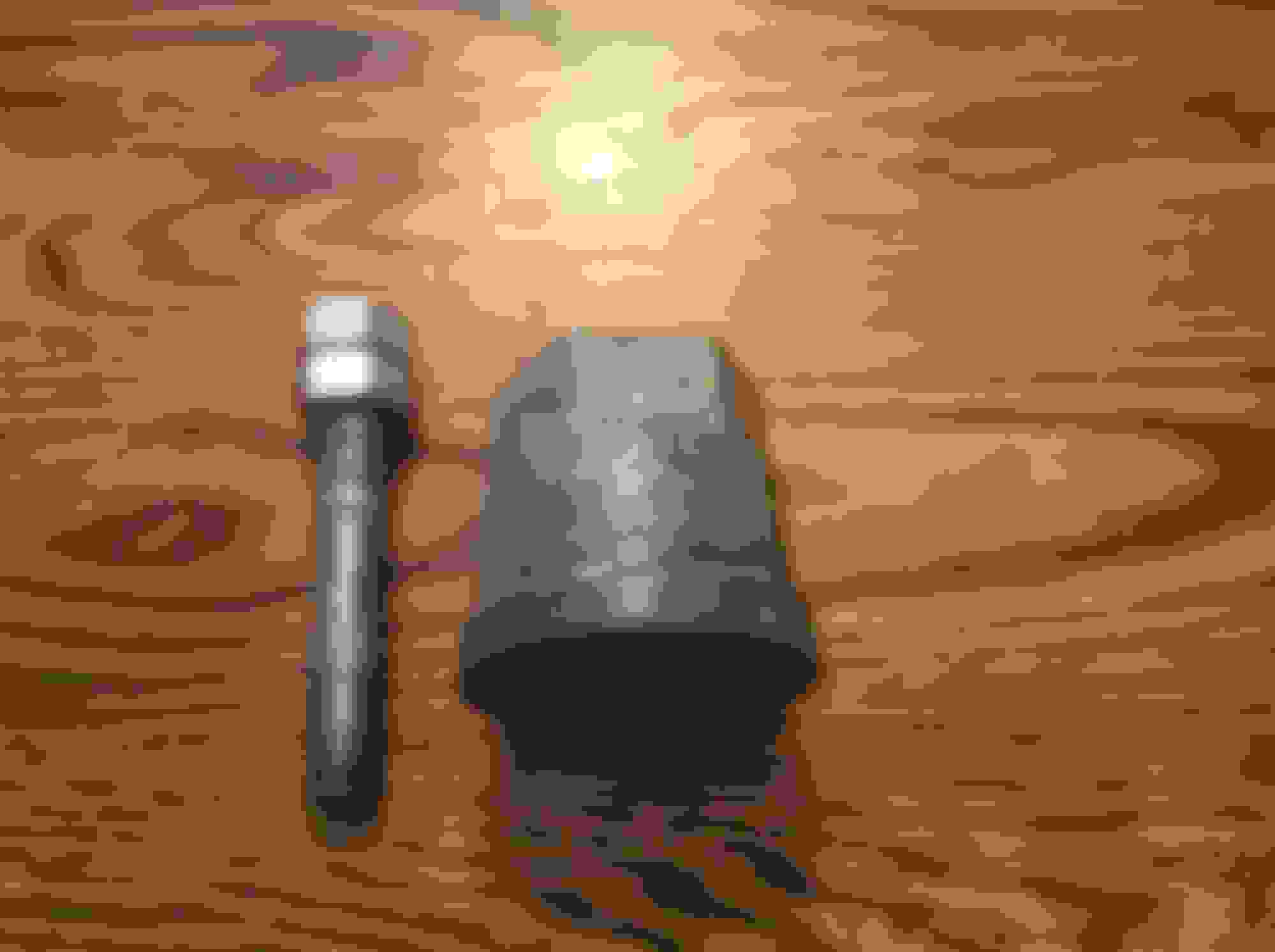
I can't find my welded one to take a picture. This one is a metric bolt about the size of a 1/4" nipple. I cut the head of the bolt off and threaded the end for 1/4" iron pipe size. I first tried welding a 1/4" nipple to threaded rod, but the nipple colappsed. I used a 1" x 1/2" iron pipe reducing coupling (the one in the picture is 1 1/2" x 1") some washers and tighten down on the nuts. I used 2 nuts for more thread engagement. The 56 and up heads had a 1/4" sender and the 54&55 heads had a 3/8" sender. (iron pipe size) The one in the picture can be used for the larger sender with the addition of a 3/8"X1/4" bushing at the bottom. My other one , which I can't find at the moment is a 3/8" nipple welded to some 1/2" threaded rod. Dennis
Thanks, Dennis. My BIL, Dave Bollinger (a Lancaster County transplant) will be able to rig something up. You might know him. He used to work for C. G. Sweigart Oil Co in Denver. He worked on a lot of Glenn's stuff.
Glad you figured something out setting them back on. I got lucky setting the first one right on. But the second one, I think it was the passenger side, I almost messed up the head gasket trying to lean out over the fender and line it up while setting it down.
It is probably a 2 man job. The fender alignment rod makes it difficult too. My BIL commented how low the engine sits and I said or is it the big fenders? It must have been especially hard with your F500.
Do not install anything that has a missing dowel, they are imperative for alignment! The bolts only apply torque, not position. Hate to see you have to it twice. Even if you get it installed in the correct position as it heats and cools it's going to stretch and shift and the dowels keep it in place. Not staying in place means it's constantly moving and will eventually cause gasket failure and sometimes, depending on the gasket technology, erosion/brinelling at sealing surfaces that can require machining to correct.
Last edited by CBeav; Feb 21, 2017 at 05:11 PM.
Reason: I do my best proofreading after hitting 'Enter'.
2X CBeav
Too much to risk for such a cheap part. Many vendors have them but I'd bet NAPA or other parts houses could get them. Maybe NumberDummy will chime in with a part number. Wouldn't surprise me if a small block Ford's dowel would be the same.
There is no such thing s a cheap part in Detroit. A 3 cent part on a half million cars equals an executive being able to eat lobster instead of chicken in the executive dining room. Or Charmin vs. single-ply in the washroom. :-)
This Hennessey Takes the Expedition Tremor's Off-Roading Capability to the Next Level
Slideshow: The VelociRaptor Expedition gains a lift, upgraded suspension, Brembo brakes, and trail-ready equipment while retaining the stock 440-horsepower EcoBoost V6.
Rezvani's Latest Post-Apocalyptic Monster Is a Ford F-150 Raptor Underneath
Slideshow: Called the Fortress, the 850-horsepower pickup combines Raptor underpinnings with military-inspired features, survival equipment, and a starting price of $285,000.


















 Here's some that shipping will cost more than the dowels. Dowel pins head to block 4 pc kit #dp-1