


64 F-500 engine

Thread Starter
|
More Turbo
Joined: May 2008
Posts: 532
Likes: 11
64 F-500 engine
Hello Guy's,
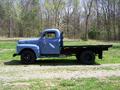
I'm new to these years F-500, and I've seen one interesting.
whit which engines did they come?, and is there a preferred engine for this series?
The ad says it has a 200CUI 6inline.
are there any other points to look for when I want buying one?
Thanks in advance,
I'm new to these years F-500, and I've seen one interesting.
whit which engines did they come?, and is there a preferred engine for this series?
The ad says it has a 200CUI 6inline.
are there any other points to look for when I want buying one?
Thanks in advance,

Ford Parts Specialist
Joined: Nov 2006
Posts: 88,826
Likes: 784
From: Simi Valley, CA

1964 F500 could have a 223 or 262 I-6; 292 2V; 330 2V Medium Duty FT engine; 330 2V Heavy Duty FT engine. 361 2V & 391 4V also available but rarely installed in an F500.
The 4th digit of the VIN is the engine code, post what it is.

Lead Gopher


Joined: Aug 2012
Posts: 10,049
Likes: 1,603
From: Seattle

Hello Guy's,
I'm new to these years F-500, and I've seen one interesting.
whit which engines did they come?, and is there a preferred engine for this series?
The ad says it has a 200CUI 6inline.
are there any other points to look for when I want buying one?
Thanks in advance,
I'm new to these years F-500, and I've seen one interesting.
whit which engines did they come?, and is there a preferred engine for this series?
The ad says it has a 200CUI 6inline.
are there any other points to look for when I want buying one?
Thanks in advance,
.
Thread Starter
|
More Turbo
Joined: May 2008
Posts: 532
Likes: 11
Ok, I'll see if I can get that pic.
@Nd, I already thought that was a small motor for a 500.
but please enlighten me, what does the 2V and 4V in the other type of engines mean?
And another question, would there be anybody so kind to me to explain me how they moved all that weight in the days, only with such (relatively) small engines?
I also have a US pick-up, with a 318 V8, and that one has already "difficulty" with a 2.5 metric tonnes trailer behind!?
@Nd, I already thought that was a small motor for a 500.
but please enlighten me, what does the 2V and 4V in the other type of engines mean?
And another question, would there be anybody so kind to me to explain me how they moved all that weight in the days, only with such (relatively) small engines?
I also have a US pick-up, with a 318 V8, and that one has already "difficulty" with a 2.5 metric tonnes trailer behind!?
Believe Nothing

Joined: Jun 2004
Posts: 7,514
Likes: 398
From: W. Central FL.
Not Bill, he may be gone for the day, but I'll throw up the answers.
The V designation is the number of carburetor venturi, otherwise referred to as barrels of the carb. One barrel, two barrel or four barrel, 2V or 4V.
They used a lot of gearing ratio to move the weight. It did not move fast but the lower power got the job done with gearing.
Who was it, Archimedes, who said, "Give me a lever long enough and I will move the earth." It is all about mechanical advantage, gearing.
The V designation is the number of carburetor venturi, otherwise referred to as barrels of the carb. One barrel, two barrel or four barrel, 2V or 4V.
They used a lot of gearing ratio to move the weight. It did not move fast but the lower power got the job done with gearing.
Who was it, Archimedes, who said, "Give me a lever long enough and I will move the earth." It is all about mechanical advantage, gearing.
Thread Starter
|
More Turbo
Joined: May 2008
Posts: 532
Likes: 11
Thanks Ray,
So If I'm correct, the heavy haulers of the day (say F-400 and up?) are not the fastest, (as you might know, I'm new to this era of trucks) but can they keep up with modern day traffic?
And I also heard that there is such a thing as a Two speed rear axle, can somebody tell me please how that is used?
So If I'm correct, the heavy haulers of the day (say F-400 and up?) are not the fastest, (as you might know, I'm new to this era of trucks) but can they keep up with modern day traffic?
And I also heard that there is such a thing as a Two speed rear axle, can somebody tell me please how that is used?
Thread Starter
|
More Turbo
Joined: May 2008
Posts: 532
Likes: 11

this should be the 200cui??? that the owner sended.
I asked him also to sent a pic from the datatag at the doorsill.
Trending Topics
Ford Parts Specialist
Joined: Nov 2006
Posts: 88,826
Likes: 784
From: Simi Valley, CA
Pic: Here's an example of a 200 I-6. Notice that the intake manifold is made as part of the cylinder head.
FTE Stories
Ford Trucks for Ford Truck Enthusiasts

2027 Ford Super Duty Buyer's Guide (Every Model, Engine, & Package)
Brett Foote
Top 10 Ford Truck Tragedies
Joe Kucinski
AEV FXL Super Duty - the Super Duty Raptor Ford Doesn't Make
Brett Foote
Lobo Vs Lobo: Proof the F-150 Lobo Should Be Even Lower!
Michael S. Palmer
Ford's 2001 Explorer Sportsman Concept Looks For a New Home
Verdad Gallardo
10 Best Ford Truck Engines We Miss the Most!
Joe Kucinski
2026 Shelby F-150 Off-Road: Better Than a Raptor R?
Brett Foote
2027 Super Duty Carhartt Package First Look: 12 Things You NEED to Know!
Michael S. Palmer
10 Most Surprising 2026 Ford Truck Features!
Joe Kucinski
Welder User


Joined: Feb 2009
Posts: 5,269
Likes: 50
From: northwest MT
It has the early style valve cover(54-59), so it probably has been swapped in at some point.
Believe Nothing
Joined: Jun 2004
Posts: 7,514
Likes: 398
From: W. Central FL.
Thanks Ray,
So If I'm correct, the heavy haulers of the day (say F-400 and up?) are not the fastest, (as you might know, I'm new to this era of trucks) but can they keep up with modern day traffic?
And I also heard that there is such a thing as a Two speed rear axle, can somebody tell me please how that is used?
So If I'm correct, the heavy haulers of the day (say F-400 and up?) are not the fastest, (as you might know, I'm new to this era of trucks) but can they keep up with modern day traffic?
And I also heard that there is such a thing as a Two speed rear axle, can somebody tell me please how that is used?
The final drive ratio is possibly in the 5:1 to 7:1 range. Depending on tire size, the engine will spin quite high. Find the rear end ratio, figure circumference of the drive axle tires, locate one of many engine speed calculators on line and you can get an idea what your engine will spin at various road speeds.
Most two speed rear ends are high ratio and higher.

Thread
Thread Starter
Forum
Replies
Last Post
clockmaker
1961 - 1966 F-100 & Larger F-Series Trucks
9
Aug 18, 2012 06:22 PM
Still in the 60's
1961 - 1966 F-100 & Larger F-Series Trucks
7
Oct 22, 2005 09:35 AM