


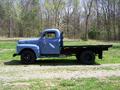




49 F1 L6

Thread Starter
|
New User
Joined: Jan 2017
Posts: 8
Likes: 0
49 F1 L6
I am working on a 49 F1 226 has fuel and spark but wont start.
Ran a compression test highest cylinder 32 lbs lowest 5. Dows anyone know what it should be? I know its like within 5% but it has to be around at least 90 to 100 lbs correct?
Ran a compression test highest cylinder 32 lbs lowest 5. Dows anyone know what it should be? I know its like within 5% but it has to be around at least 90 to 100 lbs correct?
Knuckle Bandage Sales Rep


Joined: Feb 2011
Posts: 3,677
Likes: 1,248
From: Maine

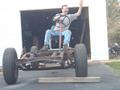
The 226 in my '49 pictured below had been sitting outside for 48 years and I got it to start. Posted the video on here last spring.
The compression was low (but not 5 pounds, ouch) and after I ran it all cylinders were over 110. The valves had been stuck, that's all.
Before doing anything to it I poured Marvel Mystery Oil down the cylinders and let it sit for more than a week. Then with ignition off I cranked it for a while to build up oil pressure. When oil came out of the sending unit hole I screwed it back in and added spark. I used just a small amount of gas poured down the carb.
Here is the thread and a video.
https://www.ford-trucks.com/forums/1...ith-video.html
Tom
The compression was low (but not 5 pounds, ouch) and after I ran it all cylinders were over 110. The valves had been stuck, that's all.
Before doing anything to it I poured Marvel Mystery Oil down the cylinders and let it sit for more than a week. Then with ignition off I cranked it for a while to build up oil pressure. When oil came out of the sending unit hole I screwed it back in and added spark. I used just a small amount of gas poured down the carb.
Here is the thread and a video.
https://www.ford-trucks.com/forums/1...ith-video.html
Tom
Logistics Pro

Joined: Sep 2014
Posts: 4,920
Likes: 21
From: Bothell & Silverdale, WA
I think the book calls for 110 psig @ 100 r/m. Sounds to me like you have stuck valves AND stuck rings. You can check for bad rings by squirting some engine oil into the cylinders and re-taking the compression test. You can also perform a leak-down test on each cylinder and keep an ear to the carburetor, the road draft tube, and the exhaust pipe.
Mountain Pass
Joined: Aug 2012
Posts: 116
Likes: 11
From: Queen Creek
I took an engine apart and the piston rings were sieve to the pistons, so no compression. I agree that if you think the engine was running before it was parked, then a good soaking with kerosene or Marvel might free things up.
Make sure when you try and start it, that you wait until after dark. 'Cause if it fires up with all that Marvel Mystery Oil, you'll smoke out the neighborhood.
Also, if it does start, if might quit after a few minutes due to fouled plugs. I used Marvel on an old flat head and I bet I had to clean the plugs about 10 times before it finally started firing on all cylinders.
Make sure when you try and start it, that you wait until after dark. 'Cause if it fires up with all that Marvel Mystery Oil, you'll smoke out the neighborhood.
Also, if it does start, if might quit after a few minutes due to fouled plugs. I used Marvel on an old flat head and I bet I had to clean the plugs about 10 times before it finally started firing on all cylinders.
Trending Topics

Junior User
Joined: Sep 2016
Posts: 59
Likes: 0
From: Sudbury ontario
Just wondering about the quality of your compression tester ,many of them are not accurate at all other than showing the variance between cylinders .I worked in a large shop with 26 mechanics on the floor ,we did a test between our compression testers and many of them were out by 30-40 lbs and a few were 60 lbs out of whack .If it's not a better quality unit ,it's probably best to just use it as a guide .The guys with the 60 pound units sold the most engine jobs ,and until we finally checked into their gauges ,they were always selling engines .
FTE Stories
Ford Trucks for Ford Truck Enthusiasts

10 Ugly Ford Trucks That We Still Kinda Love
Joe Kucinski
10 Things Every Truck Owner NEEDS (2026 Edition)
Michael S. Palmer
Rezvani's Latest Post-Apocalyptic Monster Is a Ford F-150 Raptor Underneath
Verdad Gallardo
Top 10 Most Expensive Ford Trucks Ever Sold on Bring a Trailer
Joe Kucinski
2027 Ford Super Duty Buyer's Guide (Every Model, Engine, & Package)
Brett Foote
Top 10 Ford Truck Tragedies
Joe Kucinski
AEV FXL Super Duty - the Super Duty Raptor Ford Doesn't Make
Brett Foote
Lobo Vs Lobo: Proof the F-150 Lobo Should Be Even Lower!
Michael S. Palmer
Ford's 2001 Explorer Sportsman Concept Looks For a New Home
Verdad Gallardo
Thread Starter
|
New User
Joined: Jan 2017
Posts: 8
Likes: 0
Thanks all. I brought my compression tester in a older craftsman back when they made good tools. Here are the results. I number cylinders front to back not by firing order.
1st with oil added
#1 45lb 60lb
#2 55lb 65lb
#3 50lb 60lb
#4 28lb 45lb
#5 22lb 25lb
#6 30lb 32lb
what I was told about truck. it ran 8 months ago. I so no. The gas in tank was so putrid
had to be several years old. How much mystery oil should I put in each cylinder ?
Also I used an inspection camera to look into each cylinder while cranking. Everything was moving freely.
1st with oil added
#1 45lb 60lb
#2 55lb 65lb
#3 50lb 60lb
#4 28lb 45lb
#5 22lb 25lb
#6 30lb 32lb
what I was told about truck. it ran 8 months ago. I so no. The gas in tank was so putrid
had to be several years old. How much mystery oil should I put in each cylinder ?
Also I used an inspection camera to look into each cylinder while cranking. Everything was moving freely.
Logistics Pro
Joined: Sep 2014
Posts: 4,920
Likes: 21
From: Bothell & Silverdale, WA
Thanks all. I brought my compression tester in a older craftsman back when they made good tools. Here are the results. I number cylinders front to back not by firing order.
1st with oil added
#1 45lb 60lb
#2 55lb 65lb
#3 50lb 60lb
#4 28lb 45lb
#5 22lb 25lb
#6 30lb 32lb
what I was told about truck. it ran 8 months ago. I so no. The gas in tank was so putrid
had to be several years old. How much mystery oil should I put in each cylinder ?
Also I used an inspection camera to look into each cylinder while cranking. Everything was moving freely.
1st with oil added
#1 45lb 60lb
#2 55lb 65lb
#3 50lb 60lb
#4 28lb 45lb
#5 22lb 25lb
#6 30lb 32lb
what I was told about truck. it ran 8 months ago. I so no. The gas in tank was so putrid
had to be several years old. How much mystery oil should I put in each cylinder ?
Also I used an inspection camera to look into each cylinder while cranking. Everything was moving freely.
Mountain Pass
Joined: Aug 2012
Posts: 116
Likes: 11
From: Queen Creek
Probably should add that you need to leave the plugs out before turning over after the soaking. This way you will not hydraulic lock the motor and bend anything.
It wouldn't hurt to put in a bit more, just remember to change your oil once everything is running and warmed up.
It wouldn't hurt to put in a bit more, just remember to change your oil once everything is running and warmed up.

Hotshot


Joined: Jan 2001
Posts: 16,887
Likes: 3,129
From: SE Wisc. (the Rust Belt)
Here's the situation I had with my 226 in my F-2 a few years ago. I had it running early in the summer but got busy and hadn't driven it for a little over a month. It ran fine but is an old engine with low compression. I went to start it and it wouldn't start. I replaced everything in the ignition system even though I had a good spark. It had gas. I gave up and posted here about the problem, willing to sell my most prized possession for the price of scrap. A couple of local FTE members came over to help out. One had the great idea to try to pull start it to make the engine spin fast enough to overcome the low compression. I tried jumping with 12 volts but that didn't work. We hooked the F-2 behind my daily driver and pulled it for about 20 feet, popped the clutch and it kicked over. I left it run for about 15 minutes to get the engine warm and for the rings to loosen and expand. From that point on I've never had trouble with it starting, even after letting it sit through 2-3 winters.


Ford Parts Specialist
Joined: Nov 2006
Posts: 88,826
Likes: 787
From: Simi Valley, CA

Trucks: 1948/51 226 I-6 & 1950/53 254 I-6 / 1949/51 Ford Passenger Cars 226 I-6.