When you click on links to various merchants on this site and make a purchase, this can result in this site earning a commission. Affiliate programs and affiliations include, but are not limited to, the eBay Partner Network.
Y2KW57, thanks for that great information. I'm sure I'll be asking more in the coming weeks. Is there a source for replacement parts for the 345P if needed? Does the current Reyco-Granning still support it even though its out of production?
Y2KW57, thanks for that great information. I'm sure I'll be asking more in the coming weeks. Is there a source for replacement parts for the 345P if needed? Does the current Reyco-Granning still support it even though its out of production?
The cancellation memo from Reyco Granning directed interested parties to the aftermarket for service parts. There is nothing on the system that cannot be bought or fabricated elsewhere. The torque arms (both transverse and as well as the paralleling arms) can be purchased at heavy truck supply parts houses. I doubt that Reyco Granning has any parts or resources to support it anymore. They claimed to have lost $6 million dollars in development expenses (most of which was spent on engineering the electronic controls for Ford's planned but cancelled version of the system).
I found a few more photos of your truck being built. These are film prints, which I just piled on the counter and snapped a digital photo of for another Classic Traveler owner a couple of years back. The column on the left is your truck being made. The top left truck, in bright Ford blue paint, was the prototype proof of concept truck that made it's public debut at SEMA.
Below the blue truck on the left hand side are various stages of construction of the 550 Classic Traveler. Here, you get to see what is underneath the curvy fiberglass skin... including
The all steel tub made of corrosion resistant galvaneal steel, and still coated with multiple paint processes during production, rather than just at the end
the bed hitch super structure is not one but TWO 1/2" steel plates that traverse the frame rails and extend 42" (don't quote me, I'm starting to forget the dimensions) fore and aft along the frame axis. The reason two 1/2" plates were used instead of one 1" plate was simple... 1" plate was too heavy for the guys to work with in production.
The two plates are welded together and pierced for bolting the Pull Rite Super 5th fiver hitch, as well as cut open in the center for the recessed DrawTite foldover Remove-A-Ball gooseneck hitch. (also branded by Reese, depending on year of production).
Bear in mind, this hitch support set up was designed before B&W made a name for itself in gooseneck hitches. We are talking 1998 here. Just 10 years prior to that, it was quite common for ranchers to have a 1/2" to 3/4" plate in the back of their dually pick ups with a ball welded to the center of it. That is how stock trailers were towed... heavy iron plate. This was still the mentality of the market when the Classic Traveler was developed. It no longer is today.
One critical feature that most would not notice is how the twin 1/2" plates are attached to the frame. Those cowboys and ranchers would just drill through the bed and through the top flanges of the frame to mount their plate. But Fontaine knew better, and Fontaine also had Ford looking over their shoulders, so all Ford QVM standards had to be met. Therefore no drilling in frame flanges. Instead, you'll notice four vertical tabs, one at each corner of the hitch foundation plates, that bolt through the vertical web of the chassis cab frame. This does two things... first, it allows for the frame to flex somewhat independent of the hitch foundation. And second, it doesn't weaken the frame by drilling through the flanges.
Finally, still on the left hand column here, Fontaine built a frame jig in the shop that matched the frame dimensions of Ford's F-450 and 550 chassis cab exactly.... flange depth, web height, edge contour, factory holes, etc. Basically, it was a section of truck frame in the shop that the welders could fixture the hitch foundation plates to, and skip weld back and forth so that as the metal shrunk when cooling, production could be assured that the assembly would still fit on the actual chassis cabs. This avoided any welding near or on the actual truck itself.
Ok, on the right hand side of the photo composite below are a few photos of the F-650 SuperCrewZer at various stages of the production process. Both the Classic Traveler and the SuperCrewZer were built in the same facility by the same company, sharing a property line with a storage yard that was part of Ford's Kentucky Truck Plant.
I own a 2002 F550 Classic Traveler and just found this thread. I registered simply to thank Y2KW57 for sharing so much information on a little-known vehicle. This is a great example of the positive that the Internet can bring.
@GGraves:
I am lucky enough to be the 2nd owner of the truck where the original owner kept meticulous records. I even have the original sales paperwork, Ford brochure, and ReycoGranning 345P suspension manual with diagrams. My compressor had also been relocated to the toolbox, but is a Thomas 1/3HP 12v compressor. I've had to replace the head gasket on the compressor as well as replace the pressure switches to control it.
I've had a challenge keeping bushings in the rear stabilizer links; they don't last long. I even broke both links one time and had almost given up finding parts and was about to resort to making my own with all-thread. But then I found some for a Lincoln Towncar that were the right length. So far they've held up for 5000 miles (about 3000 of which was towing my 5th wheel).
Here are two images from the suspension manual; I hope they help someone.
bought a 1999 f550 with fifth wheel box,
Air compressor is on passenger side on frame. Found multiple Leaks on hose and connection with soapy water. Air bags wont blow up, only with compressor nipple, not pump, even though pump sounds like it's working. Have yet to see another truck like this in the valle, likely won't either...
box needs work on the underneath brackets that support wheel wells, as vibration on rough roads.
Husband wants to pull the box off
bought a 1999 f550 with fifth wheel box,
Air compressor is on passenger side on frame. Found multiple Leaks on hose and connection with soapy water. Air bags wont blow up, only with compressor nipple, not pump, even though pump sounds like it's working. Have yet to see another truck like this in the valle, likely won't either...
box needs work on the underneath brackets that support wheel wells, as vibration on rough roads.
Husband wants to pull the box off
Y2KW57 Wow.... what else can be said.. I tow have one of these the 2000 model which I think kicked it all off. My Dad was first owner now I have it.
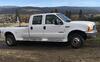
I am trying to locate some replacement air bladders for the rear suspension as will as I noticed that the brackets with the Zirk fitting that holds the rear sway bar are both broken. As you noted Ford was not much help as they said it was not an OEM suspension. Do you know of a location to start getting extra parts? BTW: I have just under 30K miles on the truck and get offers all the time for purchase.
You do have the earlier marketing paint and the rare openable tailgate. Most tubs were built contiguous wrap with a pull through cut out for the hitch...
Your truck, on the other hand, has the extra cost optional fold down tailgate. That was very expensive, as it required a lot of extra fabrication, hardware, and time to square it up.
Your truck also has the extra cost polished stainless steel beauty trim under the rear window, to distract the eye from the bed rails being designed 6" lower than the standard bed rails to facilitate towing. That cost extra.
Plus, you have the WeatherTech InChannel vent visors. Yours are the original ones, when they were made in Germany. Extra cost option.
Even your Ford F-550 chassis was loaded with items that were not standard, like the sliding rear window, the aluminum wheels, and the Lariat trim package.
You have, what I would call, the HALO truck. That is likely the truck that went to RV shows. It showed everything available. I'm curious if your truck has the seating upfit?
You might have the Silent Drive suspension. You'll have to photograph the rear suspension for me to be of any help to you in confirming.
You can get everything you need at a heavy truck suspension shop, if they are competent with air suspensions, but it might be easier if you brought the original diagrams and parts list for the type of suspension you have.
Get rid of those tires immediately. No matter how nice they look, no matter how much tread is on them.
This truck must have been stored in a garage. The reds have not faded.
Thanks for the followup. We are in North Florida. This truck was making the show circuit through Pensacola, FL where my dad first saw it. He followed it down to Orlando when for what ever reason it was put up for sale. So its been his till resent. He took most of the lettering off the truck as he said in 2000 it was just too much. 100% garage kept and only out for a few tows. Dad was not a distance traveler. It sits in my garage now. It has tan leather seats with the front being a 40-60 split with fold down seat console. The rear is a full bench with center fold down armrest. I attached some under pictures. It has the 4.88 rear-end and at 70 would get close to red line. So a few years ago we put a GearVender Over/Under drive just for around town driving. The tires are new as of about 2 years ago, same rims. I had to replace the mudflaps as the Fontain was gone and they started cracking and looking bad. The sway bar / anti roll bar brackets broke last week. Normal trip to Walmart not towing, heard something metal to metal looked underneath and the sway bar was free hanging. I am now looking for new hangers. I live in a small town in Niceville, Fl. Not a selection of big truck shops close buy. I was hoping to be able to order the parts. Strange though that the top hanger mounding point is horizontal and the the lower one in vertical. It's like they took a standard and 45 degree-ed one mount. It cam with a Rhino Lining but it was pealing and detaching from the bed, so I had it removed and replaced with a Line-x one. Any Books or PDF's you may have would be great. I love the photo in your above reply..
Well... can't say you didn't do what I asked... You took lots of undercarriage photos.
Problem is, the photos are too large for my decade old little phone to see. Your pics won't fully load, and my phone can't pinch to zoom out so as to get oriented within the portions of the photo that does partially load.
I generally try to compress or resize pics to 800 pixels or less when uploading, such as seen in the photo of the closed tub twin of your Dad's truck that you wanted above.
I won't be able to get to a computer to look at your pics for a week, however, I've seen enough to at least partially diagnose your issues to help you get the parts that you seek.
1. You do not have the Silent Drive suspension.
2. You DO have the earlier iteration of the Reyco Granning 345P Parallelogram rear air suspension, with bags mounted directly on top of the square axle tube.
3. You have TWO rear suspension problems...
4. The first problem is the broken sway bar brackets that mount on the forward facing facet of the square tube axle. Those actually ARE Ford parts. If I recall correctly, the original OEM sway bar was recovered from the leaf spring suspension removal and reutilized in the Reyco Granning deployment. I know this is true for the later Reyco Granning air suspensions for the Ford chassis cabs. There is however, some room for doubt on the earlier version, but not enough room to stop me from believing that the greater likelihood is that the sway bar and brackets holding the sway bar are OEM Ford parts as part of the design to reduce the cost of the air suspension.
I won't be able to help you confirm for another week, but in the meantime,you might be able to verify for yourself by looking for any symbols stamped in the broken brackets that you removed (check all surfaces both sides).
5. Your second rear suspension issue is the transverse torque rod arm above the axle, that is attached to an angular plate bracket on top of the axle pumpkin, and that reaches toward and attaches to the driver's side frame rail. This arm is a critical component that maintains the lateral location of your rear axle, and the upper bracket wherethe torque rod attaches to the frame has a safety recall issued due to cracks in the bracket propagating to complete failure of the torque rod's ability to prevent the axle from shifting sideways on acceleration and in general.
The fact that your swaybar brackets are broken leads me to suspect that your rear axle is moving beyond the range of permitted movement within the spherical zone of oscillations allowed for by original design. The broken stuff that you see might have caused by bigger stuff breaking that you can't see, and that isn't entirely broken... yet. The weakest, thinnest metal in the connect chain will fatigue to failure first, and inarguably, the straps holding the bushings for the sway bar bracket are a lot thinner than the bolted on weldment bracket holding the big transverse torque rod to the frame.
While this issue is an official NHTSA identified Safety Recall, it is a Fontaine Modification Company recall, not a Ford recall. So while the Ford dealer can sell you the swaybar brackets for the axle, the transverse track rod (aka torque rod) bracket recall is outside of Ford's scope, and you will need to contact Fontaine Modification Company, who was the EXCLUSIVE distributor for this one particular model of Reyco Granning suspension system, to formulate a game plan for how to get that recall resolved.
As an aside, some of the FMC staff who might still remember this narrow niche product are likely out of the office now for the NTEA trade show in Indy this week. But you can easily google the recall and get more info.
Thank you sir,, I will get the suspension checked this weekend and I'll take the brackets to Ford for a match up. Also I located all the recall information and have it printed, I don't see any paperwork to indicate the recall was done. I will see if I can call Fontain and see if they have a record of the recall being done. Have a safe week.
Well I'm still looking for the sway bar brackets. Ford said don't have. Reyco said nope. Fontaine said nope. Also I found the bolts that Fontaine sent for the recall. I went up under the truck and discovered why it was not done. It would be physically impossible for dad to have replaced them. As well as I don't see a way that I could replace them. I will try Fountaine again to see if under the recall they will inspect and replace. I was looking at the torque specification and I don't have anything that would go to 400+ ftbls. Its getting frustrating; Reyco the manufacture won't even try to assist, Fontaine points you back to reyco, and Ford says it's an aftermarket suspension go back to Reyco. no "Big Truck" centers within 100 miles and the ones I did talk with said they don't deal with anything that small.
Those swaybar brackets are never going to last long because the load is in the wrong direction. That's clearly a design flaw. You could design and fabricate a bracket that attaches to the original mount that rotates the bushing and bracket 90 degrees, or make a substantially beefier bracket. I would just machine a big block of Delrin and use some 3/4" high grade bolts. That would work much better.
Well I'm still looking for the sway bar brackets. Ford said don't have. Reyco said nope. Fontaine said nope. Also I found the bolts that Fontaine sent for the recall. I went up under the truck and discovered why it was not done. It would be physically impossible for dad to have replaced them. As well as I don't see a way that I could replace them. I will try Fountaine again to see if under the recall they will inspect and replace. I was looking at the torque specification and I don't have anything that would go to 400+ ftbls. Its getting frustrating; Reyco the manufacture won't even try to assist, Fontaine points you back to reyco, and Ford says it's an aftermarket suspension go back to Reyco. no "Big Truck" centers within 100 miles and the ones I did talk with said they don't deal with anything that small.
I'm sorry you are having so much trouble.
When you posted your photos, they were H U G E files sized, and would not open on my phone accept partially. For the last week I did not have access to a computer, until today.
So today, I actually looked at your undercarriage photos in full for the first time. Here are my findings....
1. Yes, you do have the Reyco Granning 345P (means Class 3, Class 4, Class 5 Parallelogram) air suspension, designed specifically for the Ford F-350 narrow frame, and F-450, and F-550 chassis cabs.
2. Since these Chassis Cabs (350, 450, 550) used a different axle (ie, the 450 used a round tube Dana 80, while the 550 used a square tube Dana 135), some parts differ between versions of 345P suspensions as they relate to grasping the axle of different tubular dimensions.
3. Simultaneously, Reyco Granning also offered another air suspension system of an entirely different design (R1350F) that fit the same three Ford Chassis Cab applications, and that used more original Ford parts.
4. YOUR specific anti roll bar brackets are NOT Ford parts. The are Reyco Granning parts for the F-550 version of their 345P air suspension. I'm sorry for inadvertently sending you down the Ford OEM reutilization rabbit hole (still true for some suspensions, but not yours), but since I could not fully see your photos, and only could make out enough to know that you didn't have Silent Drive, I was alerting you to the possibility, subject to confirmation, which I did say would take me about a week to get back to you.
5. The specific brackets that broke on your truck are not called out individually in the information I currently can see. Checking my files, I did find that I have this suspension on floppy disc, but alas, no longer have any computer that reads floppy discs! However, even if I did, and could see the information on them clearly, that still won't force Reyco Granning to help you, if they choose not to. However, on the subject of the track rod bracket, you have the force of law to help you leverage them to assist you with the recall. We'll discuss that later below, but in the meantime, back to the anti roll bar brackets.
6. On the Bill of Materials provided in the Owner's Manual for the 345P suspension, referring to Page m.13, the anti roll bar is identified as Item 66 in Drawing 99212 that is on Page m.14. The Part Number for the entire anti-roll bar ASSEMBLY (which includes the bar, the endlinks, the bushings, and the brackets, but does not the Gr.5 bolts, the soft washers, or the Gr. C locknuts) is 25219-01. This assembly may be further detailed in Drawing 99238, which I don't have, or if I do have, I cannot see as it is on a floppy disc. The relevant drawings from the owners manual (99212) from page m.14, and the bill of materials list from page m.13, have already been posted earlier upthread, but for your scrolling convenience are reposted here below:
(Ignore the highlighting for purposes of confirming the anti roll bar (aka sway bar) assembly part number. Refer to Item 66 to confirm part.
7. I do not know where Reyco sourced the anti roll bar, the bushings for the anti roll bar, or the brackets for the anti rollbar that broke (with the grease fittings). Had I been able to see the grease fittings on the brackets, I would have known straight away that those are NOT Ford parts. Again, sorry for the confusion. Ford does not offer brackets which apply petroleum grease to rubber.
8. If I had to guess, I would bet that Reyco sourced the brackets generically. The 45 degree cuts on the corners of each tab is labor intensive, so that to me indicates that these brackets were made by machine, by a company that makes them by the many thousands, not just the 293 total number of Classic Travelers that have this suspension system. Fontaine had the exclusive on the 345P, so no other truck has this suspension system. Fontaine did produce a very limited number of aluminum flat bed bodied F-550s with this suspension system, so maybe the total number of units is a generous estimate of 400 units at the most. My guess is that the anti roll bar assembly was sourced by Fontaine from another supplier in bulk, and specifically adapted to the 345P application by folding over the top tab (the tab that broke off) of the bracket so as to not have it sticking up so high when the suspension was fully compressed.
9. If the hunch in #8 above is correct, then the folding over of the bracket tab might constitute the "second folding" of that tab, in a direction diametrically opposing the "first folding", when the bracket was initially formed into the more typical U bracket with symmetrically oriented flange tabs. The second folding of the top tab would likely fatigue the metal at the folded joint (if the production method postulated is true), and thus the bracket becomes doomed to fail at that location at the outset, before the first mile is ever driven.
10. Ford and Fontaine Modification Company worked together to create the F-650 Super CrewZer, and out of that working relationship, Fontaine produced the "baby SuperCrewZer" as a concept truck on an F-550 chassis, which went on display at a few industry trade shows alongside the F-650 SuperCrewZer. It was from this "baby SuperCrewZer" that the F-550 Classic Traveler was born. The point being that back then, Ford and Fontaine had a working relationship, and Ford saw, and oversaw, many of the things Fontaine was doing with their chassis. Among the things that interested the folks at Ford at the time was this then new, and then quite innovative, parallelogram suspension that Reyco had designed. Ford was considering a version of this air suspension for an upcoming (but later cancelled) F-450 pickup. Ford wanted some changes, including an electronic monitoring, control, and feedback system that Reyco reportedly invested $6 million unrecovered dollars into developing, exclusively for Ford, to work with Ford's onboard network protocol topology. In the meantime, Ford was testing the actual suspension system, with some weld fabricated pieces replaced by faster to form castings. I was told some small parts kept failing in testing. I was not told which parts, but the gist of what I remember is that the parts that failed were anti roll bar and or track rod bracket related. The parallel arms and the bags, etc were not a problem. Ford went so far as to include "air suspension" in a preliminary version of the 2003 Order Guide. But Ford cancelled the program, choosing instead to hold off making an F-450 pickup for another 5 years.
11. Fontaine, in the meantime, was having trouble with the air compression and distribution portion of this suspension systems. One of the last things that the Sales Manager of this program asked me to do was help him find a more reliable air compressor. Big trucks have engine mounted air compressors, which are more reliable, and can produce more cfm, and do so more quickly, than any of the 12 volt compressors available at a reasonable cost at the time. I was looking at models that might add $1,000 to the cost of each truck, that was already not selling nearly as well as hoped for, and heavily discounted as it was. The trajectory established in 1999 did not play out well past 9/11, and was completely demolished in the run up on fuel prices that took hold once the invasion of Iraq began. The entire Classic Traveler program was unsustainable.
12. Fast forward to the future for a moment... it will be very interesting to see how Chevrolet does with the air suspension systems planned on their upcoming 4500/5500 crew cab chassis cabs. The Duramax diesel engine in these applications has been modified to accommodate an engine mounted air compressor. It will be interesting to observe the results of full OEM integration and exhaustive vetting that is part and parcel to all OEM subsystems, this time applied to air suspensions in Class 5 platforms useful for RV towing.
13. Blasting back to the past, Reyco Granning formerly announced that the 345P suspension system would be discontinued June 23, 2003. In that announcement, Reyco Granning stated that "Replacment parts will be available through the aftermarket", which is simply a nicer way to say "figure it out on your own pal, because we are not sustaining any inventory of replacement parts for this system".
14. Earlier, I mentioned that Reyco Granning offered a couple of different air suspension systems for the F-550 at the same time? The other parallelogram system for the F-550 was called the M700109. I do not have any details handy on this system, or how it differs from the 345P system. (unless they are one of the two floppy discs I have) To the best of my understanding, the M700109 system has also been discontinued, but that may have occurred subsequently to the discontinuance of the 345P.
15. The other Reyco Granning air suspension system simultaneously offered was a traditional Z beam design with the air bags located at the trailing ends of the Z beam aft of axle, similar to big semi air suspension systems. Only with the Reyco Granning, the axle was laterally located by rub blocks of delrin, that were positioned between the outboard flats of the frame web and brackets mounted on top of the axle. This suspension was called the RD1350F. It is now made only be special order, and may not be available for the 2000 with the Dana 135. Ford switched to the smaller Dana 110 in 2003 and beyond.
Bottom line: have someone make your brackets for the anti roll bar, and contact NHTSA if Recyco Granning or Fontaine fail to provide remedy for the safety recall issued to your truck for the track bar bracket above the axle.
Thanks Y2KW57...
I was able to locate the Sway Bar Brackets with the help of Fontaine and FleetPride.. I ordered these :https://www.suspension.com/9.5165
I then fabricated a bracket as Clubwagon noted. I attached a few pictures. If someone tries this be sure you have enough room for the opposing bolts. Separate the two holes.
I found where Fontain sent dad the 4 bolts for the recall. They are in the glove box. In looking at the "how too" I realized why he did not do them. We don't have the tools to do it. I contacted Tim at Fountain to see if I were to drive from Florida to them if they would conciser doing the recall. I, hoping for a positive answer.
Thanks..
Tommy
Rezvani's Latest Post-Apocalytic Monster Is a Ford F-150 Raptor Underneath
Slideshow: Called the Fortress, the 850-horsepower pickup combines Raptor underpinnings with military-inspired features, survival equipment, and a starting price of $285,000.






 BTW: I have just under 30K miles on the truck and get offers all the time for purchase.