When you click on links to various merchants on this site and make a purchase, this can result in this site earning a commission. Affiliate programs and affiliations include, but are not limited to, the eBay Partner Network.
Second thread today - we're toward the end of the rebuild and stuff doesn't get any easier, I'm finding.
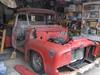
1949 Mercury M68 truck, with Ford Explorer rear-end and matching front-end wheels/hubs. New drum brakes on back, upgraded to disc brakes on front. Since it is Explorer-based, that's 5-bolt wheels. The Explorer standards are PCD of 5X114.3; we're working on going with 17X7 wheels with a 265/70 R17 tire.
For the first time I'm dealing with wheel offsets, and trying to understand the impact of that. The standard Explorer offsets are listed as 35-38, but in a conversation with a wheel vendor yesterday he said that on old trucks you are often looking for a neutral or even negative offset. So, I'm trying to understand the impact of going with a standard Explorer wheel, how that will sit on the hub and in the fender, and whether I need to think differently about this. Am I making a mistake with going with the positive offset, and if so what might happen?
Explorer wheels are called 5x4.5 here is the US of A. Explorer wheels of the vintage with drum rear brakes (pre '95 I think) had 1/2" or 13 mm of offset. Probably 7" wide. That equates to what some folks call 4" of backspacing, meaning the center of the wheel is offset 1/2' towards the outside of the fender. The tire you named above is 10.71" wide 31.65" tall when measured on an 8" wheel. When the wheel vendor mentioned negative offset, it is usually needed to space the inside of the tire away from the edge of the box inside the fender as well as the frame rail. Measure from the wheel mounting surface on the drum to the inside towards the box and frame. That will give you an idea of how much offset is needed. Keep in mind that the tire will travel upward a few inches during jounce. How much clearance you want between the box side/frame and the sidewall of the tire is up to you, but an inch would be nice.
The Ford Explorer rear end is 59 inches face of hub to face of hub. Stock fender wells are 11 inches from the side of the bed to the inside of the fender. Ideally the rear end should be 60 inches face of a hub to face of hub for a wheel with zero offset to be centered in the wheel well. The Ford Explorer rear end requires either a half inch spacer with zero offset wheels or wheels with a negative 13 mm offset in order to place the wheel in the center of the fender.
I bought a set of used Explorer wheels and tires to use on my frame to make it a roller. When I tried to set the '51 F1 Panel body on the frame, the tires hit the wheel well on the inside face. No go. I ended up buying some 7" Smoothies from Wheel Vintiques. 4" backspace.
Justin - I don't know those rims, we'll see if anyone else pipes up.
The question about the fit for a '97 truck might best be asked in the 1997-2003 forum - there may be more people there who would be able to help with that.
Second thread today - we're toward the end of the rebuild and stuff doesn't get any easier, I'm finding.
1949 Mercury M68 truck, with Ford Explorer rear-end and matching front-end wheels/hubs. New drum brakes on back, upgraded to disc brakes on front. Since it is Explorer-based, that's 5-bolt wheels. The Explorer standards are PCD of 5X114.3; we're working on going with 17X7 wheels with a 265/70 R17 tire.
For the first time I'm dealing with wheel offsets, and trying to understand the impact of that. The standard Explorer offsets are listed as 35-38, but in a conversation with a wheel vendor yesterday he said that on old trucks you are often looking for a neutral or even negative offset. So, I'm trying to understand the impact of going with a standard Explorer wheel, how that will sit on the hub and in the fender, and whether I need to think differently about this. Am I making a mistake with going with the positive offset, and if so what might happen?
I have a 2001 8.8" Explorer Sportrac rear axle and I'm running 235R60x15 on 6" wide wheels on the front and 255R60x15 on 8" wide wheels in the rear.
The springs are Posie's Dual Flex in the front and Super Slide in the rear which yields about a 2 ½" drop in the front and 1 ½" in the rear.
The wheels are '34 Ford Artillery-style from Wheelsmith.
Note the +5" offset:
Here is the offset info that I sent to Wheelsmith so that they could make the wheels (ignore the line "Current Tire size"):
Thanks petemcl. Good detail there. I'm assuming that you still have lots of height available inside the fenders even with the drop? We have dropped the front and rear about the same amounts, so wondering about that.
Yes they are Ken. Per my previous posts my truck has led a hard life. It is an F2 but one of the PO's shortened the frame by 10" which makes it 112" not 114" like an F1. Then it looked like it had some sort of utility box welded to it. Then another PO removed that box and added a well used and abused 1951 or 52 F1 6 ½' box and as you noticed the wheels were not quite centered.
So to fix that, thanks to a suggestion from Ross (ALBUQUE F-1), rather than cutting & re-welding the frame again I just moved the fenders forward a few inches. This is how it looks now:
Rezvani's Latest Post-Apocalyptic Monster Is a Ford F-150 Raptor Underneath
Slideshow: Called the Fortress, the 850-horsepower pickup combines Raptor underpinnings with military-inspired features, survival equipment, and a starting price of $285,000.