


QuickFuel 450 issues

Thread Starter
|
Moderator


Joined: Dec 2007
Posts: 7,987
Likes: 104
From: Boise, Idaho

QuickFuel 450 issues
Hi all,
So, I've had a QuickFuel 450cfm (BD-450-VS) carb on my engine since about February.
This one in particular:
https://www.summitracing.com/parts/qft-bd-450-vs
I got it because I've heard nothing but good things about QF carburetors, loved that it was perfectly sized for the 300, fully tunable, and a multitude of other factors that simply said it was the way to go.
However, it's been nothing but a headache from the very beginning and I'm about at my wits end with it.
The main issue is the power valve. Everything else about the carburetor is simply astounding. It's easy to work on, it performs great, it's solid, air tight, you name it. I really want to like it.
But the power valve simply won't stay closed under cruise, so it's horribly rich. I have no issues at idle (idle is around 17 - 18hg and about a 12.5 - 13.0 on the AFR). But cruise is about 10:1 - 11:1.
WOT actually leans it out (I'm assuming since there's enough air to mix with the fuel) to around 12 - 13:1. The leanest it gets is going down hill in gear (effectively compression braking and bringing the vacuum up to around 23), which will get it to around 14 - 15:1.
The reason I know it's the power valve is because if I take it out and install a block off plug, all the problems go away (aside from a lean acceleration). Cruise is a nice 15:1 both around town and on the interstate. So, I'm pretty sure it isn't the jetting, or some air bleed that got gummed up some how.
I've also tried multiple different power valves at multiple different vacuum levels (a 4.5 all the way up to a 9.5), and they are all the same, so I'm not dealing with a blown power valve. Plus, it if it was blown, I'd notice it at idle.
The odd kicker is that "every once in a while" it'll just behave and work right. I'll be cruising down the interstate and viola, the AFR pops up to around 15:1, richens up nicely when I step on the gas, and behaves as it should. But then, I'll pass someone, or pull up a grade, and it's back to being stuck at 10 - 11:1. It's also more prominent on the interstate (where my RPMs are around 2000+ and the engine vacuum is around 10 - 12). In town at 35 or so, it has a higher chance of behaving as it should. However, most of the time, it's still around a 11:1 AFR. And sometimes, it'll just bounce up and down from 12 - 15:1 continuously, like the PV is wiggling open and closed.
Oh, and here's the other thing. This is the second one I've had. I thought I got a bum unit, so I exchanged it after screwing with it for a month. The second one came, worked great for about a day, and then started doing the exact same thing.
I've been on and off the phone with QuickFuel for a while now and, while I hate to belittle a company, they are the most unprofessional, rude (yes, rude), and uneducated group of "tech" support people I've ever had the displeasure of dealing with. ie. the manager of the team telling me that the power valve is always open at cruise and that I need to reduce the size of the power valve restrictions to lean my cruise mixture out... Or that, even though I tell him that my power valve is open at 14hg engine vacuum, I should try a bigger power valve, like a 9.5, because it has a stiffer spring and that'll make it close easier. (The spring pushes the valve OPEN, the vacuum pulls it closed.)
Anyway, I digress.
Does anyone have ANY ideas on what I can do to address this issue? I'd really like to keep the carburetor because, this issue aside, it's the best carburetor I've ever used. But, power valve function is such a fundamental feature that the carburetor goes from first class to a piece of junk.
Thoughts? Ideas? Anything?
Right now, I have the carburetor off and my 30 year old Holley 600cfm back on it, which drives great aside from being a little soggy due to the cfm.
Otherwise, I'm going to box it up and send it back to them and say repair, replace, or refund.
Thanks everyone.
So, I've had a QuickFuel 450cfm (BD-450-VS) carb on my engine since about February.
This one in particular:
https://www.summitracing.com/parts/qft-bd-450-vs
I got it because I've heard nothing but good things about QF carburetors, loved that it was perfectly sized for the 300, fully tunable, and a multitude of other factors that simply said it was the way to go.
However, it's been nothing but a headache from the very beginning and I'm about at my wits end with it.
The main issue is the power valve. Everything else about the carburetor is simply astounding. It's easy to work on, it performs great, it's solid, air tight, you name it. I really want to like it.
But the power valve simply won't stay closed under cruise, so it's horribly rich. I have no issues at idle (idle is around 17 - 18hg and about a 12.5 - 13.0 on the AFR). But cruise is about 10:1 - 11:1.
WOT actually leans it out (I'm assuming since there's enough air to mix with the fuel) to around 12 - 13:1. The leanest it gets is going down hill in gear (effectively compression braking and bringing the vacuum up to around 23), which will get it to around 14 - 15:1.
The reason I know it's the power valve is because if I take it out and install a block off plug, all the problems go away (aside from a lean acceleration). Cruise is a nice 15:1 both around town and on the interstate. So, I'm pretty sure it isn't the jetting, or some air bleed that got gummed up some how.
I've also tried multiple different power valves at multiple different vacuum levels (a 4.5 all the way up to a 9.5), and they are all the same, so I'm not dealing with a blown power valve. Plus, it if it was blown, I'd notice it at idle.
The odd kicker is that "every once in a while" it'll just behave and work right. I'll be cruising down the interstate and viola, the AFR pops up to around 15:1, richens up nicely when I step on the gas, and behaves as it should. But then, I'll pass someone, or pull up a grade, and it's back to being stuck at 10 - 11:1. It's also more prominent on the interstate (where my RPMs are around 2000+ and the engine vacuum is around 10 - 12). In town at 35 or so, it has a higher chance of behaving as it should. However, most of the time, it's still around a 11:1 AFR. And sometimes, it'll just bounce up and down from 12 - 15:1 continuously, like the PV is wiggling open and closed.
Oh, and here's the other thing. This is the second one I've had. I thought I got a bum unit, so I exchanged it after screwing with it for a month. The second one came, worked great for about a day, and then started doing the exact same thing.
I've been on and off the phone with QuickFuel for a while now and, while I hate to belittle a company, they are the most unprofessional, rude (yes, rude), and uneducated group of "tech" support people I've ever had the displeasure of dealing with. ie. the manager of the team telling me that the power valve is always open at cruise and that I need to reduce the size of the power valve restrictions to lean my cruise mixture out...
Or that, even though I tell him that my power valve is open at 14hg engine vacuum, I should try a bigger power valve, like a 9.5, because it has a stiffer spring and that'll make it close easier. (The spring pushes the valve OPEN, the vacuum pulls it closed.)Anyway, I digress.
Does anyone have ANY ideas on what I can do to address this issue? I'd really like to keep the carburetor because, this issue aside, it's the best carburetor I've ever used. But, power valve function is such a fundamental feature that the carburetor goes from first class to a piece of junk.
Thoughts? Ideas? Anything?
Right now, I have the carburetor off and my 30 year old Holley 600cfm back on it, which drives great aside from being a little soggy due to the cfm.
Otherwise, I'm going to box it up and send it back to them and say repair, replace, or refund.
Thanks everyone.

FTE Legend


Joined: Jul 2010
Posts: 32,875
Likes: 48
From: Northeast, OK
I don't know much about QF carbs, but where does your carb get the vacuum for the power valve? Is it possible that wherever that is has a gasket covering, or partially covering, it? With no vacuum to the PV it would be open regardless of what PV you use?
Since this had happened on both QF carbs it would have to be something on the manifold or the gasket you are using. Or maybe an EGR valve?
Since this had happened on both QF carbs it would have to be something on the manifold or the gasket you are using. Or maybe an EGR valve?

Lead Driver
Joined: Jul 2009
Posts: 6,477
Likes: 19
From: Sheffield, AL
That is good, Gary! Look at AbandonedBronco's quote: "The odd kicker is that "every once in a while" it'll just behave and work right. I'll be cruising down the interstate and viola, the AFR pops up to around 15:1, richens up nicely when I step on the gas, and behaves as it should."
That sounds like something sticking?
That sounds like something sticking?
FTE Legend
Joined: Jul 2010
Posts: 32,875
Likes: 48
From: Northeast, OK
I don't think the PV valves, plural, are sticking. And since two carbs have shown the same problem, I'm thinking a piece of gasket I'd partially blocking the vacuum pickup.
I would run a straw or some such through the vacuum outlet where it goes into the PV chamber and find out where it comes out. Then match that up on the intake to see if there's anything that could possibly block it. Or, if there is a vacuum leak right there as a leak would kill the vacuum to the PV.
I would run a straw or some such through the vacuum outlet where it goes into the PV chamber and find out where it comes out. Then match that up on the intake to see if there's anything that could possibly block it. Or, if there is a vacuum leak right there as a leak would kill the vacuum to the PV.
Thread Starter
|
Moderator
Joined: Dec 2007
Posts: 7,987
Likes: 104
From: Boise, Idaho
I don't know much about QF carbs, but where does your carb get the vacuum for the power valve? Is it possible that wherever that is has a gasket covering, or partially covering, it? With no vacuum to the PV it would be open regardless of what PV you use?
Since this had happened on both QF carbs it would have to be something on the manifold or the gasket you are using. Or maybe an EGR valve?
Since this had happened on both QF carbs it would have to be something on the manifold or the gasket you are using. Or maybe an EGR valve?
The carb gets the vacuum for the PV the same as a Holley. The base plate has a hole in it that travels up into the main body to supply vacuum.
No EGR or the like on this engine, just an Offenhauser DP intake.
Thread Starter
|
Moderator
Joined: Dec 2007
Posts: 7,987
Likes: 104
From: Boise, Idaho
That is good, Gary! Look at AbandonedBronco's quote: "The odd kicker is that "every once in a while" it'll just behave and work right. I'll be cruising down the interstate and viola, the AFR pops up to around 15:1, richens up nicely when I step on the gas, and behaves as it should."
That sounds like something sticking?
That sounds like something sticking?
I don't believe it has anything to do with my intake because if I remove the carburetor and put on my 600cfm Holley, it drives just fine and doesn't have any odd issues.
FTE Legend
Joined: Jul 2010
Posts: 32,875
Likes: 48
From: Northeast, OK
I thought QF's were basically Holleys. Anyway, I'm not saying the problem is in the carb as I can't see two of them having the same problem. But, if there's a vacuum leak at the base plate/manifold interface, close to the hole in the base plate where the PV gets its vacuum, that could kill the vacuum to the PV. And maybe the Holley mounts a little differently, like has a wider flange on the base plate that seals where the QF doesn't.
Trending Topics
Thread Starter
|
Moderator
Joined: Dec 2007
Posts: 7,987
Likes: 104
From: Boise, Idaho
I don't think the PV valves, plural, are sticking. And since two carbs have shown the same problem, I'm thinking a piece of gasket I'd partially blocking the vacuum pickup.
I would run a straw or some such through the vacuum outlet where it goes into the PV chamber and find out where it comes out. Then match that up on the intake to see if there's anything that could possibly block it. Or, if there is a vacuum leak right there as a leak would kill the vacuum to the PV.
I would run a straw or some such through the vacuum outlet where it goes into the PV chamber and find out where it comes out. Then match that up on the intake to see if there's anything that could possibly block it. Or, if there is a vacuum leak right there as a leak would kill the vacuum to the PV.
FTE Stories
Ford Trucks for Ford Truck Enthusiasts

3 Best / 3 Worst Parts of Modern Ford Ownership
Brett Foote
10 Amazing Upgrades That Solve Common Ford Truck Owner Headaches
Pouria Savadkouei
Every 2026 Ford Engine Explained
Brett Foote
10 Ugly Ford Trucks That We Still Kinda Love
Joe Kucinski
10 Things Every Truck Owner NEEDS (2026 Edition)
Michael S. Palmer
Rezvani's Latest Post-Apocalyptic Monster Is a Ford F-150 Raptor Underneath
Verdad Gallardo
Top 10 Most Expensive Ford Trucks Ever Sold on Bring a Trailer
Joe Kucinski
2027 Ford Super Duty Buyer's Guide (Every Model, Engine, & Package)
Brett Foote
Top 10 Ford Truck Tragedies
Joe Kucinski
Lead Driver
Joined: Jul 2009
Posts: 6,477
Likes: 19
From: Sheffield, AL
Justin, when you removed the QF and mounted the 600 cfm Holley, did you replace the base gasket? Was it the same type as what was previously used with both QFs?
Perhaps remove the Holly 600 and rest the bases of both carburetors together to see if there is a difference, as suggested by Gary?
Perhaps remove the Holly 600 and rest the bases of both carburetors together to see if there is a difference, as suggested by Gary?
Thread Starter
|
Moderator
Joined: Dec 2007
Posts: 7,987
Likes: 104
From: Boise, Idaho
I thought QF's were basically Holleys. Anyway, I'm not saying the problem is in the carb as I can't see two of them having the same problem. But, if there's a vacuum leak at the base plate/manifold interface, close to the hole in the base plate where the PV gets its vacuum, that could kill the vacuum to the PV. And maybe the Holley mounts a little differently, like has a wider flange on the base plate that seals where the QF doesn't.
The way I do see it being the carbs is if there happened to be a design flaw. I bought one, had an issue, returned it, and got another one from the same batch. Dunno.
If it wasn't sealing properly, wouldn't I be getting vacuum leaks at the base plate?
Thread Starter
|
Moderator
Joined: Dec 2007
Posts: 7,987
Likes: 104
From: Boise, Idaho
Justin, when you removed the QF and mounted the 600 cfm Holley, did you replace the base gasket? Was it the same type as what was previously used with both QFs?
Perhaps remove the Holly 600 and rest the bases of both carburetors together to see if there is a difference, as suggested by Gary?
Perhaps remove the Holly 600 and rest the bases of both carburetors together to see if there is a difference, as suggested by Gary?
This is the third time I've tried a different carburetor to diagnose this issue. The first time I put my Holley 465cfm back on and it ran normally (I've since sold it.) The second time I put my Holley 600 back on while I sent the QF back for an exchange, and now.
All three times, the Holley behaved like a regular, old problem free carb.
I'm uploading some pictures of the carb and will post them in a moment.

FTE Legend
Joined: Jul 2010
Posts: 32,875
Likes: 48
From: Northeast, OK
Does the gasket have an area cut out for the PV vacuum? Or, does it just have round holes to match the throttles?
If it has round holes, maybe the gasket is getting compressed and blocking the vacuum port. And, maybe the Holley's base plate has a larger height difference there so the gasket doesn't block its port.
If you have an old, but serviceable, gasket maybe you could cut that area out for a test?
If it has round holes, maybe the gasket is getting compressed and blocking the vacuum port. And, maybe the Holley's base plate has a larger height difference there so the gasket doesn't block its port.
If you have an old, but serviceable, gasket maybe you could cut that area out for a test?
Thread Starter
|
Moderator
Joined: Dec 2007
Posts: 7,987
Likes: 104
From: Boise, Idaho
The hole for the power valve is in a slot that is about an 1/8 - 1/4" deep, so there's no gasket provision. I believe the depth of the slot is all the provides vacuum to the power valve. I do suppose it's possible though that the gasket is flexing and covering the hole. I hadn't thought of that.
I have a four hole spacer on it right now:
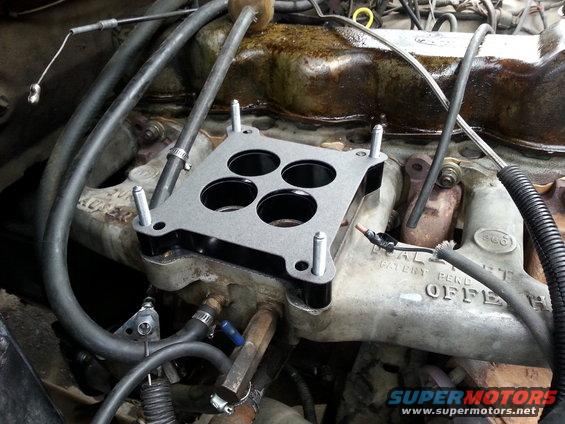
But it requires one since it's a 4 hole intake. I suppose I could, temporarily, put an open plemum spacer on it and see if it alleviates the issue. It would screw up the dynamics of how the intake works, but it's just a test.
Maybe I need a gasket more like this?

I have a four hole spacer on it right now:
But it requires one since it's a 4 hole intake. I suppose I could, temporarily, put an open plemum spacer on it and see if it alleviates the issue. It would screw up the dynamics of how the intake works, but it's just a test.
Maybe I need a gasket more like this?
FTE Legend
Joined: Jul 2010
Posts: 32,875
Likes: 48
From: Northeast, OK
I don't know that either the open plenum or the above gasket would do the trick. Both of them still try to cover the area where the vacuum port is.
I would cut a piece out of the gasket to match the base plate of the carb.
I would cut a piece out of the gasket to match the base plate of the carb.