




Bending Pushrods on startup

Tuned


Joined: May 2010
Posts: 281
Likes: 9
From: Benton City, Wa
They can make anything you need. Cup/ball, ball/ball, holes, solid, standard duty, heavy duty...Phone: 360-256-7985
Dan

Laughing Gas


Joined: Dec 2005
Posts: 904
Likes: 115
From: Laurel, MS
I thought if you put a new lifter on a used cam that you had the possibility of wiping that cam lobe because the cam and lifter wear in together as a set (on flat tappet cams)... was I told wrong?

Lead Driver
Joined: Jul 2011
Posts: 8,678
Likes: 191
From: On the Edge of the Desert
Originally Posted by Mikulh
I thought if you put a new lifter on a used cam that you had the possibility of wiping that cam lobe because the cam and lifter wear in together as a set (on flat tappet cams)... was I told wrong?
Laughing Gas


Joined: Mar 2013
Posts: 1,027
Likes: 5
From: Garner NC
Did you get the correct length rod? They come in an array of sizes. Nothing says the stock ones are still in place. Putting one in that is too long will cause the weakest link (the rod) to bend and maybe transfer some damage to the lobe. I would remove the rocker train and check all the rods, one by one so they can go back in the right spot, first for straight and then measure them to make sure they match. A lot can happen in nearly 50 years. When you remove the rocker train, crack each bolt free and get out the speed handle and start with a half turn each run and when it gets looser a whole turn.
BTW:
http://www.alexsparts.com/
BTW:
http://www.alexsparts.com/
Last edited by Rasputin53; Aug 1, 2016 at 05:57 PM. Reason: added alex's parts

Hotshot

Joined: Mar 2013
Posts: 14,255
Likes: 199
From: Phoenix, Az.
2X Ras but I need to add one thing. I remember back in the day selling Reman FE's. They used to have various colors of tabs of paint behind each pushrod on the block. Prolly on the pushrods also but never looked. These dabs represented which length of pushrod went in what position. Depending on how far in to the heads they went when grinding the valve seat. So OP's engine may not have a matching set of pushrods.
FTE Stories
Ford Trucks for Ford Truck Enthusiasts

AEV FXL Super Duty - the Super Duty Raptor Ford Doesn't Make
Brett Foote
Lobo Vs Lobo: Proof the F-150 Lobo Should Be Even Lower!
Michael S. Palmer
Ford's 2001 Explorer Sportsman Concept Looks For a New Home
Verdad Gallardo
10 Best Ford Truck Engines We Miss the Most!
Joe Kucinski
2026 Shelby F-150 Off-Road: Better Than a Raptor R?
Brett Foote
2027 Super Duty Carhartt Package First Look: 12 Things You NEED to Know!
Michael S. Palmer
10 Most Surprising 2026 Ford Truck Features!
Joe Kucinski
Top 10 Ford Trucks Coming to Mecum Indy 2026
Brett Foote
5 Best / 5 Worst Ford Truck Wheels of All Time
Joe Kucinski
Lead Driver
Joined: Aug 2003
Posts: 7,592
Likes: 10
From: **** hole San Jose ca.
I've never seen a oil holes in a Fe engine push rods. Oil runs down the P-rods plus they are feed with oil through the block.
My 1961 Gt motor back in the day didn't have oil holes in the P-rod as they were not hollow as they were solid as was the lifters. Oil was thorn out of the rockers that went every where.
Many of small blocks had oiling push rods as well as the I-6 think does.
Orich
My 1961 Gt motor back in the day didn't have oil holes in the P-rod as they were not hollow as they were solid as was the lifters. Oil was thorn out of the rockers that went every where.
Many of small blocks had oiling push rods as well as the I-6 think does.
Orich

Tuned
Joined: Oct 2014
Posts: 406
Likes: 2
From: Tucson Arizona
If you pulled a *rocker arm* and replaced the pushrod then that motor is *NOT* an FE. If you pulled a lifter without removing the manifold then it is not an FE.
What did the bottom of that lifter look like? It'll give you a bit of information about the condition of the cam.
What did the bottom of that lifter look like? It'll give you a bit of information about the condition of the cam.
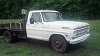
Ok, so I purchased a 72 highboy for my second oldest son, when i went to look at it, it ran very well. started great, idled well, it's a fairly clean truck.
But then I brought it home...
After I got it home I drove it around the block, revved it up, (it's got a true dual exhaust, with glass packs, it sounds really good.) and shut it off. The next day I went to start it and it had trouble starting, and after priming the carb with a little gas it fired, but with a slight knock/tap sound.
I did a lot of research here on the forums, and took the right/passenger side valve cover off, and the push rod for the valve that is second from the front of the engine was bent. I pulled the rocker arm then the push rod and fished the lifter with a magnet.
The lifter was stuck solid, so I purchased a new one and a new push rod. I soaked the new lifter overnight in oil, purchased a hydraulic lifter removal tool from napa and reinstalled everything, I put new plugs in, autolite 45's with a .35 gap for points ignition. Fired up the truck and it ran well, drove it to the gas station filled it with ethanol free gas and drove it home. I never opened up the throttle even as tempting as it was... lol When I went to fire it up this morning, it fired then died, and after priming the carb again it fired and ran but the knock/tap sound is back, I haven't pulled the valve cover yet to be sure but I'm betting the same lifter/pushrod issue.
Here are the details everyone is asking for by now... When i purchased the truck the gentleman told me it was his grandfathers and he took it from a 351 to a 460 (Bored and stroked). I am calling bull****, just by the research i have done here... in my research, I believe it is a 360... 5 bolts on the valve cover and the vin indicates the same. So it is entirely possible "grandpa" could have had it stroked to a 427 or maybe a little larger but doubtful considering the stock intake, vacuum distributor, and stock exhaust manifolds.
My plan for the day is to pull the valve cover and find the bent push rod, pull the corresponding lifter and replace both (with the spare parts I bought originally). It may be important to note I never changed the oil before driving the truck. (I know, dumb decision... I was just to anxious to check it out) but I'm changing it today with rotella 10-30 diesel service oil (for the detergents) and some marvel mystery oil, or lucas oil stabilizer whichever I get the most feed back for.
Are there any known Issues that could be causing my troubles? or is my plan for the day a good start to solving the problem?
I am really trying to not have to pull down the entire engine (as I'm sure you can tell by now) 1: I've never done it, 2: I travel for work and am short on time
I'm not saying I can't do it, I just don't want to if its avoidable.
I'm much more of a diesel guy but love these old highboys. So any useful info would be wonderful...
Thanks everyone!
But then I brought it home...
After I got it home I drove it around the block, revved it up, (it's got a true dual exhaust, with glass packs, it sounds really good.) and shut it off. The next day I went to start it and it had trouble starting, and after priming the carb with a little gas it fired, but with a slight knock/tap sound.
I did a lot of research here on the forums, and took the right/passenger side valve cover off, and the push rod for the valve that is second from the front of the engine was bent. I pulled the rocker arm then the push rod and fished the lifter with a magnet.
The lifter was stuck solid, so I purchased a new one and a new push rod. I soaked the new lifter overnight in oil, purchased a hydraulic lifter removal tool from napa and reinstalled everything, I put new plugs in, autolite 45's with a .35 gap for points ignition. Fired up the truck and it ran well, drove it to the gas station filled it with ethanol free gas and drove it home. I never opened up the throttle even as tempting as it was... lol When I went to fire it up this morning, it fired then died, and after priming the carb again it fired and ran but the knock/tap sound is back, I haven't pulled the valve cover yet to be sure but I'm betting the same lifter/pushrod issue.
Here are the details everyone is asking for by now... When i purchased the truck the gentleman told me it was his grandfathers and he took it from a 351 to a 460 (Bored and stroked). I am calling bull****, just by the research i have done here... in my research, I believe it is a 360... 5 bolts on the valve cover and the vin indicates the same. So it is entirely possible "grandpa" could have had it stroked to a 427 or maybe a little larger but doubtful considering the stock intake, vacuum distributor, and stock exhaust manifolds.
My plan for the day is to pull the valve cover and find the bent push rod, pull the corresponding lifter and replace both (with the spare parts I bought originally). It may be important to note I never changed the oil before driving the truck. (I know, dumb decision... I was just to anxious to check it out) but I'm changing it today with rotella 10-30 diesel service oil (for the detergents) and some marvel mystery oil, or lucas oil stabilizer whichever I get the most feed back for.
Are there any known Issues that could be causing my troubles? or is my plan for the day a good start to solving the problem?
I am really trying to not have to pull down the entire engine (as I'm sure you can tell by now) 1: I've never done it, 2: I travel for work and am short on time
I'm not saying I can't do it, I just don't want to if its avoidable.
I'm much more of a diesel guy but love these old highboys. So any useful info would be wonderful...
Thanks everyone!

Cargo Master

Joined: Jan 2016
Posts: 2,671
Likes: 372
Might help to pull all spark plugs and have someone hand crank the motor while you watch all the rockers and pushrods...make sure there's no interference since it was rebuilt.
BTW, you can pull all the lifters through the manifold holes on an FE...if it's a stock manifold and not an aftermarket aluminum.
BTW, you can pull all the lifters through the manifold holes on an FE...if it's a stock manifold and not an aftermarket aluminum.
Tuned
Joined: Oct 2014
Posts: 406
Likes: 2
From: Tucson Arizona
I had this problem a few years ago on an H1 Hummer that had sat for several years. The oil had evaporated from the valves stems and moisture had gotten in. The rust was preventing the valves from opening. I pulled the springs and removed the old seals, then I sprayed penetrating oil on the stems and let it sit for a few hours and sprayed them again. I finally hammered the valves with a hammer and pulled them back up with vise grips. That got the oil into the guides. The next day I put new seals on the stems and reassembled in reverse order. I drove that Hummer for a couple of years and then sold it. The stock cast iron guides were meant to have a constant oil film.

Thread
Thread Starter
Forum
Replies
Last Post
Wassup599
Big Block V8 - 385 Series (6.1/370, 7.0/429, 7.5/460)
4
Feb 6, 2016 06:11 PM
eradicator006
1973 - 1979 F-100 & Larger F-Series Trucks
2
Jul 7, 2011 10:29 PM